Clear Sky Science · en
Live-shaping of hydrogel thin films with light
Shapeshifting Surfaces Made of Soft Gels
Imagine a surface that can wrinkle, smooth out, and push tiny objects around just by shining different colors of light on it. In this study, researchers created ultra-thin, water-rich "hydrogel" films that behave like living skin: they can be reshaped in less than a second with patterns of light, hold those shapes for long periods, and then be erased or rewritten on demand. Such controllable soft surfaces could underlie future smart sensors, optical devices, and even lab-grown tissues that experience lifelike mechanical cues.
Lessons from Color-Changing Animals
Many animals rely on finely structured skins and shells to control how they interact with their surroundings. Lotus leaves repel water thanks to microscopic pillars, while butterfly wings and peacock feathers use nanoscale patterns to produce vivid structural colors. Some creatures go further: chameleons and cephalopods dynamically change their skin’s appearance for camouflage and communication. Engineers have long tried to imitate these tricks using soft, water-filled materials called hydrogels, which can swell or shrink when triggered by temperature, chemicals, or light. But most light-responsive hydrogels change shape too slowly—over tens of seconds or minutes—and their surface patterns are usually larger than the wavelength of visible light, limiting practical uses in photonics and fast actuation.
How Light Makes the Gel Breathe
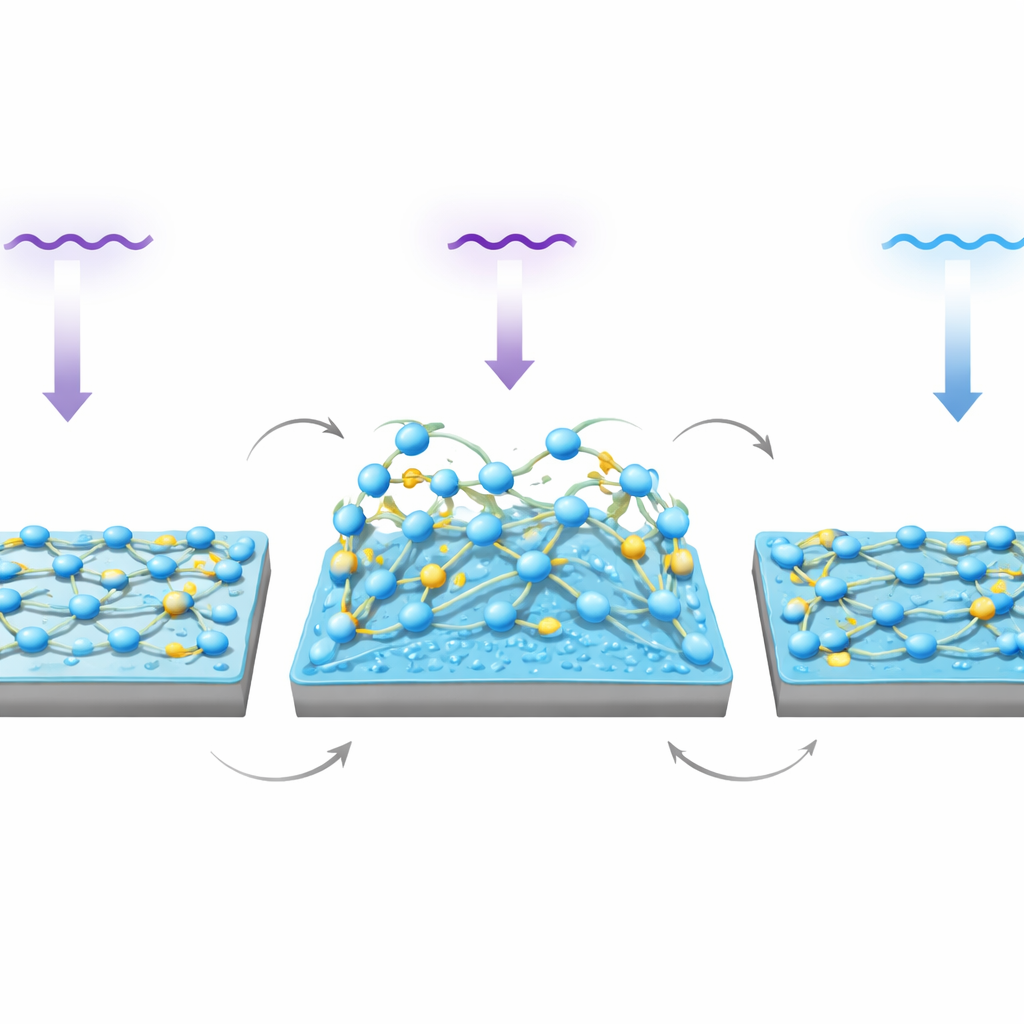
The team tackled these limits by designing a very thin hydrogel film that is firmly attached to a solid surface, so it can only expand strongly in the up–down direction. The polymer network contains special "guest" molecules, based on azobenzene, which can flip between two shapes when illuminated with ultraviolet or visible light. In water, a ring-shaped "host" molecule called cyclodextrin can clasp one of these shapes but not the other. When host and guest bind, the network becomes more water-loving and swells; when they separate, it becomes more water-repelling and contracts. Because the film is only tens to hundreds of nanometers thick, water can flow in and out quickly, turning this molecular switch into rapid, reversible motion of the entire surface.
Drawing and Erasing Tiny Landscapes with Light
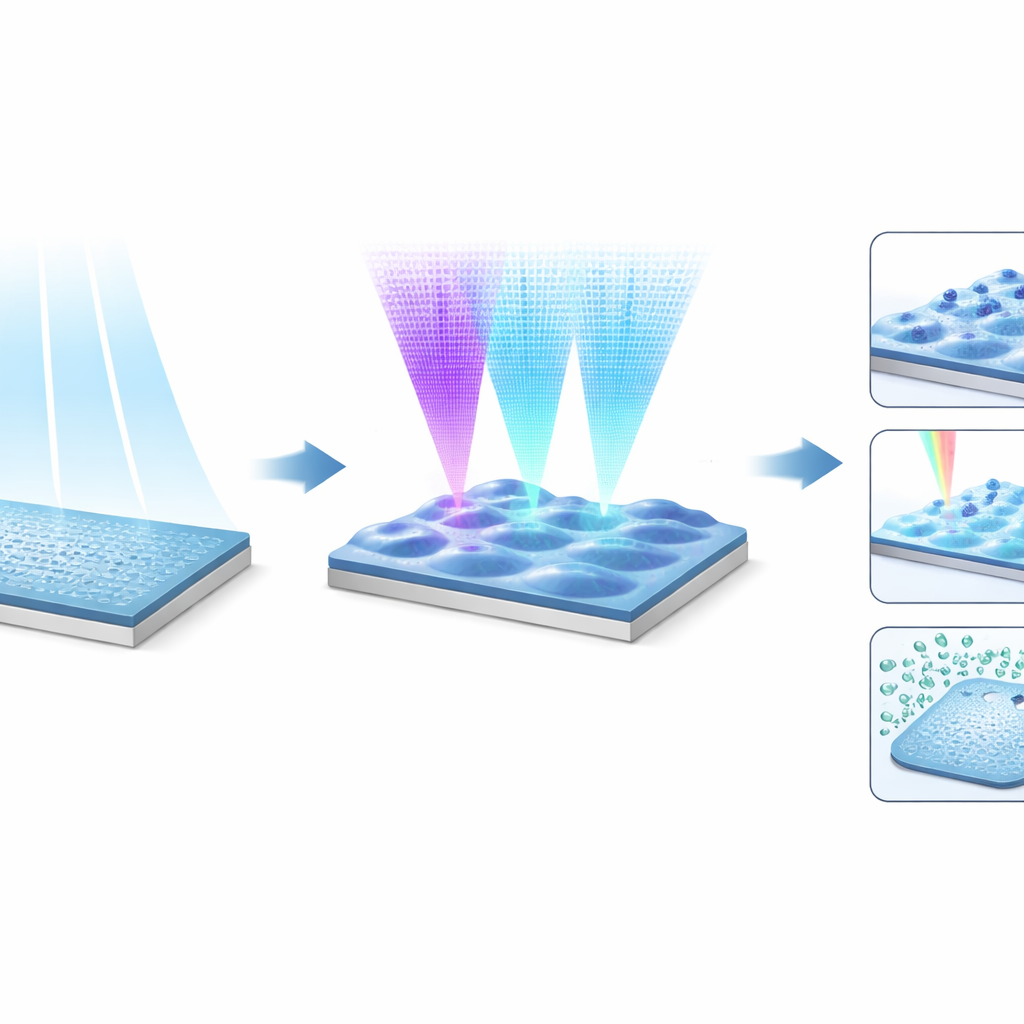
Using carefully controlled laser patterns, the researchers converted flat films into tiny landscapes of ridges, waves, and bumps. By first compressing the film with ultraviolet light and then exposing it to patterned visible light, they could create ordered "surface relief gratings"—regular ripples with heights of hundreds of nanometers and spacing down to 800 nanometers, smaller than a wavelength of visible light. These features appeared within seconds, could be completely erased with another ultraviolet pulse, and could then be replaced by a different pattern on exactly the same spot. The film’s thickness nearly doubled between its contracted and expanded states, it withstood hundreds of light-switching cycles, and it could be driven at up to two shape-change cycles per second—fast enough to mimic a human resting heartbeat. When the patterned gel was dried, the structures became stable for weeks in air but vanished quickly when exposed to moisture, acting like rewritable humidity-sensitive tags.
Moving Waves that Carry Tiny Cargo
Beyond static patterns, the authors showed that combining ultraviolet and visible light at the same time lets them steer surface features in real time. A broad ultraviolet beam kept most of the film contracted while a smaller visible-light spot created a local bump or grating patch. Moving this visible spot caused the raised region to migrate like a traveling wave, while the ultraviolet background erased the trail behind it. On slightly thicker films, these moving bumps could physically push microscopic glass beads, separating clusters of particles and conveying individual beads over tens of micrometers—effectively turning the gel surface into a programmable conveyor belt without any mechanical parts.
Floating Films that Change Color and Steer Light
The team also lifted the concept off the solid support to create free-floating hydrogel sheets. They first embossed a passive ripple pattern into the gel, then let the sheet float on a solution containing the host molecules. Shining light on this floating film made it swell or shrink in all directions, which changed the spacing of the ripples. Because these ripples diffract light, altering their spacing changed the perceived color at a fixed viewing angle, recalling the tunable hues of chameleon skin. When a laser beam was passed through the floating grating, its outgoing direction swung back and forth by several degrees in step with the light-driven swelling, demonstrating a simple form of light-controlled beam steering.
Why This Matters for Future Devices
In essence, the researchers have built a soft, reprogrammable surface whose shape and optical behavior can be written, moved, and erased using only light. The films respond on human timescales—from fractions of a second up to a few seconds—while offering extremely fine spatial control, down to structures smaller than the wavelength of visible light. Because the gels are water-rich and mechanically gentle, they could one day provide dynamic environments for cells in culture, model biological rhythms like breathing, or form the basis of adaptive optical components and moisture-sensitive tags. This work shows how a simple molecular handshake, controlled by color, can be scaled up into intricate, living-like motion of an entire surface.
Citation: Paatelainen, M., Meteling, H., Berdin, A. et al. Live-shaping of hydrogel thin films with light. Nat Commun 17, 3613 (2026). https://doi.org/10.1038/s41467-026-71438-4
Keywords: light responsive hydrogels, dynamic surfaces, surface relief gratings, adaptive photonics, soft actuators