Clear Sky Science · en
Probing ultrafast heating and ionization dynamics in solid density plasmas with time-resolved resonant X-ray absorption and emission
Watching Matter Transform in a Flash
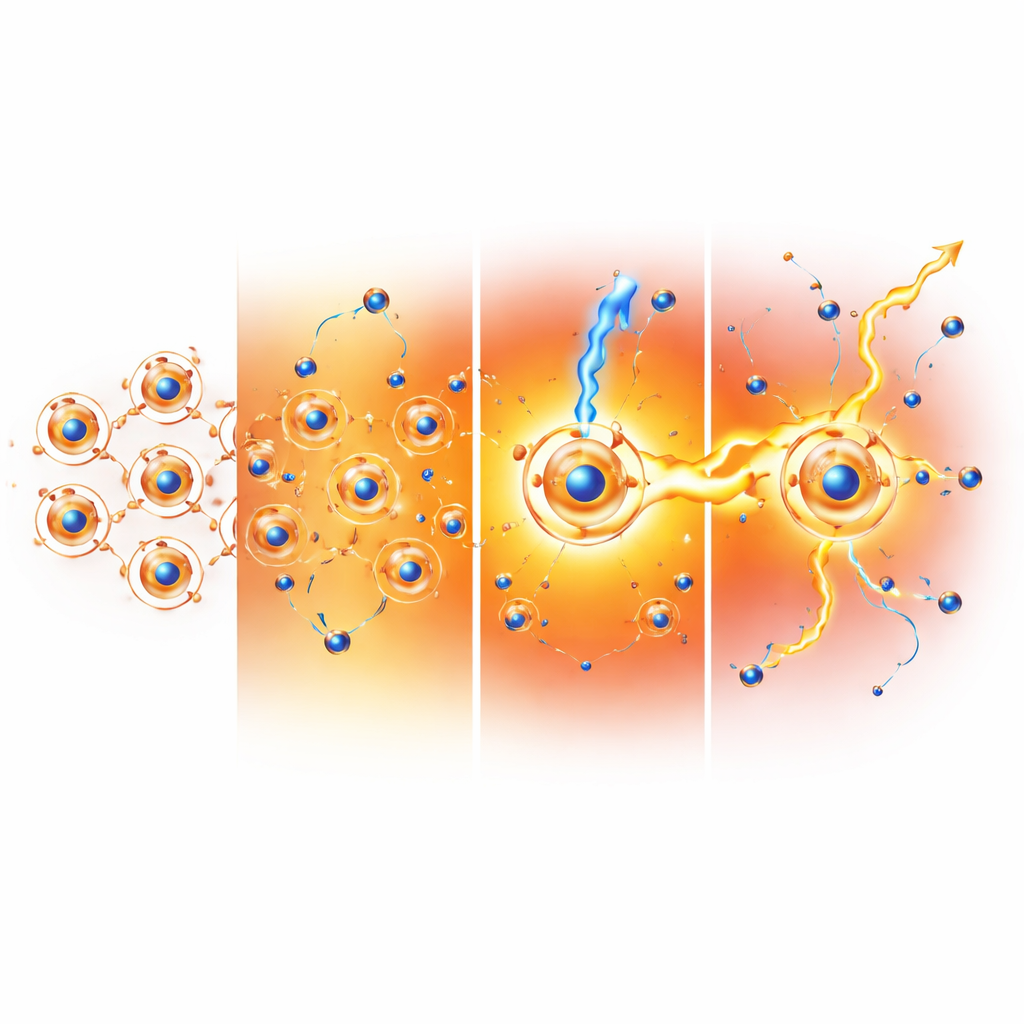
When an extremely powerful laser hits a solid metal, the material is driven into a strange state where it is neither a normal solid nor a familiar gas, but an ultra‑hot, ultra‑dense soup of charged particles called plasma. These extreme conditions are central to ideas for fusion energy and for compact particle accelerators, yet they change so quickly that they are hard to measure. This study shows how scientists can watch, in real time and at microscopic scales, how a tiny copper wire heats up and becomes ionized using carefully timed X‑ray pulses from one of the world’s brightest X‑ray sources.

A Tiny Wire in a Giant Laser Laboratory
The researchers used a simple but powerful arrangement: a hair‑thin copper wire was struck by an ultra‑short, ultra‑intense optical laser pulse to create a solid‑density plasma. At nearly the same time, an X‑ray free‑electron laser (XFEL) fired a tightly focused beam of high‑energy X‑rays through the same region. By choosing the X‑ray energy so that it matched a specific inner‑shell transition in highly charged copper ions, the team could make those ions absorb and then re‑emit X‑rays in a resonant way, like tuning a radio to a particular station. Measuring both the X‑rays that came out of the wire and those that were absorbed allowed them to probe how hot and how ionized the copper became, with a time resolution of less than a trillionth of a second.
Reading the Glow of Excited Copper
The key signals were sharp X‑ray emission lines from copper atoms and ions, measured as the delay between the laser and the XFEL was scanned from before the laser hit to several trillionths of a second afterward. A strong resonant emission feature appeared only after the main laser pulse arrived, rose quickly to a maximum about 2.5 picoseconds later, and then faded over roughly 10 picoseconds. This rise‑and‑fall pattern tracks the population of a particular copper charge state, in which most but not all of the atom’s electrons have been stripped away. Comparing the timing and strength of this feature with detailed atomic simulations showed that the plasma near the wire surface stayed hotter than about 500 electronvolts—millions of degrees—over that entire period.
Seeing Where the Heat and Charge Live
At the same time as they recorded the emitted spectrum, the team imaged how much of the XFEL beam was transmitted through the wire. They found that when resonant emission was strong, the transmitted X‑ray signal dipped, and when the emission weakened, transmission recovered. This tight, nearly linear link between emission and absorption indicates that the resonant copper ions occupy a very thin region only a few micrometers deep near the front surface, rather than filling the entire wire. The wire geometry confines the hot electrons generated by the optical laser, slowing how quickly energy leaks away and making the resonant signal last longer than in earlier experiments with flat foils.
Testing Computer Models of Extreme Matter
To interpret the measurements and understand the underlying physics, the authors ran advanced computer simulations that combine kinetic particle‑in‑cell methods with fluid‑like magnetohydrodynamics. They compared two ways of modeling ionization: one that assumes local thermal balance and one that allows for non‑equilibrium effects and high‑energy “tail” electrons. Only when they used a non‑equilibrium model, realistic laser focusing, and a pre‑heated “preplasma” profile predicted by separate simulations did the calculated heating depth and ion charge distribution agree with the data. The simulations also revealed that the most highly ionized region remains tightly localized near the surface, consistent with the absorption and emission measurements.
Why This Matters for Future Fusion and High‑Energy Experiments
By combining an intense optical laser with a precisely tuned XFEL probe, this work demonstrates a way to watch, in exquisite detail, how solid matter is driven into and out of extreme plasma states. The ability to follow specific ion charge states, their temperatures, and how deeply they penetrate into solid targets over trillionth‑of‑a‑second timescales provides a powerful testbed for theories and simulations that underlie inertial fusion energy and other high‑energy‑density applications. In simple terms, the study shows that with the right X‑ray “flashlight” and careful modeling, we can now see how and where energy flows inside a tiny piece of metal as it is pushed toward the conditions needed for fusion.
Citation: Huang, L., Mishchenko, M., Šmíd, M. et al. Probing ultrafast heating and ionization dynamics in solid density plasmas with time-resolved resonant X-ray absorption and emission. Nat Commun 17, 3219 (2026). https://doi.org/10.1038/s41467-026-71429-5
Keywords: ultrafast plasma dynamics, x-ray free-electron laser, solid-density copper plasma, inertial fusion energy, laser-matter interaction