Clear Sky Science · en
Anti-Nogo-A NG101 treatment induces changes in spinal cord micro- and macrostructure following spinal cord injury
New hope for damaged spinal cords
Spinal cord injuries often leave people with life changing weakness or paralysis, especially in the arms and hands. Once the spinal cord is hurt, the body has only a limited ability to repair the damage. This study explores a drug called NG101 that aims to lift some of the brakes that normally stop nerve fibers from regrowing. Using advanced MRI scans and electrical tests, the researchers asked whether this drug can protect the injured spinal cord in people and how doctors might best spot those who are most likely to benefit.
A drug that releases the brakes on nerve growth
NG101 is an antibody that blocks a molecule called Nogo A, which usually tells nerve fibers in the brain and spinal cord not to grow. In animals, turning off Nogo A helps cut nerve fibers sprout new branches and form fresh connections, leading to better movement. A recent clinical trial hinted that NG101 could improve arm and hand strength in people with neck level spinal cord injuries. In the present work, scientists focused on what happens inside the spinal cord itself by following more than one hundred people with recent injuries who either received NG101 or a placebo and then underwent repeated scans and nerve tests over six months. 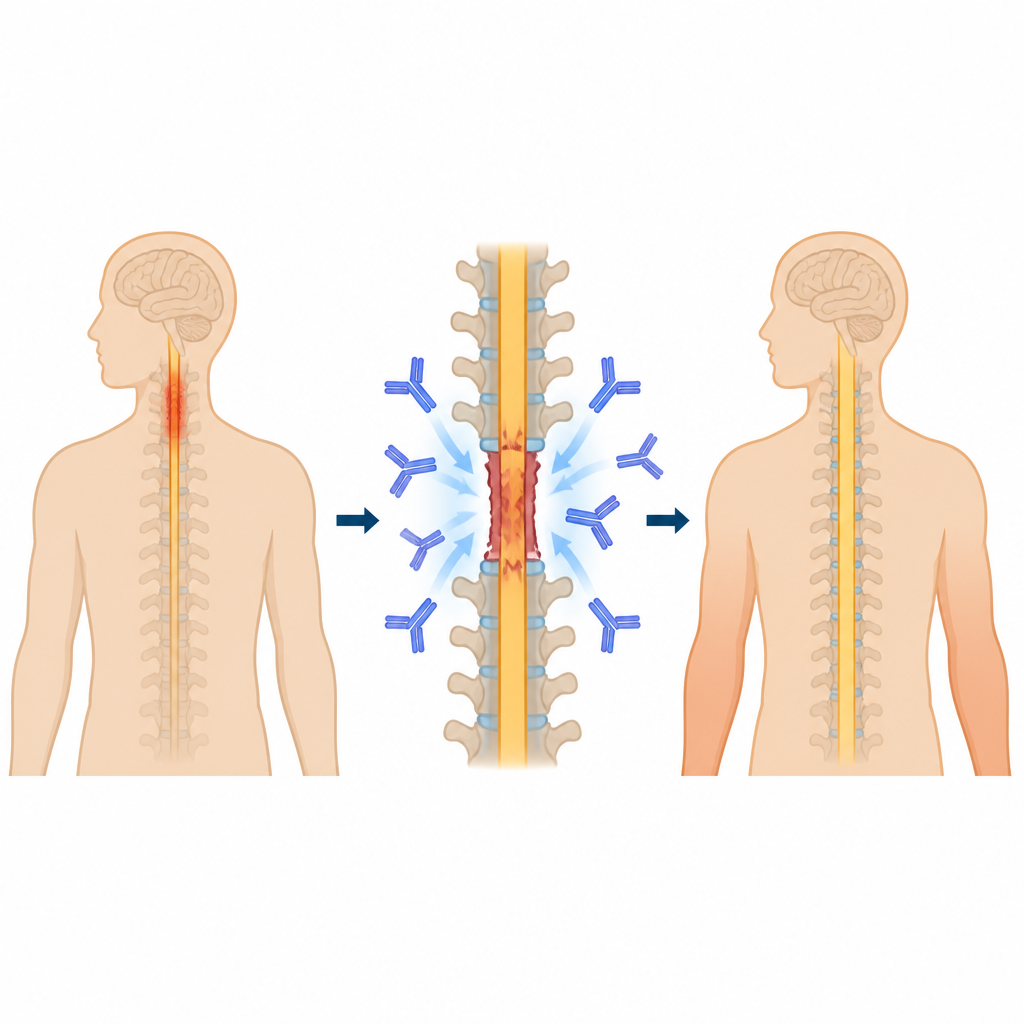
Seeing inside the injured spinal cord
The team used detailed MRI methods to measure both the shape and the internal fabric of the spinal cord. They tracked the size of the lesion at the injury site, the amount of intact tissue running through that area, and the overall cross sectional area of the cord further up in the neck, which shrinks as nerve fibers die back. They also used a technique sensitive to myelin, the insulating sheath that helps signals travel quickly along nerve pathways. In parallel, they recorded electrical signals traveling along sensory pathways to learn whether long distance connections were still working. By combining these measures, they could follow how the spinal cord changed over time and how this differed between people receiving the drug and those on placebo.
Protecting structure near and far from the injury
People who received NG101 started out with slightly larger injuries, yet their lesion volumes shrank more quickly over the following months than in the placebo group. The drug group also showed a slower loss of overall spinal cord area higher up in the neck, where the cord in placebo treated participants thinned over time. At the microscopic level, markers related to myelin decreased in both groups, reflecting ongoing damage, but this decline was noticeably slower with NG101, especially in key movement and touch pathways. These patterns suggest that NG101 does not simply mask symptoms: it appears to slow down the spread of damage and may support regrowth or rerouting of nerve fibers around the injured zone.
Finding the people most likely to benefit
The study also asked how best to design future trials so that treatment effects can be seen with fewer participants. Standard clinical groupings based on how much movement remains after injury captured some benefit of NG101, but the gains were modest and required large sample sizes. When the researchers instead combined MRI signs of preserved tissue bridges across the lesion with the presence of detectable sensory signals in nerve tests, the picture changed. In people who had both visible strands of spared tissue and preserved electrical responses, NG101 was linked to much larger improvements in arm and hand use and daily self care, and far fewer participants would have been needed to show a clear effect. 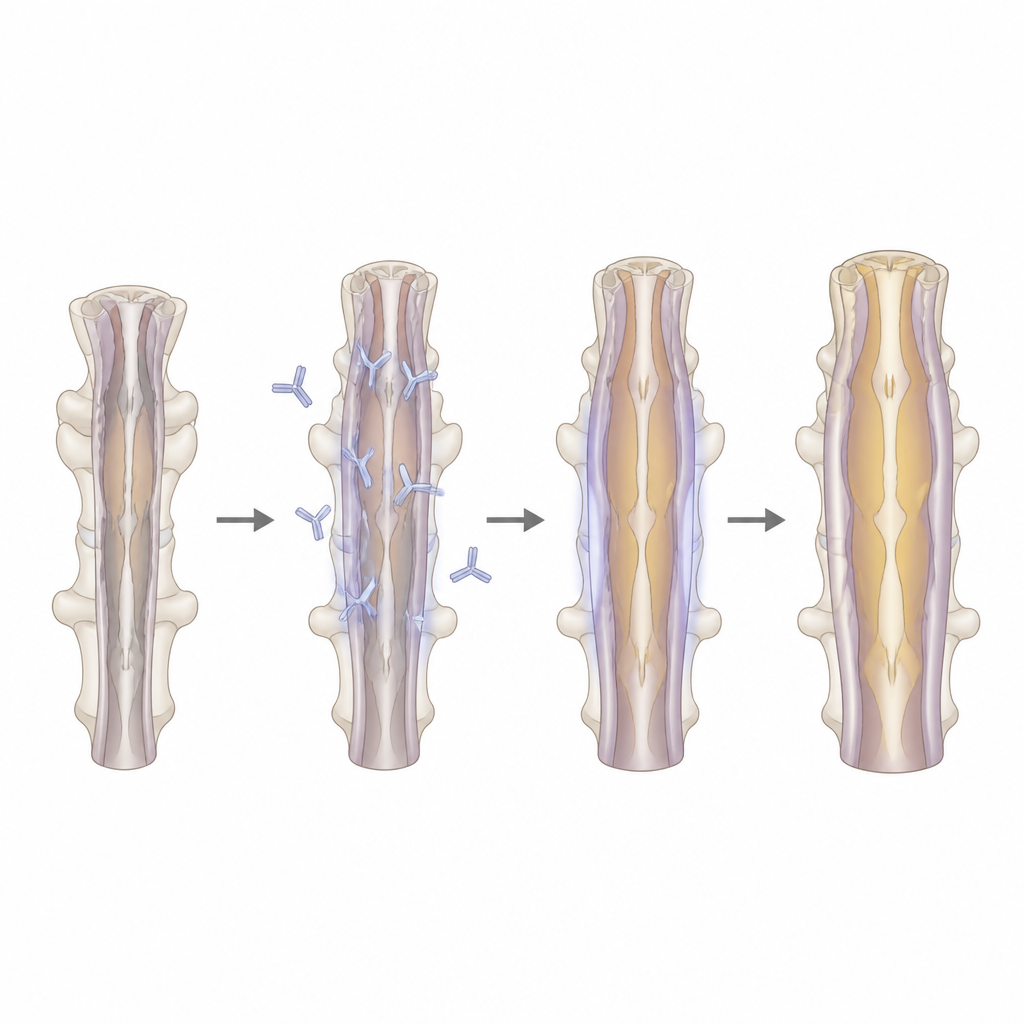
What this could mean for patients
For people living with spinal cord injuries, these findings suggest that NG101 may help protect and possibly repair the spinal cord, not only right at the injury but also in regions above it. The benefits were strongest in those who still had some intact tissue and measurable nerve signals, pointing the way toward more tailored treatment. Just as important, the work shows that advanced MRI and nerve tests can reveal helpful changes that simple strength scores might miss and can make future trials faster and more efficient. While NG101 is not yet a standard treatment, this study offers cautious optimism that pairing biologic therapies with smart imaging and testing strategies may move spinal cord repair closer to reality.
Citation: Farner, L., Scheuren, P.S., Sharifi, K. et al. Anti-Nogo-A NG101 treatment induces changes in spinal cord micro- and macrostructure following spinal cord injury. Nat Commun 17, 4197 (2026). https://doi.org/10.1038/s41467-026-71412-0
Keywords: spinal cord injury, neuroregeneration, MRI biomarkers, Nogo A antibody, clinical trial design