Clear Sky Science · en
International trade and air-quality-related mortality
Why the Air You Breathe Depends on What Others Buy
When we purchase clothes, electronics, or food, we rarely think about the distant smokestacks and busy ports that make those products possible. This study shows that everyday economic choices in richer countries can quietly shift dangerous air pollution—and the deaths it causes—onto people living in poorer nations. By tracing how money, emissions, and winds move around the globe, the authors reveal a hidden side of international trade: millions of premature deaths from dirty air that are effectively “exported” across an economic divide.
Following the Trail from Shopping Carts to Smokestacks
To uncover this hidden footprint, the researchers combined three kinds of models. First, they mapped global economic transactions, tracking which countries produce which goods and who ultimately uses them. Second, they used an air pollution model to estimate how fine particles from fuel burning and industry spread through the atmosphere and where people breathe them in. Finally, they applied health data that links long-term exposure to these tiny particles with an increased risk of early death. By merging these layers of information for about 200 countries, they could ask not only where pollution is released, but whose spending really drives it and where the resulting health damage occurs.
Who Really Bears the Burden of Dirty Air
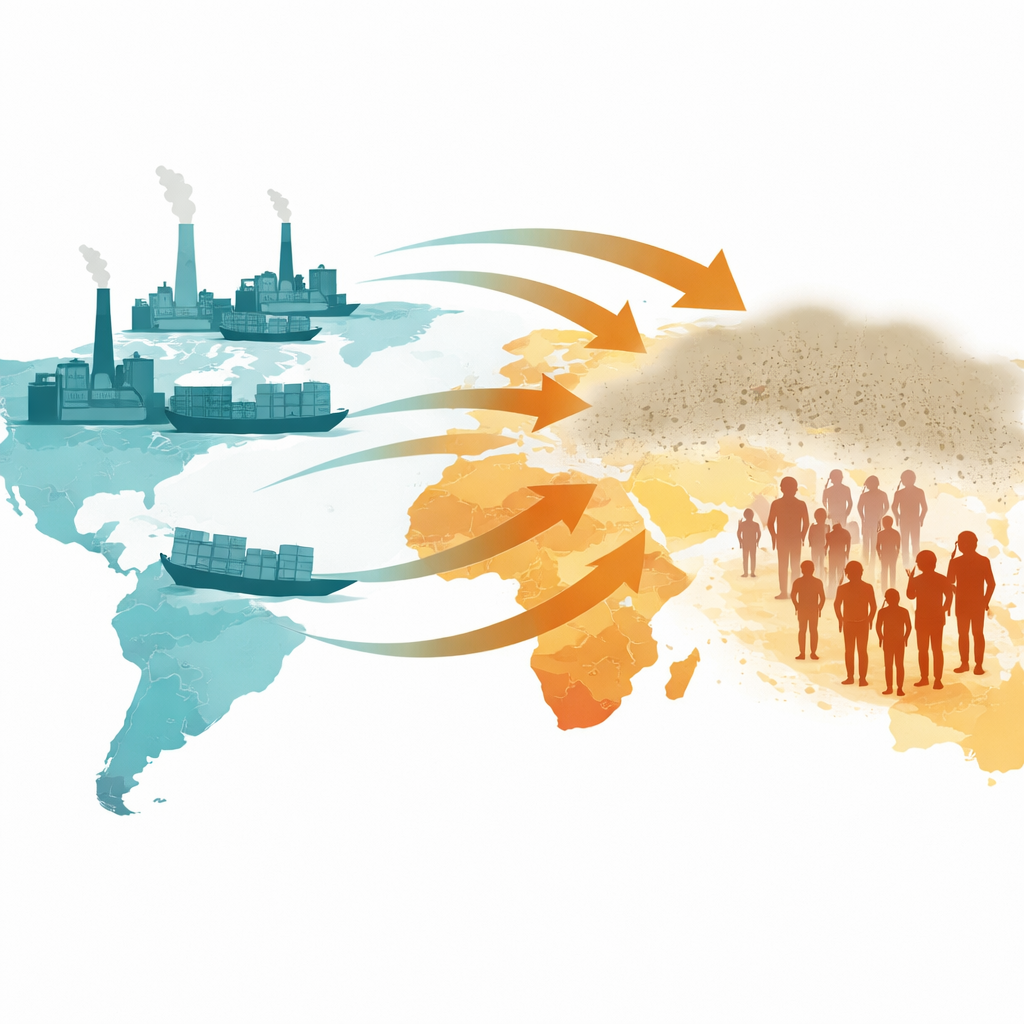
The analysis focuses on deaths linked to fine particulate matter, small particles that can penetrate deep into the lungs and bloodstream. In 2017, the study estimates 5.1 million deaths worldwide from this type of air pollution, with about 2.8 to 2.9 million directly tied to economic activity. Remarkably, 40 to 48 percent of these economy-related deaths were linked to goods and services traded across borders, rather than produced and consumed in the same country. In most nations, the majority of deaths caused by their consumption actually occur somewhere else—often in large manufacturing exporters such as China and India, where factories, power plants, and associated transport cluster.
When Wealthy Buyers and Poorer Workers Trade Places on Risk
A central finding is how strongly this health burden lines up with income differences between countries. High-income regions in North America and Europe tend to be “exporters” of air-pollution deaths: their demand for products drives pollution that kills more people abroad than at home. In contrast, much of Asia and parts of Africa are “importers” of these deaths: they experience more pollution harm than their own consumption causes elsewhere. The authors estimate that 14 to 18 percent of all global deaths from fine particles are tied to trade between countries where the buyer’s average income per person is at least 50 percent higher than the producer’s. In everyday terms, many people in lower-income countries are breathing the pollution created to satisfy the wants and needs of people who are far better off financially.
Which Parts of the Economy Push the Problem Abroad
The study also explores which kinds of industries are most linked to this imbalance. Countries that specialize in services, finance, and high-tech sectors are more likely to push pollution deaths into poorer trading partners, because they import many pollution-heavy goods rather than making them at home. On the other side, countries with economies centered on farming, mining, and low-value manufacturing tend to receive more of these imported health burdens. Examples include garment and electronics production in China that serves customers in the United States and Japan, causing thousands of deaths per year in factory regions while the finished products are enjoyed elsewhere.
Rethinking the Price Tag of Pollution
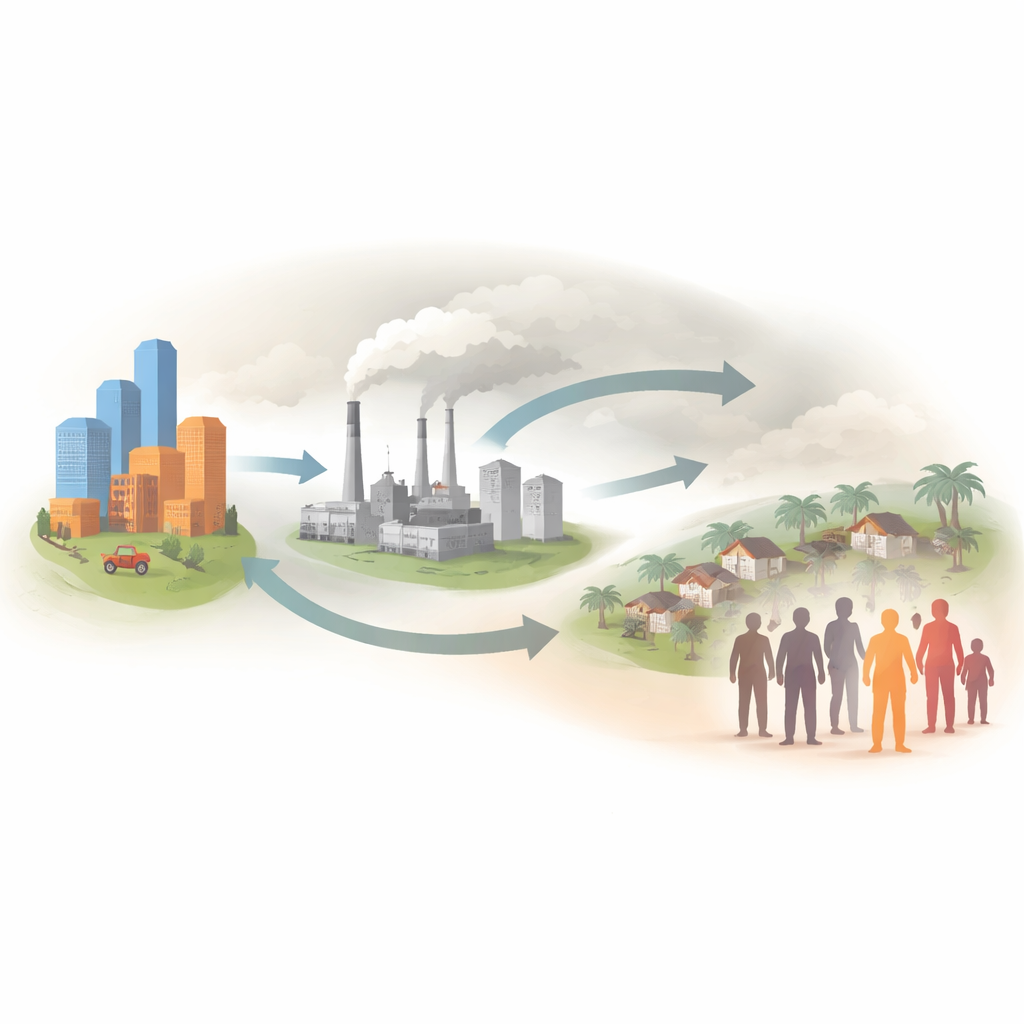
Beyond counting deaths, the authors ask how to put a monetary value on this harm in a way that does not quietly favor richer nations. Standard practice often values lives according to local income and may ignore deaths that occur outside a country’s borders, making it appear cheaper for wealthy nations to let polluting industries operate in poorer places. The authors propose a different “fair trade in pollution” approach: if a high-income country’s demand causes deaths in a lower-income country, those deaths should be valued at the higher country’s standard. Under this lens, the apparent economic cost of air pollution to wealthy nations rises sharply, making it harder to justify shifting dirty production abroad. For the general public, the takeaway is simple but powerful: global trade can bring prosperity, but unless we count the full human cost of dirty air—no matter where people live—we risk building our comfort on someone else’s shortened life.
Citation: Wang, S., Thakrar, S., Johnson, J. et al. International trade and air-quality-related mortality. Nat Commun 17, 3518 (2026). https://doi.org/10.1038/s41467-026-71408-w
Keywords: air pollution, international trade, global health, environmental justice, economic inequality