Clear Sky Science · en
Nonergodicity and Simpson’s paradox in neurocognitive dynamics of cognitive control
Why this matters for everyday thinking
When scientists study the brain, they usually average data across hundreds or thousands of people and then draw conclusions about how any one person thinks or behaves. This paper shows that for a core mental ability—stopping actions and resisting impulses—those averages can be not just incomplete, but sometimes flatly wrong for individuals. Understanding this gap matters for everything from how we interpret brain scans to how we design personalized treatments for attention and impulse-control problems.
Group trends versus personal patterns
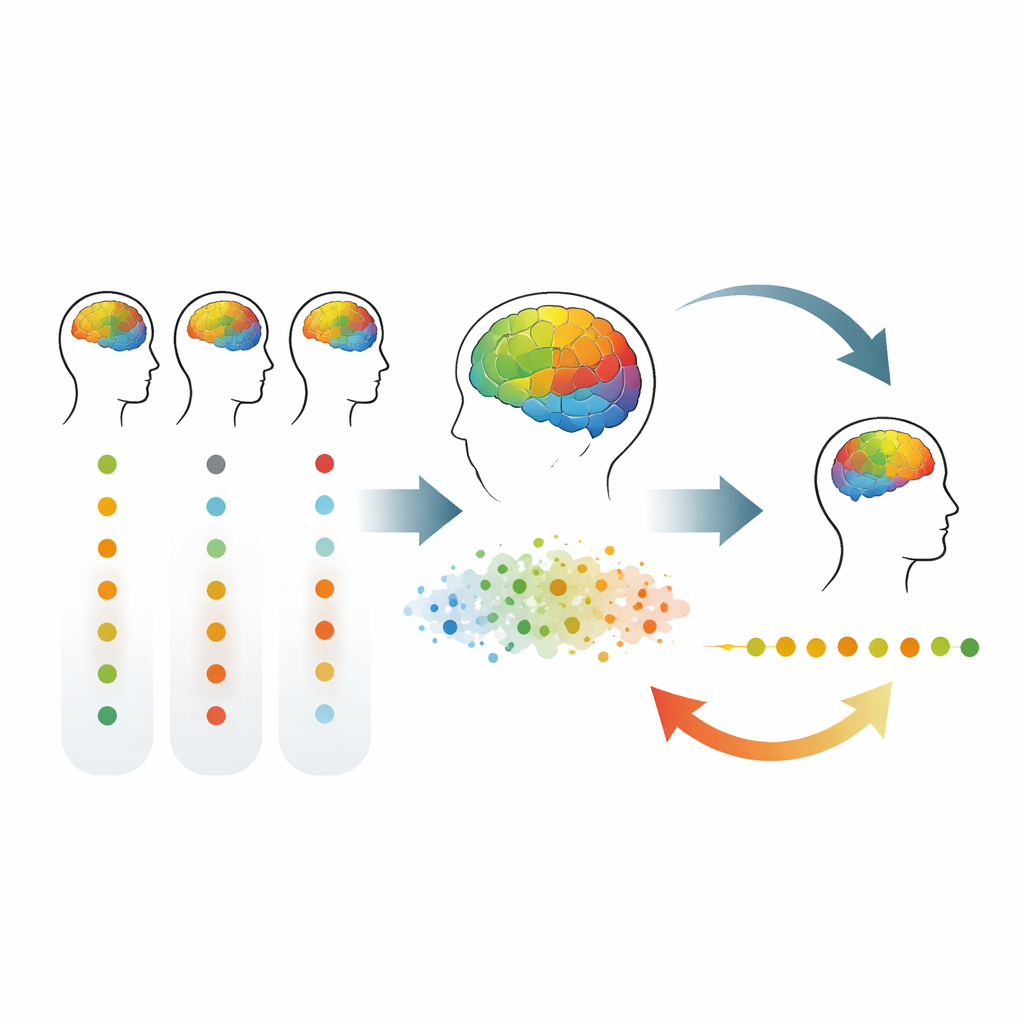
The authors focus on a basic form of self-control called inhibitory control: the ability to cancel or withhold actions, thoughts, or emotions that are no longer appropriate. It is often measured with the stop-signal task, where people respond quickly to a "go" cue but occasionally must stop their response when a stop cue appears. Most brain studies collect one or two sessions of this task from many volunteers, average their brain activity, and then relate that average to a single behavioral score, such as overall reaction time. The hidden assumption is that what holds across people (the group pattern) also holds within each person over time, an idea borrowed from physics called ergodicity.
When averages tell the opposite story
Using brain scans and behavior from about 4,000 children in the Adolescent Brain Cognitive Development study, the team directly tested this assumption. They compared two kinds of relationships between brain activity and behavior: those seen between different people, and those seen within each person from moment to moment. For simple reaction time, the group-level picture suggested mostly one-sided links between slower responses and higher activity in certain brain networks. But within individuals, trial-to-trial fluctuations told a richer and often opposite story—some of the very same regions showed reversed relationships. In areas that usually quiet down during tasks, for example, activity was higher in slower children on average, yet within a given child these areas tended to be more suppressed on their slowest trials. This is a classic pattern known as Simpson’s paradox, where trends in pooled data contradict trends within subgroups.
Peering into hidden mental processes
Reaction times alone blur together multiple mental operations, so the researchers built a computational model, called PRAD, to tease apart underlying processes on every trial. The model estimates how quickly a person can stop (reactive control), how often they choose to delay responses in anticipation of a possible stop signal, and how long those delays are (both forms of proactive control). These hidden quantities were then aligned with brain activity for each trial. Again, relationships at the group level and within individuals often pointed in different directions. For instance, people who were faster stoppers overall tended to show lower average activity in some control regions. Yet inside a single person, trials with slower stopping were linked to higher bursts of activity in those same regions, suggesting extra effort or compensation when control falters.
Distinct brain routes for planning ahead and slamming the brakes
With these trial-level measures in hand, the team then asked whether the brain treats proactive and reactive control as variations of the same thing or as distinct operations. They compared the detailed spatial patterns of brain activity tied to each process within individuals. Across many networks, patterns linked to proactive control strongly resembled each other but were largely distinct from patterns linked to reactive control. In other words, the brain seemed to use partly separate circuitry for preparing to stop versus actually stopping in the moment. 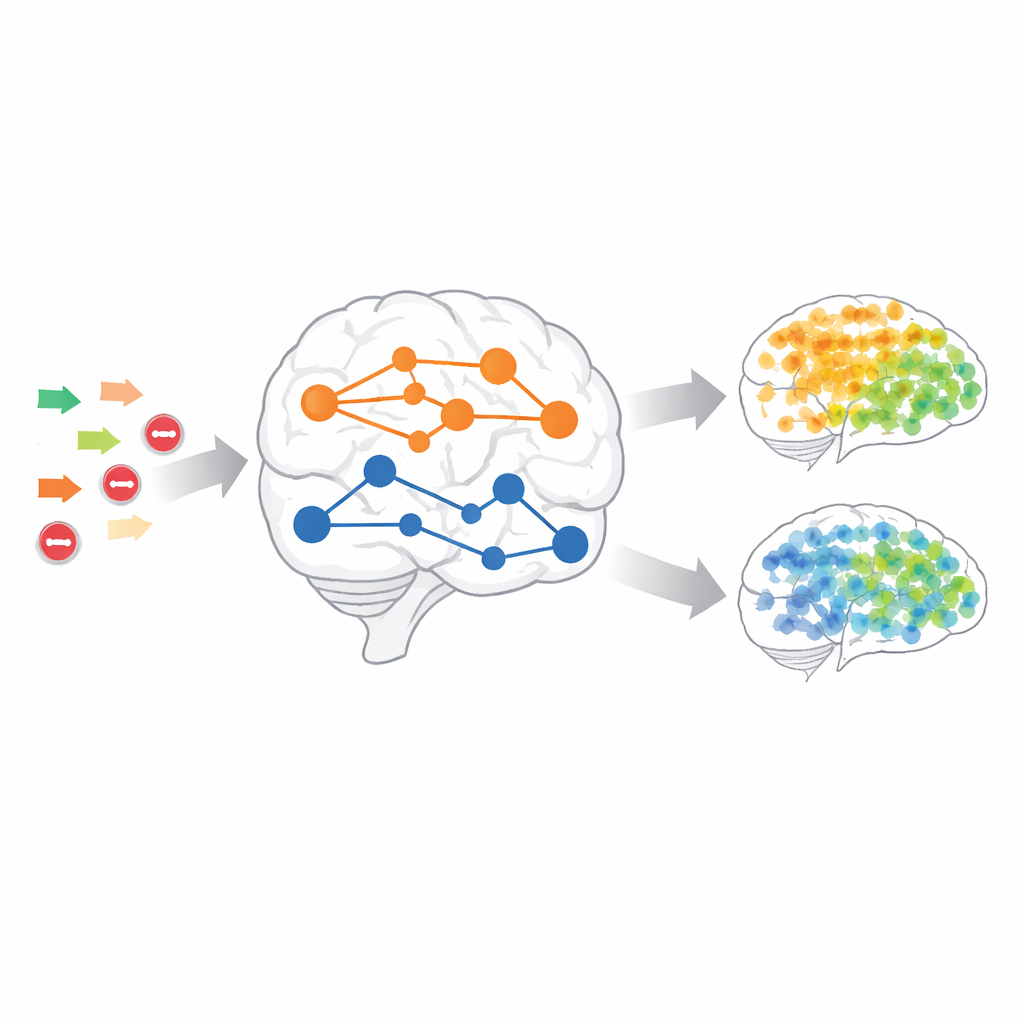
Stable, but not one-size-fits-all, brain–mind links
To check that their results were not statistical flukes, the authors repeatedly reanalyzed random subsets of the data. The within-person brain–behavior patterns proved surprisingly stable even in samples much smaller than the full study, and they held up under many alternative analysis choices and model variants. This suggests that the non-matching and sometimes reversed relationships between group and individual patterns are a robust feature of how inhibitory control works in the brain, not an artifact of any particular method.
What this means for brain science and personalized care
For a layperson, the main takeaway is that what is true on average across many brains need not be true for you—and may even be the opposite. The study argues that to truly understand self-control, and to design tailored interventions for problems like ADHD or impulse-control disorders, scientists must study how each person’s brain and behavior co-vary over time, not just how they compare to others. By embracing this nonergodic view, neuroscience can move closer to explanations and treatments that respect the individuality of our mental lives.
Citation: Mistry, P.K., Branigan, N.K., Gao, Z. et al. Nonergodicity and Simpson’s paradox in neurocognitive dynamics of cognitive control. Nat Commun 17, 3494 (2026). https://doi.org/10.1038/s41467-026-71404-0
Keywords: inhibitory control, brain-behavior relationships, cognitive control strategies, nonergodicity, functional MRI