Clear Sky Science · en
Topological non-Abelian gauge structures in Cayley-Schreier lattices
Building designer crystals for future electronics
Imagine being able to design a crystal like a circuit board, where not only the positions of the atoms but also hidden internal switches at every site can be programmed at will. This study introduces a powerful recipe for such “designer crystals,” showing how they can host rich patterns of quantum behavior that may one day be explored in tabletop experiments using electronics instead of exotic materials. 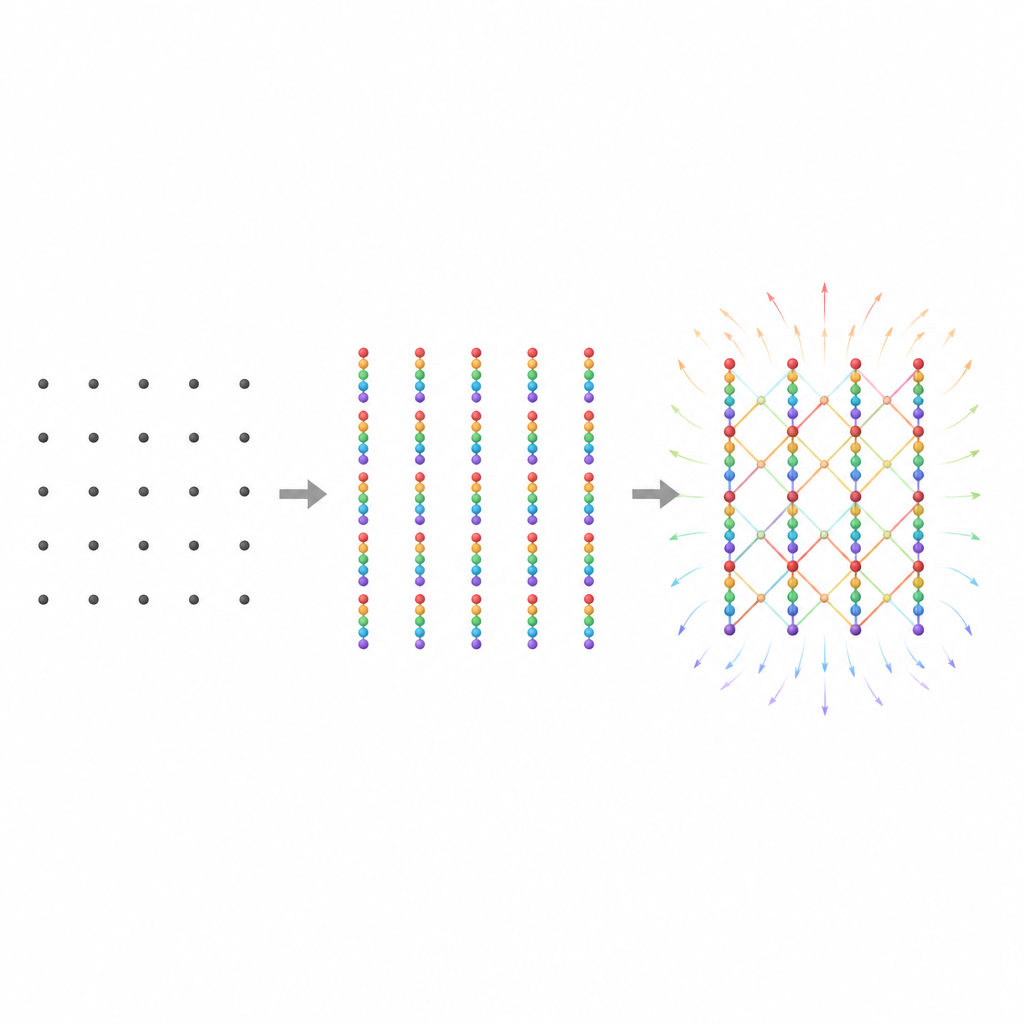
Sites that secretly hold little internal machines
In ordinary crystals, each site is just a place an electron can sit or hop through. In the structures studied here, called Cayley-Schreier lattices, each site is replaced by a vertical pillar of many internal states. You can think of every pillar as a tiny machine with several colored buttons, each button standing for a different internal configuration. When particles hop between neighboring pillars, the rules of the internal machine decide which button they arrive at, not just whether they arrive. These rules are organized using mathematical groups, and the authors focus on a particularly rich one known as the quaternion group.
Hidden fields that cannot be simplified away
Because hopping always follows the group rules, particles moving around a closed loop in the lattice pick up a kind of memory of the path they took, like going around a roundabout whose exits are color coded rather than signposted. In familiar cases the accumulated “color” is simple and path independent; such situations are described by Abelian gauge fields. Here, the internal rules are non-Abelian, meaning that changing the order of steps around the loop changes the outcome. The result is a synthetic field woven into the lattice itself that cannot be undone by simply relabeling internal states. 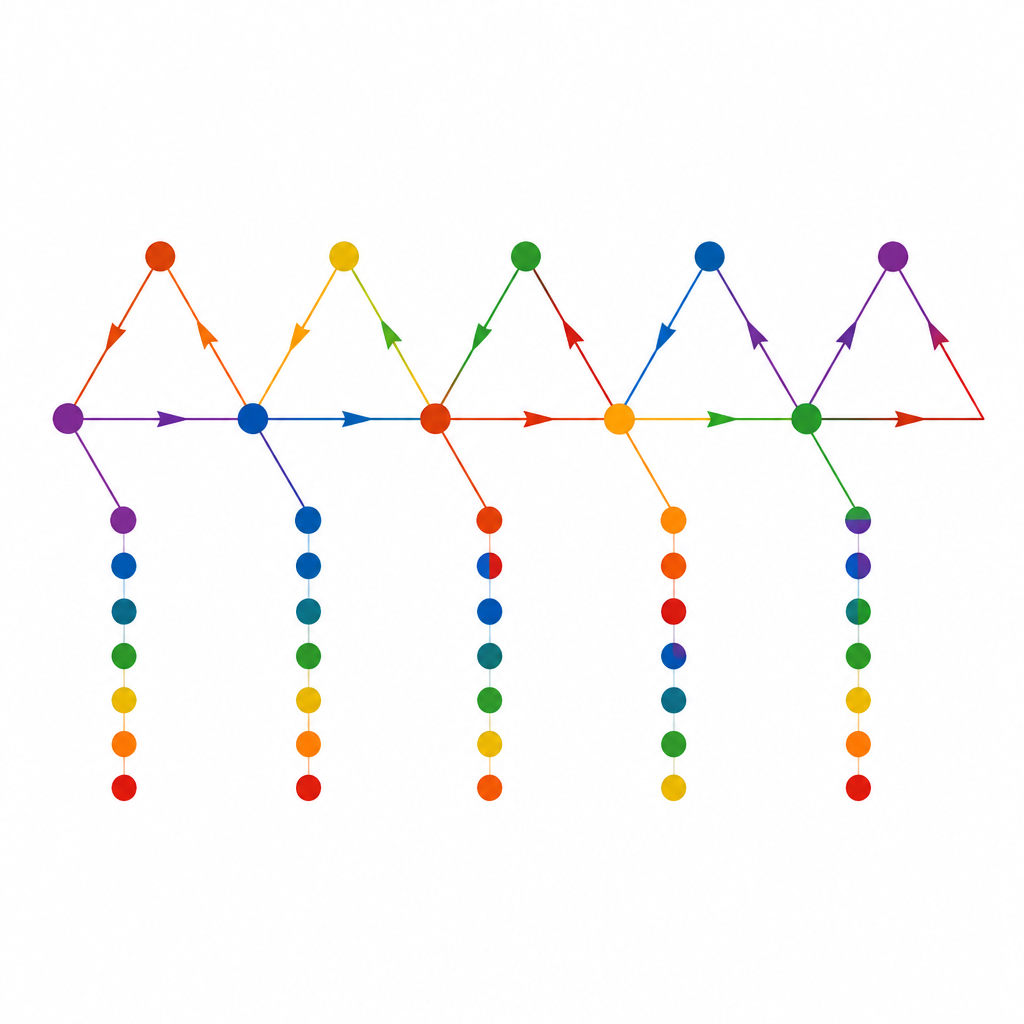
From hidden rules to effective spins and topological edges
By rearranging the description of the internal pillars in a systematic way, the authors show that the full lattice naturally splits into independent sectors, each behaving like particles with a particular kind of “pseudospin.” Some sectors look like spinless particles moving in simple flux patterns, while others behave exactly like spin one half particles experiencing a structured non-Abelian field. Within a single Cayley-Schreier lattice, one can therefore host several different flavors of band topology at once, including phases where the bulk of the system is insulating but robust conducting states appear at the edges.
Simple model ladders and honeycomb grids
To make these ideas concrete, the team builds models on triangular ladders and on a honeycomb lattice reminiscent of graphene. In the ladder, carefully chosen hopping paths make neighboring triangles carry different types of quaternion flux. This arrangement produces edge states that come in locked pairs, protected by time reversal and other symmetries, and pinned at special energies. On the honeycomb lattice, similar ingredients mimic well-known topological spin phases but now generated purely by the engineered internal structure rather than by real electron spin and relativistic effects.
Turning theory into tabletop circuits
The work does not stop at abstract models. The authors outline how to implement these lattices in electric circuits built from capacitors and inductors. Each internal state in a pillar becomes a node in the circuit, and hopping is realized by carefully wired capacitors. By injecting alternating currents with specific phase patterns, experimenters can selectively excite one pseudospin sector at a time and read out its spectrum by measuring voltage responses. This provides a practical route to exploring non-Abelian gauge structures and their topological edge modes in easily reconfigurable hardware.
What this means for future materials
In everyday terms, the study shows how to embed intricate, non-commuting “traffic rules” into artificial crystals and to separate their behavior into different effective spins inside a single platform. This opens a playground where a wide variety of topological insulators and metals, including ones with no simple counterpart in natural materials, can be designed and tested. By extending these ideas to more complicated internal groups, researchers may discover entirely new kinds of protected edge states and unusual metallic phases, guided not by chemistry but by the abstract logic of symmetry and gauge structure.
Citation: Guba, Z., Slager, RJ., Upreti, L.K. et al. Topological non-Abelian gauge structures in Cayley-Schreier lattices. Nat Commun 17, 4669 (2026). https://doi.org/10.1038/s41467-026-71401-3
Keywords: synthetic gauge fields, topological insulators, non-Abelian lattices, electric circuit networks, Cayley-Schreier lattices