Clear Sky Science · en
Atomic-scale reconstruction of sapphire induced by selective tribochemical removal of surface atoms
How rubbing can reshape an ultra hard crystal
Sapphire is famous for its toughness, which is why it protects smartphone cameras and spacecraft windows. This study reveals that, under the right conditions, simple rubbing can quietly carve sapphire at the scale of atoms, creating tiny, scale like patterns that are both durable and useful for harvesting mechanical energy.
From nature’s skins to long lasting surfaces
In nature, insects, leaves, and snakes gain special abilities from their microscopic surface shapes, such as glare free vision or high wear resistance. Engineers try to copy these tricks by machining similar nanostructures into hard materials, but fine patterns often wear out quickly under friction. Conventional ways to structure sapphire, like chemical etching or laser drilling, usually damage its crystal lattice, softening the surface and shortening its life. The authors instead set out to find a way to sculpt sapphire while keeping its original, high hardness intact.
Letting friction and chemistry do the work
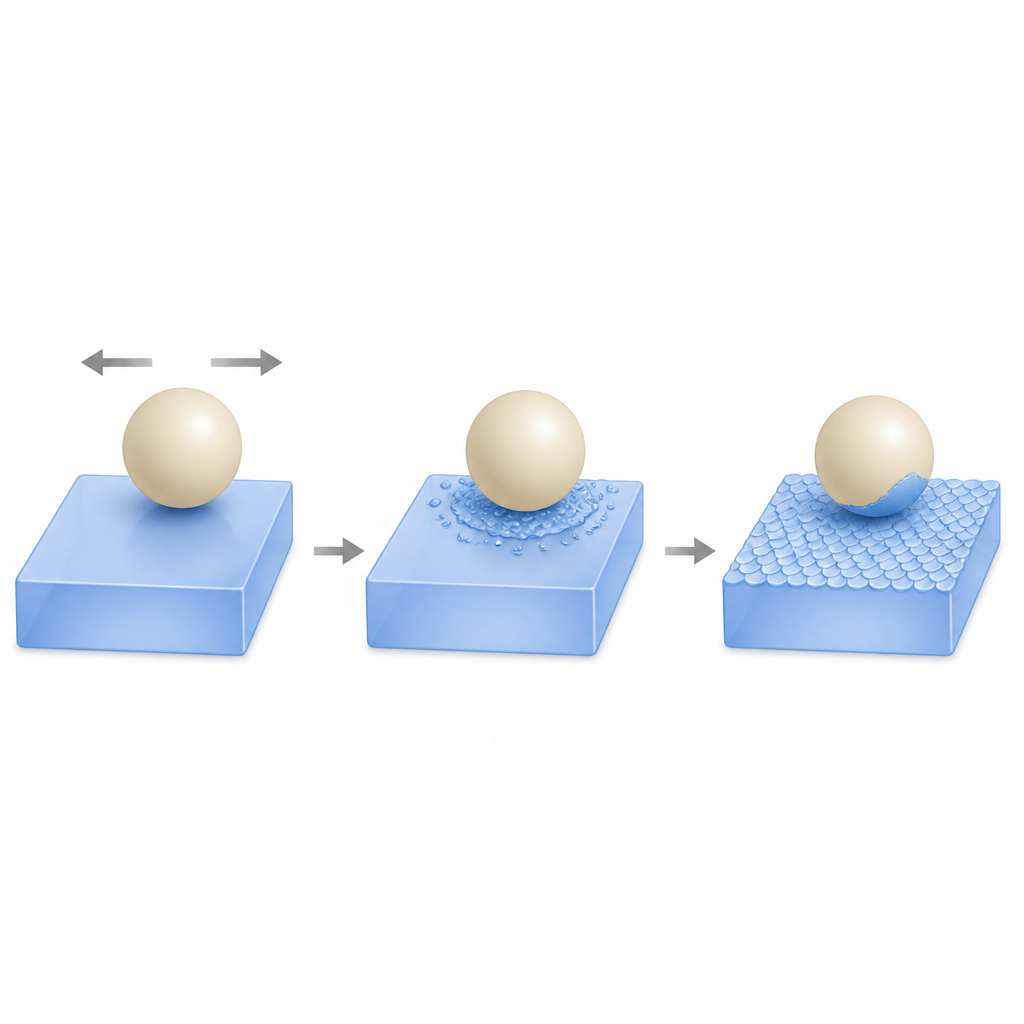
The team discovered that sapphire can “rebuild” its own surface when it is rubbed against a silica (SiO2) ball in water. Real sapphire wafers are not cut perfectly on one crystal plane; they carry a slight tilt called a miscut, which creates atom high steps on the surface. When the silica ball slides over such a tilted surface at controlled pressure, water molecules between the two solids split into reactive groups that briefly link the sapphire and silica atoms together. Because different crystal faces on the stepped surface are not equally reactive, atoms are removed faster from some planes than others, gradually reshaping the flat surface into a regular, overlapping scale like pattern.
Following atoms one by one
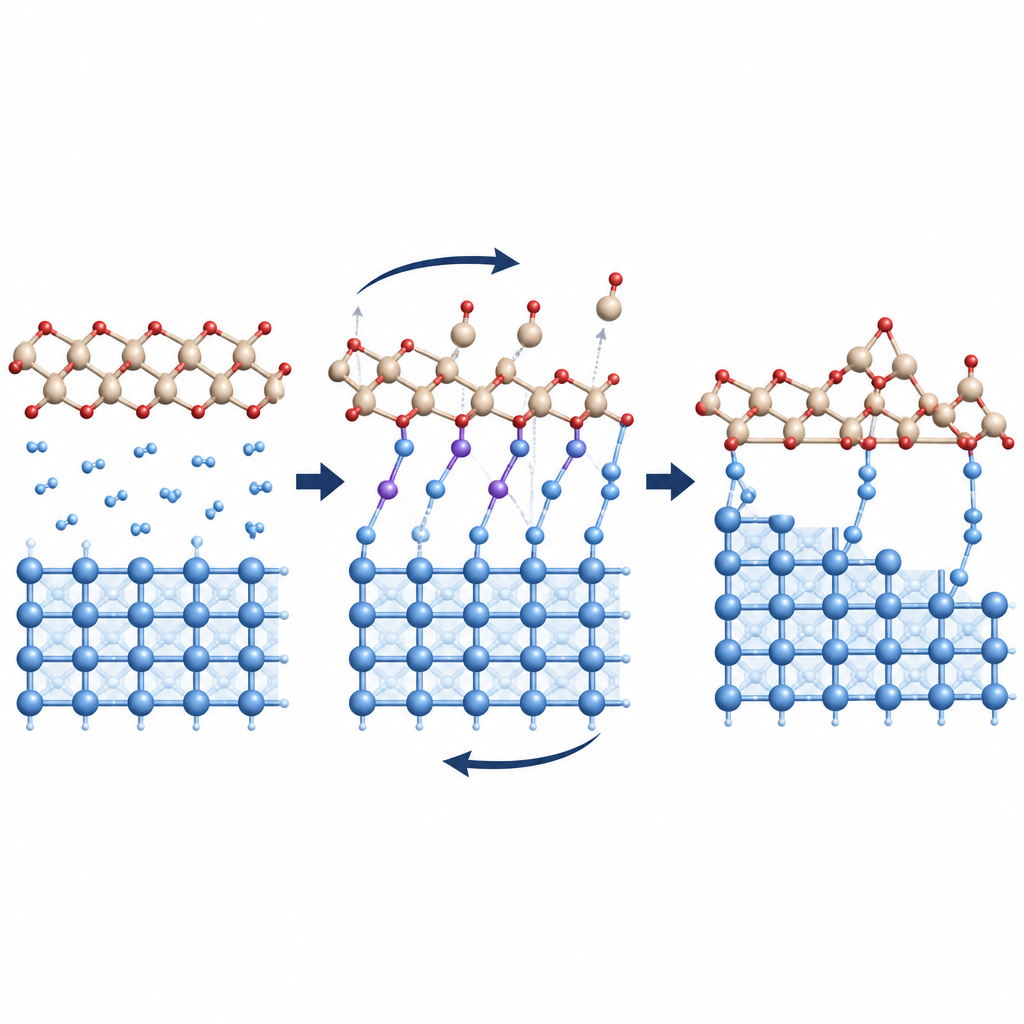
To understand this invisible process, the researchers combined high resolution microscopy with reactive molecular simulations. Electron microscopy showed that after rubbing, the new nanostructures remain a single crystal, with the same atomic spacing as the original sapphire and no obvious new defects. Chemical tests confirmed that material from the sapphire ended up attached to the silica ball, while almost nothing transferred in the opposite direction. Simulations revealed how water splits into hydroxyl groups that attach to both solids and then condense into bridge bonds linking silicon, oxygen, and aluminum atoms. Under shear, these bridges tend to break on the sapphire side, pulling out atoms in a controlled way. The difference in removal rate between tightly packed and more open crystal planes naturally produces the scale like relief.
Turning nano scales into better energy harvesters
To test whether these sculpted surfaces survive real use, the authors built sliding triboelectric nanogenerators, devices that turn motion into electricity through contact and separation of two materials. They paired either flat or nanostructured sapphire with a diamond like carbon coating and cycled them for one hundred thousand rubbing events. The flat sapphire devices produced modest electrical signals that stayed low over time. In contrast, the patterned sapphire devices delivered two to three times higher voltages and charge densities, because the tiny scales pressed into the softer carbon layer, creating elastic plastic dents and greatly increasing true contact area. Despite this intense sliding, the sapphire nanostructures showed almost no wear, and their hardness remained essentially identical to that of bulk sapphire.
What this means for tough, smart surfaces
In easy to grasp terms, the study shows that you can use friction, water, and a partner material to coax a supposedly rigid crystal into a new shape without weakening it. A slight built in tilt of the crystal guides where atoms are plucked away, leaving behind a tough, ordered landscape of nanoscale scales. These patterns boost energy harvesting while shrugging off long term wear, hinting at robust surfaces for sensors, self powered devices, and components that must endure harsh conditions without losing their function.
Citation: Zhang, J., Li, C., Wang, Y. et al. Atomic-scale reconstruction of sapphire induced by selective tribochemical removal of surface atoms. Nat Commun 17, 4673 (2026). https://doi.org/10.1038/s41467-026-71385-0
Keywords: sapphire, nanostructures, triboelectric nanogenerator, surface reconstruction, wear resistance