Clear Sky Science · en
Accelerated directional growth of seaweed-like iron oxide branches driven by localized electric fields of gold nanoparticles in liquid
Why tiny branches in liquid matter
At first glance, wispy branches of rust forming in a liquid might sound like a lab curiosity. But at the nanoscale, the exact shape of these branches can change how catalysts work, how batteries charge, and how filters clean water. This study shows a new way to steer the growth of such tiny iron oxide branches using nearby gold nanoparticles, revealing how invisible electric forces can sculpt matter in liquid.
From messy seaweed shapes to guided growth
When iron oxide forms in liquid, it often spreads out in tangled, seaweed-like patterns. These branching shapes create a large surface area, which is useful, but the growth is hard to control. The researchers wanted to see whether the presence of gold nanoparticles could tame this chaos and make the branches grow in a chosen direction. To watch this process unfold, they turned to a powerful tool that can look directly into liquids at the nanoscale.
Watching branches grow in real time
The team used in situ liquid-cell transmission electron microscopy, a technique where a very thin layer of liquid is sealed between transparent windows and imaged with an electron beam. They prepared a solution containing iron precursors and added tiny gold spheres only a few nanometers across. Under the beam, iron oxide began to form and spread out in branching patterns on a flat membrane. With the help of a deep-learning image analysis method, the scientists traced the exact outlines of each branch frame by frame, turning videos into precise maps of how the structures evolved over time.
What happens without gold nearby
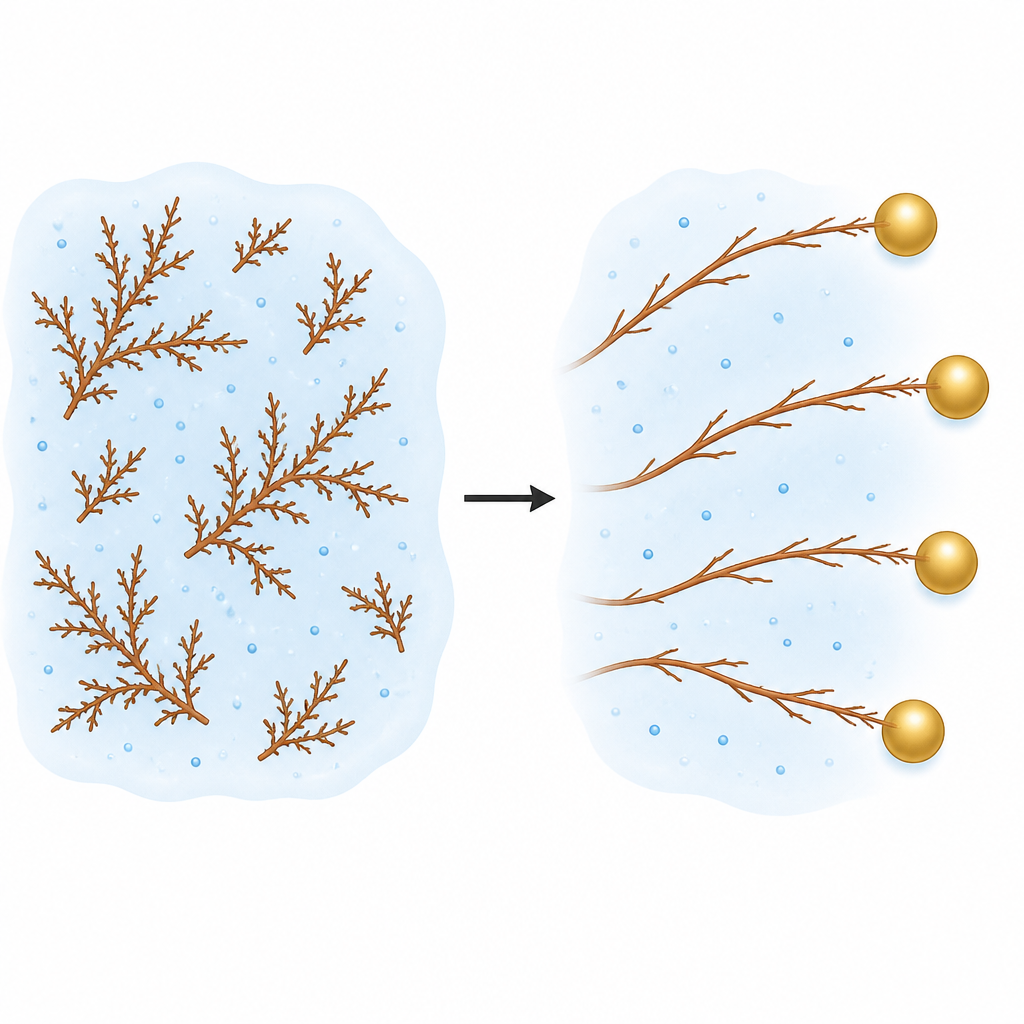
In regions of the liquid where no gold nanoparticles were present, the iron oxide branches behaved in a familiar way. As a branch tip advanced, it widened, became unstable, and then split into two or more new tips. This repeated splitting produced dense, tree-like patterns similar to seaweed spreading across a rock. Careful measurements showed that the growth followed known rules for diffusion-limited growth, where material slowly drifts through the liquid and attaches where it happens to arrive. The resulting structure had a relatively high fractal dimension, reflecting its crowded, bushy nature.
Gold particles turn into hidden guides
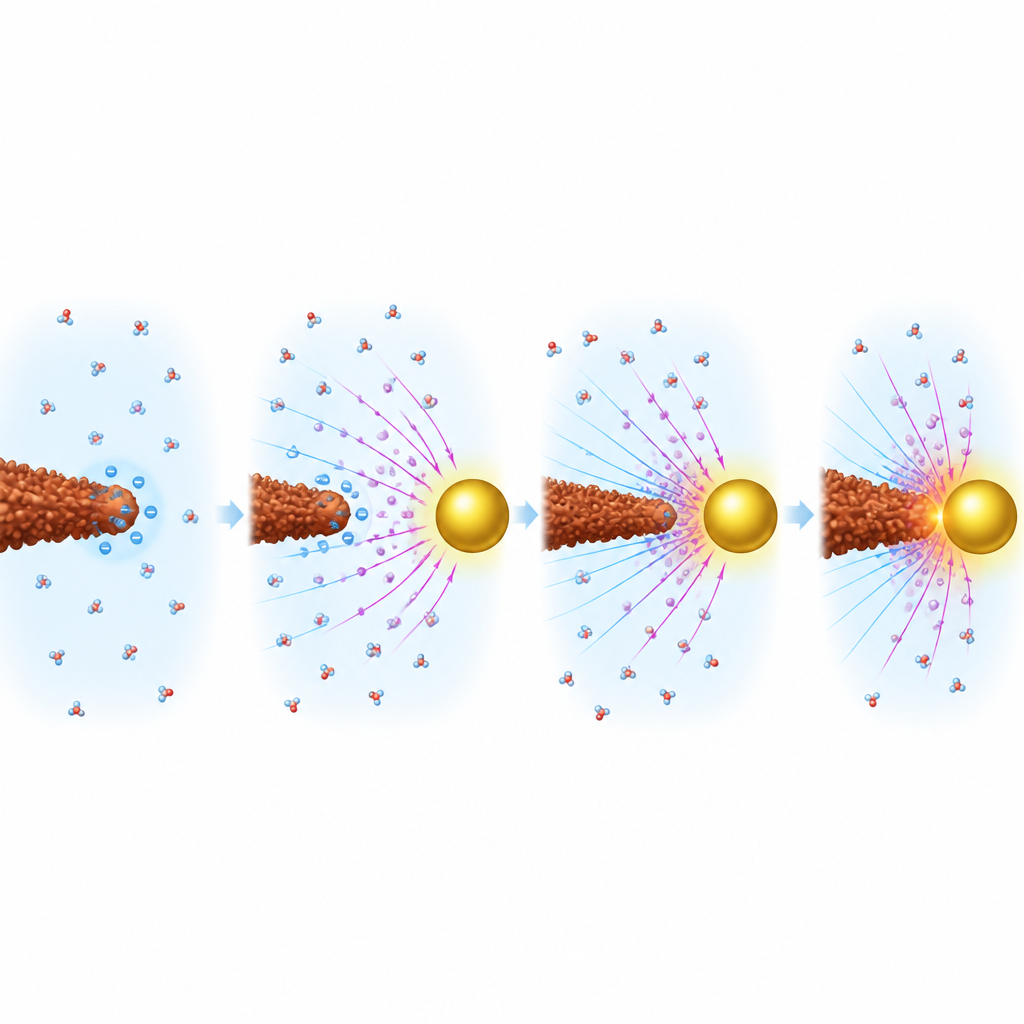
When a gold nanoparticle lay ahead of a growing branch, the behavior changed dramatically. Instead of widening and splitting, the branch tip stayed sharp and bent toward the gold sphere, accelerating as it approached. If more than one gold particle was in front, new branches grew toward each one. The overall pattern became much sparser, with fewer side branches and a lower fractal dimension. To understand why, the researchers modeled the electric field created between the positively charged gold particles and the negatively charged iron oxide tips. Their calculations showed a concentrated electric field funneling positively charged reactants straight toward the branch tip, speeding growth along the line that connects tip and particle.
Invisible forces and a hidden stopping point
The team also explored how the strength of this guiding force changes with distance. They found that the rate of growth increased sharply as the tip moved closer to a gold nanoparticle, following a simple distance rule similar to that of electrostatic attraction. However, once the gap shrank to only a few nanometers, growth slowed again. This threshold matched the combined length of organic molecules coating both the iron oxide and the gold, which act like soft brushes. When these brushes press together, they block the flow of reactants, and the branch finally comes to rest in contact with the gold surface.
What this means for future materials
In plain terms, this work shows that tiny electric fields from charged nanoparticles can act as invisible hands that pull growing branches into place and change their shape. Instead of letting iron oxide spread in random seaweed-like patterns, gold nanoparticles steer the branches, make them grow faster, and keep them from splitting. Understanding and using this kind of nanoscale guidance could help scientists design better catalysts, safer batteries, and more efficient filters by shaping materials as they form, rather than trying to fix their structure after the fact.
Citation: Zhou, M., Wang, W., Sun, J. et al. Accelerated directional growth of seaweed-like iron oxide branches driven by localized electric fields of gold nanoparticles in liquid. Nat Commun 17, 4646 (2026). https://doi.org/10.1038/s41467-026-71352-9
Keywords: branched nanostructures, iron oxide growth, gold nanoparticles, local electric fields, liquid cell TEM