Clear Sky Science · en
Synthesis of atomically dispersed catalysts via hydrogen embrittlement-like assisted thermal activation for acidic oxygen reduction
Turning Metal Atoms into Efficient Helpers
Fuel cells can turn hydrogen into electricity while emitting only water, but they rely on expensive and sometimes fragile catalysts to speed up the key oxygen reaction. This study shows a new way to arrange precious metals like ruthenium, palladium, platinum, and gold as isolated single atoms on carbon, making them more efficient and durable while using far less metal. The work borrows an idea from how hydrogen can weaken metals, and applies it to build better engines for clean energy devices.
Why Single Atoms Matter
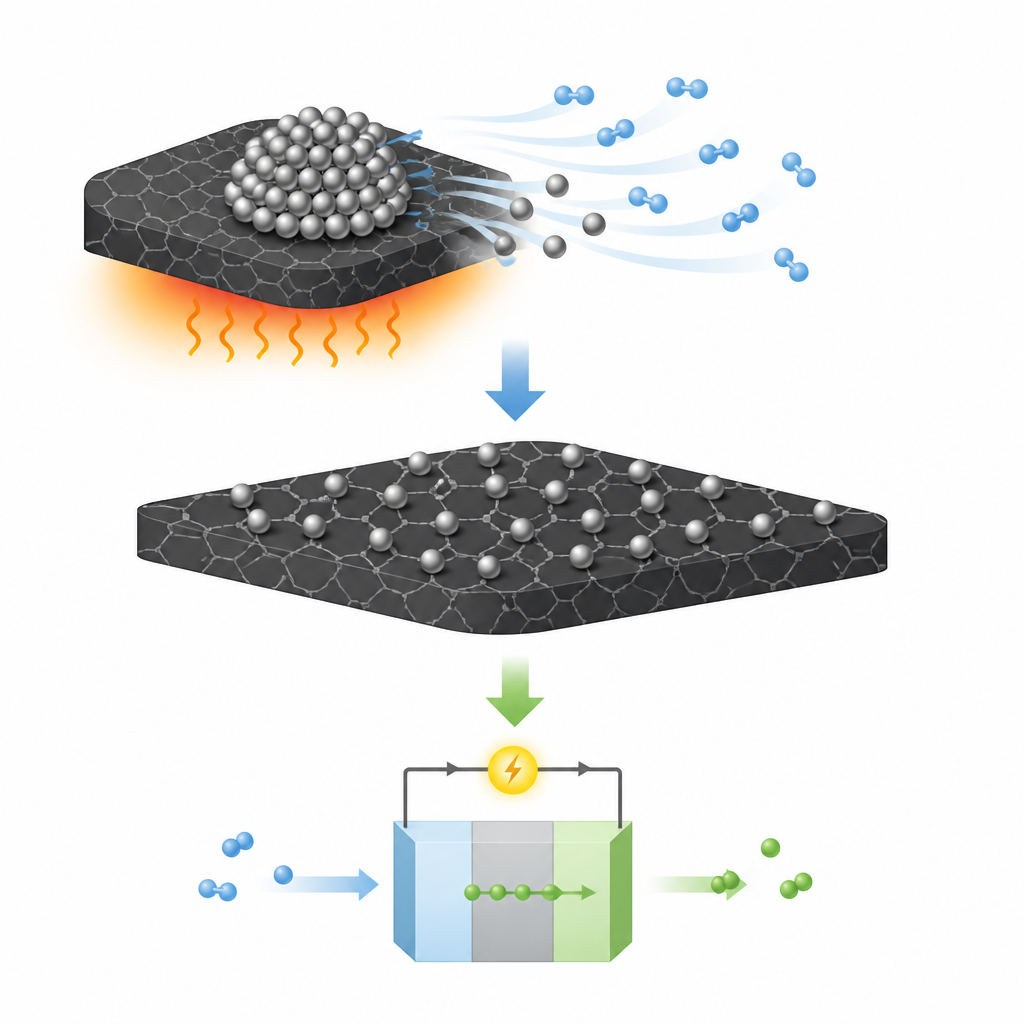
In many fuel cell and battery reactions, metals such as iron, cobalt, and manganese are already used as isolated atoms to catalyze chemical steps with high precision. Doing the same with heavier metals like ruthenium and platinum could greatly boost performance, but these metals strongly attract each other and tend to clump into clusters or nanoparticles. When that happens, only the atoms at the surface take part in the reaction and a lot of costly material is wasted. The challenge is to pull these metals apart into separate atoms and keep them from rejoining during the high heat needed to make practical catalysts.
Using Hydrogen to Pull Clusters Apart
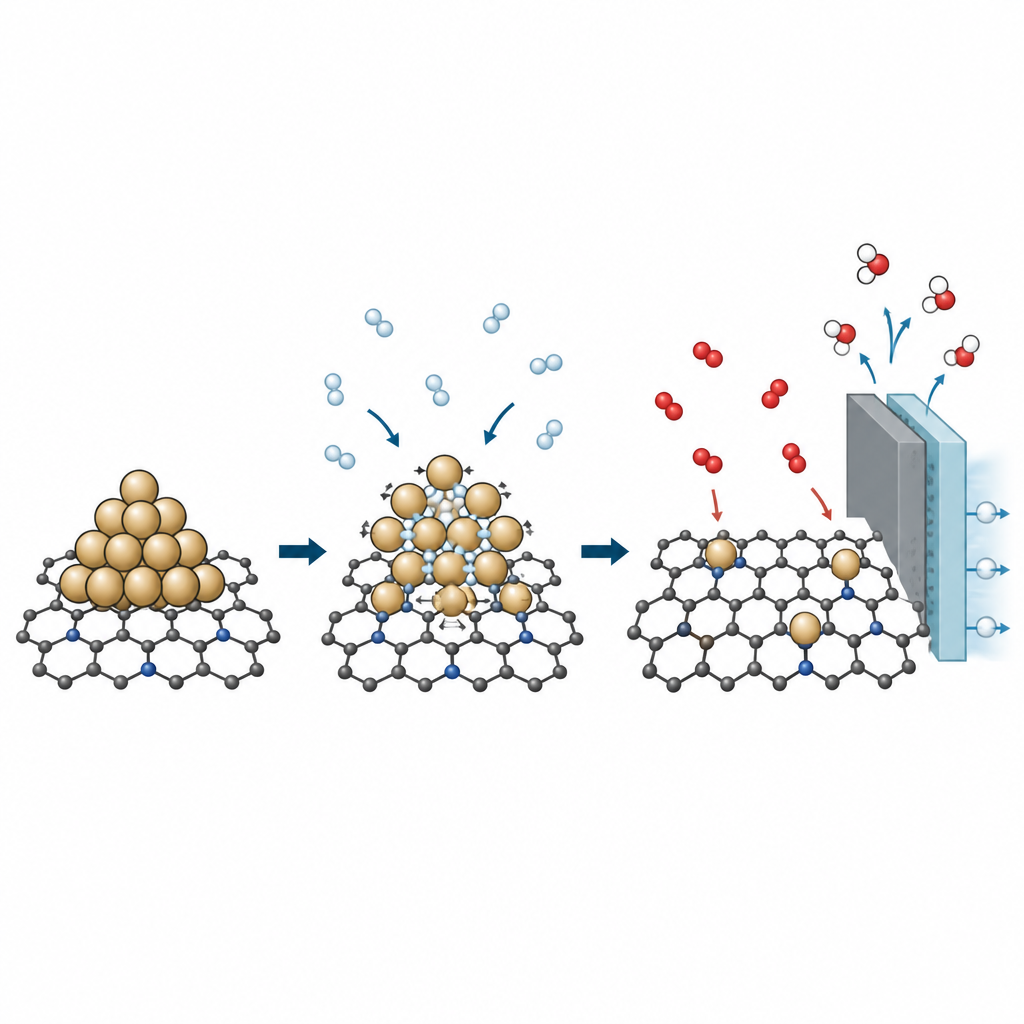
The researchers took inspiration from hydrogen embrittlement, a well known problem where hydrogen sneaks into metals and makes them crack. In their design, small clusters of a noble metal are held inside a porous, nitrogen rich carbon material. When the material is heated in a flow of hydrogen gas, hydrogen atoms slip into the metal cluster and slightly push the metal atoms apart. Computer calculations show that this hydrogen filled state lowers the energy barrier for a metal atom to leave the cluster and move to a nearby nitrogen site in the carbon. Experiments using high resolution electron microscopes and X ray techniques confirm that, as the temperature rises, metal clusters shrink and finally vanish, replaced by isolated single atoms each bound to four nitrogen atoms in the carbon.
Ruthenium Catalyst Performance in Harsh Acid
To test how well this strategy works in real devices, the team focused on ruthenium as a model metal for the oxygen reduction reaction in acidic conditions, the demanding environment inside many proton exchange membrane fuel cells. A sample heated to 950 degrees Celsius under hydrogen produced a dense array of single ruthenium sites and showed much higher oxygen reduction activity than material treated without hydrogen. In rotating electrode tests, it approached the performance of commercial platinum catalysts while giving nearly complete four electron conversion of oxygen to water with very little peroxide byproduct. The ruthenium catalyst also kept its activity after 30,000 test cycles, far outlasting a state of the art iron based catalyst.
From Model Catalyst to Working Fuel Cell
The team then built full fuel cell devices using the hydrogen treated ruthenium catalyst at the cathode. Under practical hydrogen air conditions, the cells reached power outputs that match or exceed many reported non platinum and non iron systems, and they did so with good efficiency. Importantly, after 30,000 rapid voltage swings meant to mimic heavy use, the ruthenium based cell retained more than four fifths of its peak power, while the iron based cell lost about half. Further chemical tests and simulations suggest that the ruthenium sites are more tightly bound to the carbon and less prone to generate reactive species that can damage the support and the ion conducting membrane.
A New Recipe for Future Clean Energy Materials
For a non specialist, the main message is that carefully using hydrogen during heat treatment can gently break apart precious metal clusters and pin the freed atoms onto a stable support. This simple idea turns an unwanted metal weakening effect into a tool for building highly efficient and long lasting catalysts using much less costly metal. Because the method also works for palladium, platinum, and gold, it offers a general recipe for designing better materials for fuel cells and other energy technologies that depend on clean and efficient oxygen reactions.
Citation: Guo, P., Dai, Y., Zhang, Y. et al. Synthesis of atomically dispersed catalysts via hydrogen embrittlement-like assisted thermal activation for acidic oxygen reduction. Nat Commun 17, 4701 (2026). https://doi.org/10.1038/s41467-026-71340-z
Keywords: single atom catalyst, oxygen reduction, fuel cell, ruthenium catalyst, hydrogen treatment