Clear Sky Science · en
Global hotspots of particulate organic carbon losses under climate change
Why soil in cold places matters for our climate
Far northern and southern landscapes may look empty, but their frozen and waterlogged soils quietly store enormous amounts of carbon from dead plants. This study asks a simple, urgent question: as the planet warms, how much of that hidden carbon is likely to leak back into the air as carbon dioxide, and where are the biggest trouble spots? The answers reveal that certain cold regions are poised to become powerful sources of greenhouse gases if their soils are disturbed by rising temperatures.
Two kinds of hidden carbon in the ground
Not all soil carbon behaves the same. The authors focus on two main forms. One is particulate organic carbon, made of small pieces of plant remains that are only loosely held in the soil. The other is mineral-associated organic carbon, which is bound to tiny mineral particles and is usually better protected from decay. Because these two forms differ in how they form, how long they last, and how easily microbes can consume them, understanding their balance helps predict how soils will react to a warmer and in some places wetter world.
Building a global picture of soil carbon
To see the big picture, the researchers assembled a global database of more than 3200 topsoil samples from all major land types, including forests, grasslands, croplands, shrublands, and tundra. For each location they combined field measurements of particulate and mineral-bound carbon with information on temperature, rainfall, vegetation, soil chemistry, and land cover. They then used several machine learning methods to discover which factors best explain where each carbon form is found today and to project how these stores might change by the end of this century under three different greenhouse gas emission pathways.
Cold regions as hotspots of loss
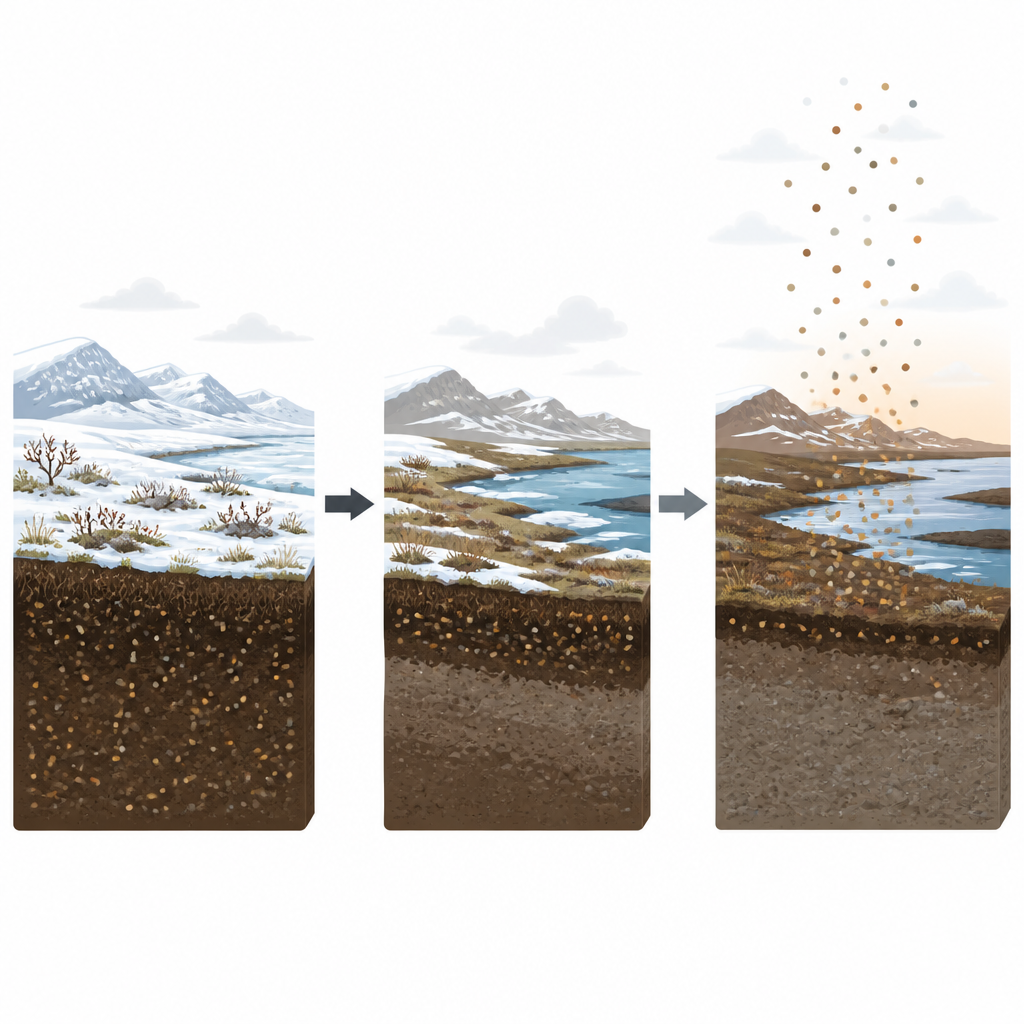
The models agree that high-latitude soils stand out as global hotspots of future carbon loss. These northern and southern landscapes currently hold large amounts of both particulate and mineral-bound carbon, but a strikingly high share of their total carbon is in the more fragile particulate form. Because this loose material responds strongly to rising temperatures, warming causes particulate stores to shrink much faster than the more protected mineral-bound stores. Under a high-emission future, the study projects that particulate losses in high-latitude soils would make up roughly four-fifths of all soil carbon losses in those regions, with tundra and boreal forests contributing the largest share.
Why the mix of carbon types signals risk
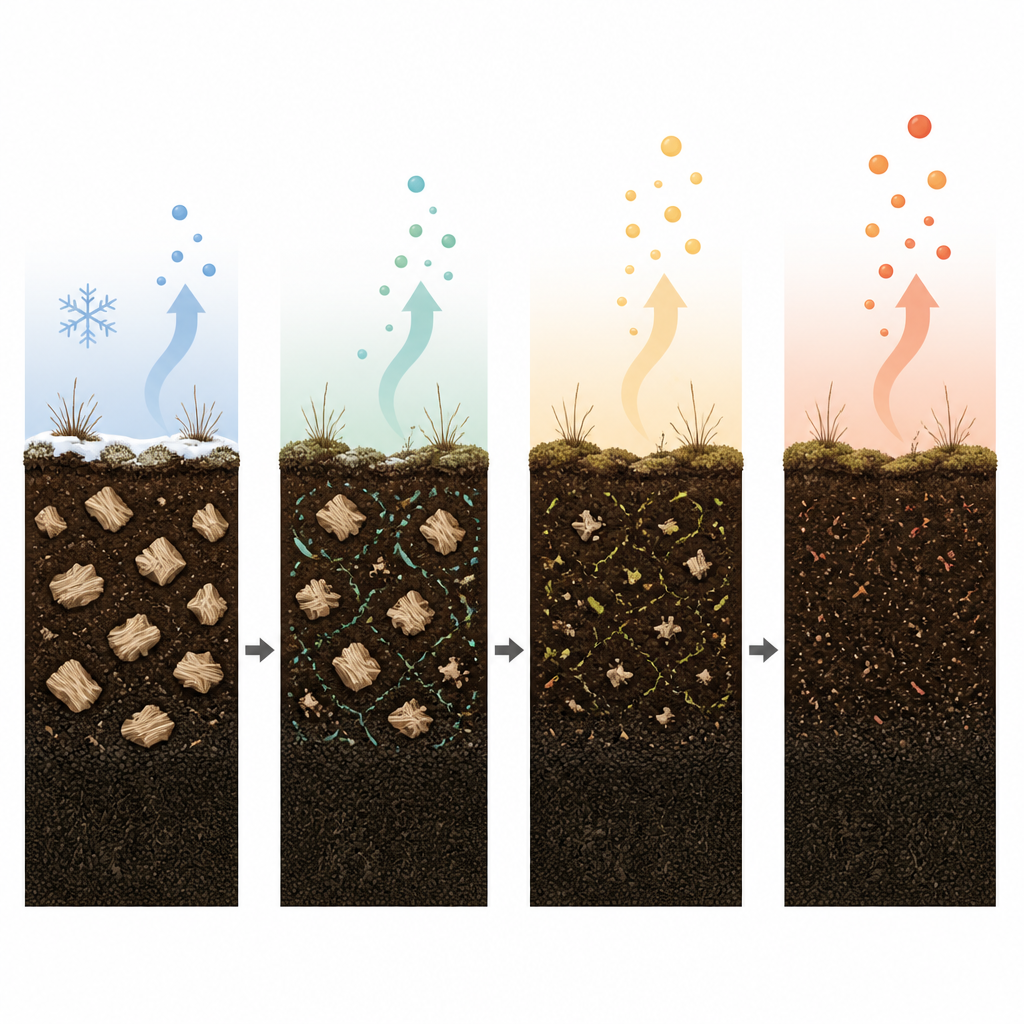
The fraction of total soil carbon that sits in particulate form turns out to be a powerful warning sign. Where this fraction is high, the models predict larger drops in total soil carbon as the climate warms, especially in cold regions where microbial communities and soil enzymes react strongly even to modest temperature increases. In tundra, years of slow breakdown under cold, wet, and oxygen-poor conditions have allowed layers of partially decomposed plant material to pile up. As these soils warm and dry, microbes gain easier access to this stockpile, speeding up decay and sending more carbon into the atmosphere. Boreal forests show a similar pattern, with plant litter that builds up as particulate matter and becomes vulnerable once conditions favor faster decomposition.
Implications for climate action and soil care
When the projected global losses of particulate carbon are translated into carbon dioxide, they amount to many tens of billions of tons of potential emissions by 2100, equal to several years of current human output. The study concludes that protecting this fragile soil carbon is essential for avoiding extra climate feedbacks. Traditional efforts have focused on strengthening the more stable mineral-bound carbon, but the results here show that safeguarding particulate carbon and, where possible, helping it convert into more stable forms is just as important. Practices such as retaining plant residues, restoring diverse vegetation, and using gentle farming methods that limit soil disturbance can help keep this vulnerable carbon in the ground, particularly in cold and high-latitude landscapes where the stakes are highest.
Citation: Sun, S., Cotrufo, M.F., Viscarra Rossel, R.A. et al. Global hotspots of particulate organic carbon losses under climate change. Nat Commun 17, 4695 (2026). https://doi.org/10.1038/s41467-026-71321-2
Keywords: soil carbon, climate change, tundra, permafrost, carbon feedback