Clear Sky Science · en
Disulfide modification and thiol protection via tris(trimethylsilyl)silane-mediated hydrosilylation of disulfides
Why protecting sulfur matters
Chemists often rely on sulfur containing groups, called thiols and disulfides, to build drugs, tune protein behavior, and design smart materials. But thiols are fragile: they oxidize easily and form unwanted links, which can derail careful syntheses or damage sensitive biological molecules. This study introduces a gentle and practical way to "protect" thiols by transforming disulfide bonds using a silicon based reagent, making sulfur chemistry easier to control in both lab made molecules and peptides.
A new helper for sulfur chemistry
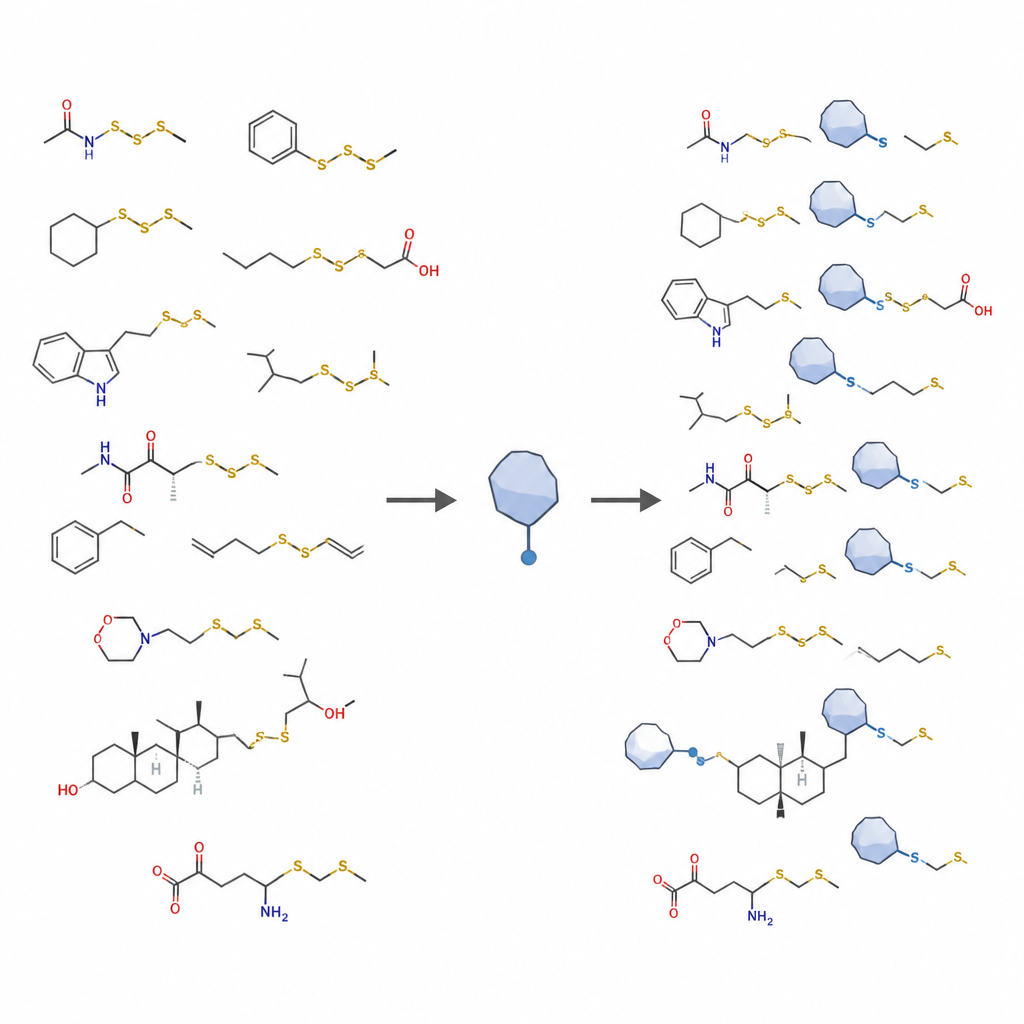
The authors focus on a special silicon hydride called tris(trimethylsilyl)silane, or TTMSS. Unlike many related reagents, TTMSS is stable in air and water, and has a reactive silicon–hydrogen bond that readily participates in radical reactions. The team discovered that simply mixing TTMSS with disulfides under mild conditions converts the sulfur–sulfur bond into a silicon–sulfur bond, giving products known as silyl sulfides. These new sulfur–silicon units are unusually resistant to breakdown by water, yet they can later be removed in a controlled way using fluoride. This combination of stability and easy removal makes them attractive as temporary "caps" for thiols.
Simple conditions and broad tolerance
A key strength of this method is how straightforward it is to use. The reaction proceeds at modest temperatures, often in common organic solvents and even in mixtures containing water, without the need for metal catalysts or strict exclusion of air. By adjusting how much TTMSS is added, and in some cases using gentle blue light, the authors achieve high yields for many different disulfides. Both aromatic and aliphatic disulfides react smoothly, as do more complex partners that include alcohols, acids, alkenes, esters, amides, sugars, steroids, and heterocycles. Across this broad set, the reaction is typically clean: the main products are the desired silyl sulfides and companion thiols formed from the broken disulfide bond.
Tools for peptides and drug like molecules
The study highlights how this chemistry can streamline work with biologically important molecules. Cystine based disulfides, which are central to peptide and protein structure, are readily transformed into silicon protected forms. The protected cysteine units survive other common protecting group chemistry, demonstrating that this strategy is orthogonal to existing methods. The authors use these building blocks to assemble peptides and then regenerate the original disulfide bridges by removing the silicon cap and oxidizing the thiols. They also show that lipoic acid and its esters, including versions attached to terpenes, sugars, alkaloids, steroids, and a cyclic peptide drug, can be selectively modified. In each case, one sulfur is converted to the robust silicon capped form while the other becomes a free thiol, which can be used for follow up reactions such as click chemistry or fluorescent labeling.
How the reaction likely works
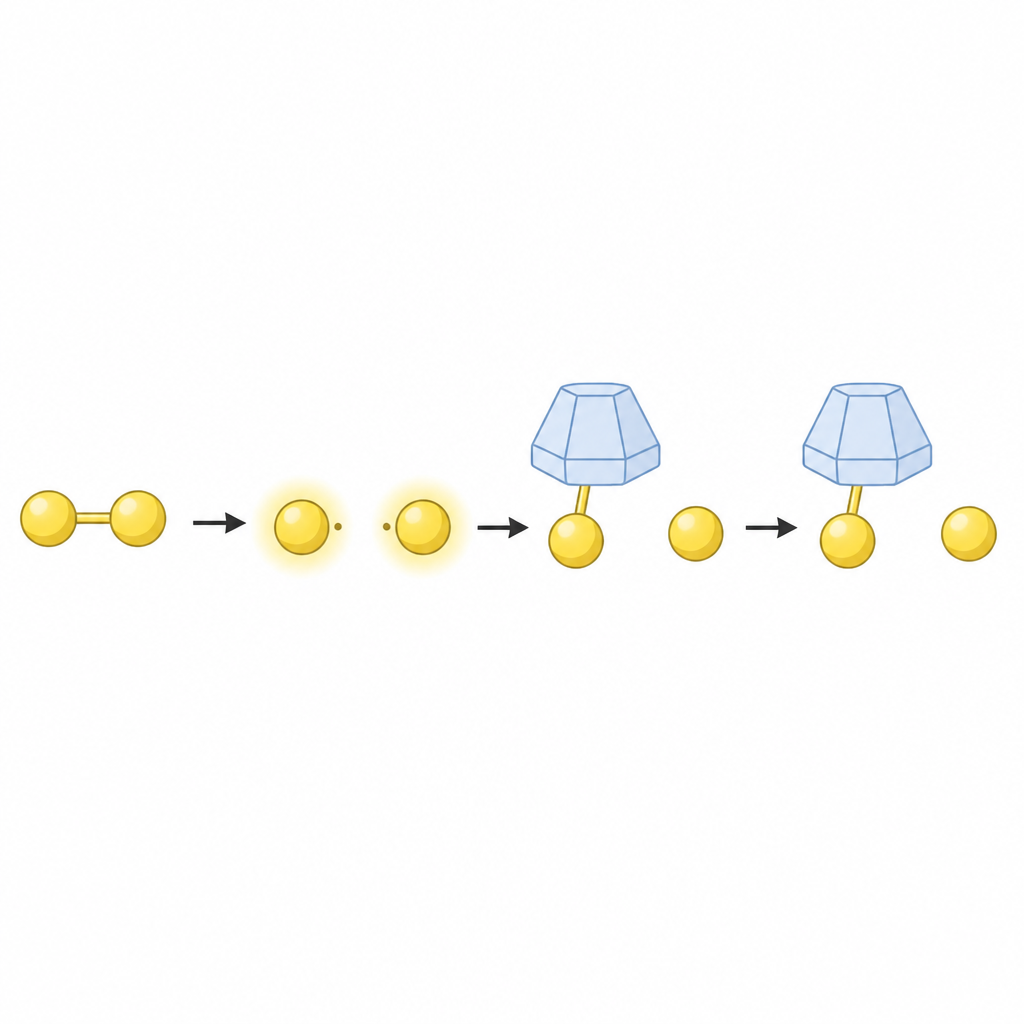
To understand what happens at the atomic level, the researchers carried out mechanistic tests. When they added a radical trapping agent, the reaction slowed dramatically and gave evidence of sulfur centered radicals, suggesting that the disulfide bond first splits into reactive sulfur fragments. Experiments with a deuterated version of TTMSS showed a strong isotope effect, indicating that breaking the silicon–hydrogen bond is a slow, rate limiting step. Light based studies further suggested that both the disulfide and TTMSS absorb blue light, which can help activate them. From these clues, the authors propose that the disulfide either undergoes stepwise radical formation followed by reaction with TTMSS, or a concerted process in which hydrogen transfer and bond reorganization occur together, ultimately yielding a silicon–sulfur bond and a thiol.
What this means for future chemistry
Overall, this work shows that by carefully choosing the size and substitution pattern around silicon, chemists can tune silicon–sulfur bonds to be both formable under mild conditions and stable enough to be useful. The TTMSS based approach offers a reliable, metal free, and broadly compatible way to protect thiols and to remodel disulfide links at late stages in synthesis. For non specialists, the key message is that handling sulfur rich molecules, including peptides and drug like compounds, can now be done with greater precision and fewer harsh reagents, opening the door to more sophisticated designs in chemical biology and materials science.
Citation: Zhang, Y., Lin, K., Zang, Z. et al. Disulfide modification and thiol protection via tris(trimethylsilyl)silane-mediated hydrosilylation of disulfides. Nat Commun 17, 4705 (2026). https://doi.org/10.1038/s41467-026-71313-2
Keywords: thiol protection, disulfide chemistry, silyl sulfides, peptide synthesis, TTMSS