Clear Sky Science · en
Triggering dynamically disordered lithium sublattice in superionic conductors
Spinning building blocks for better batteries
Most people hear about solid-state batteries as the next step for safer electric cars and phones, but few know what limits their performance. This study shows that getting certain tiny groups of atoms inside battery materials to rotate, almost like spinning toys, can help lithium ions move more freely, much like in a liquid. That simple idea could make solid batteries charge faster and last longer without sacrificing safety.
From stiff solids to liquid-like motion
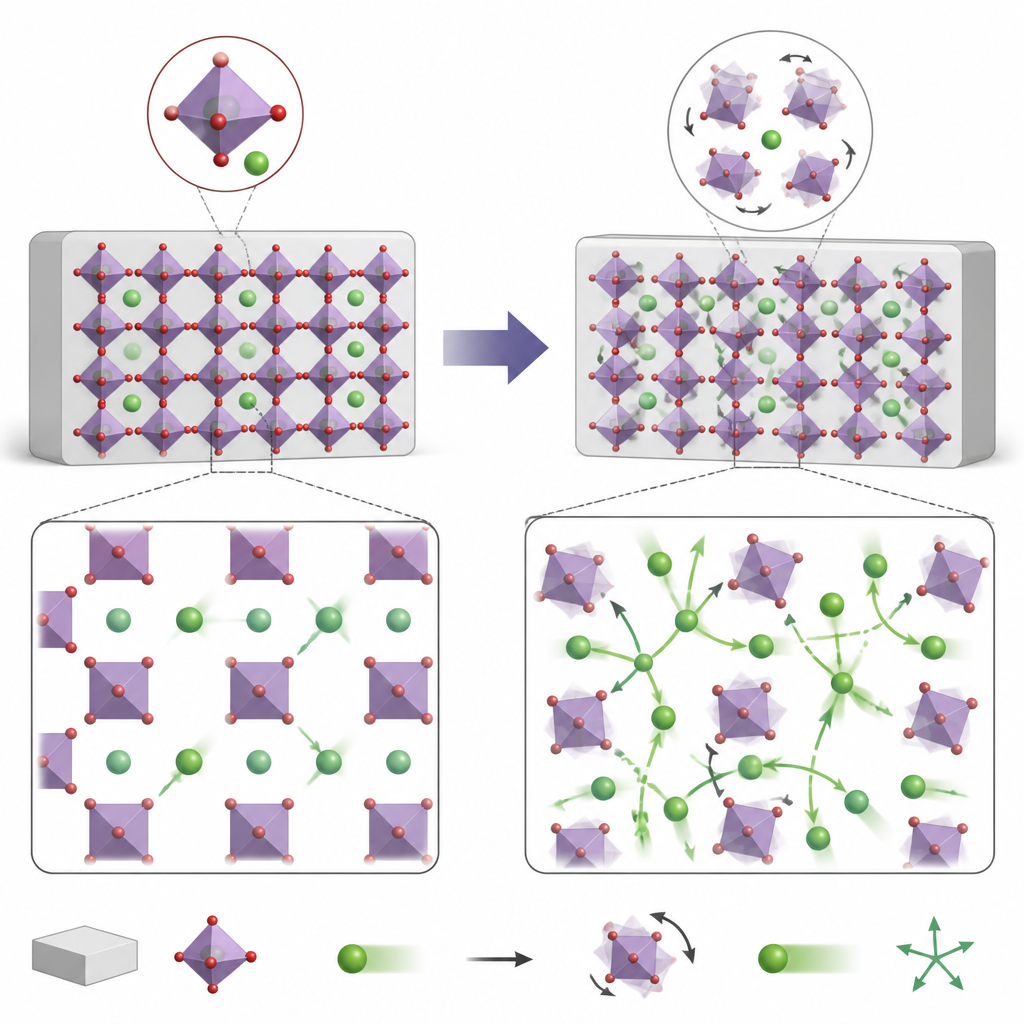
In most solid battery materials, scientists have focused on how atoms are arranged in rigid, repeating patterns. These arrangements create fixed channels for lithium ions to hop through. Some crystals are already "superionic," meaning lithium can move through them very quickly, but truly liquid-like motion of lithium is rare and not well understood. The authors revisited this problem and asked a different question: instead of changing only the static layout of atoms, what if you also engineer how parts of the material move and twist in time?
Letting atomic clusters rotate
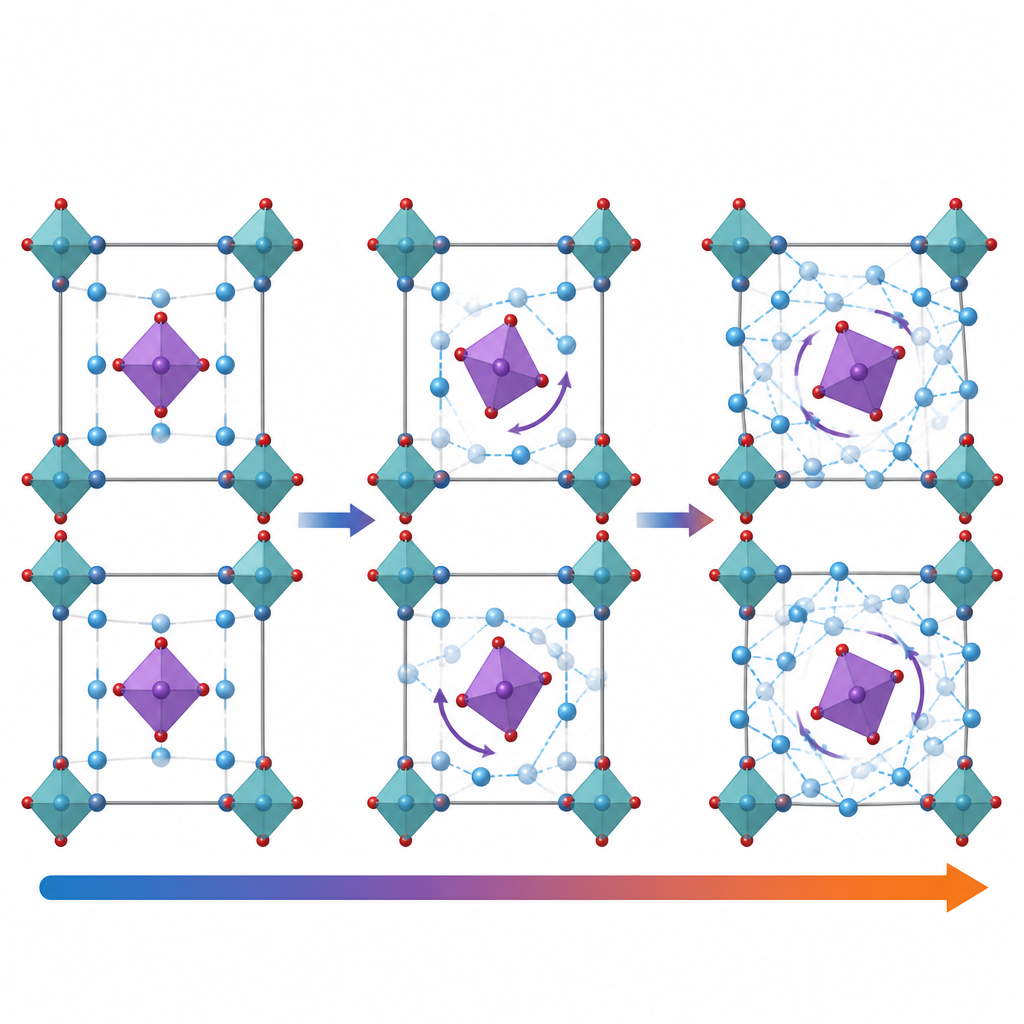
Inside many solids, negatively charged groups of atoms act like tiny molecular clusters. The team showed that when these clusters are free to rotate, they can scramble the usual tidy positions where lithium would normally sit. Using advanced computer simulations, they found that as these clusters begin to swing through large angles, they create extra, temporary resting spots for lithium ions. This makes the energy landscape that lithium feels more uneven but easier to cross, opening many short, low-barrier paths instead of a few rigid tracks. As a result, lithium starts to behave more like particles in a liquid, even though the material stays solid.
A simple rule to find good spinners
To turn this idea into a design tool, the researchers proposed a simple metric they call the rotation tolerance factor. This factor weighs how far the center of a cluster is from nearby lithium and from its own outer atoms, and also takes into account the cluster's mass and charge. Light, weakly charged clusters such as those containing SH or NH2 groups tend to rotate more easily. By scanning many possible crystal frameworks with this rule, the team identified candidate materials where these clusters should spin readily and stir up a highly disordered lithium sublattice.
Designing and testing faster conductors
Guided by their rotation-based rule, the authors designed several new halide and oxide materials in which these light clusters are built into known crystal frameworks. Simulations predicted that the rotating clusters would lower the energy barriers for lithium motion and greatly boost room-temperature conductivity, in some cases to tens of millisiemens per centimeter, which is very high for a solid. They then synthesized a practical version by adding a small amount of NH2 groups into an existing chloride material. Measurements confirmed that this modified solid conducts lithium about four times better than the original and supports stable cycling in all-solid-state test batteries using common cathode materials.
What this means for future batteries
Overall, the study argues that the path to better solid electrolytes is not only about packing atoms in the right pattern but also about encouraging the right kind of motion inside that pattern. Rotating clusters can deliberately scramble where lithium ions prefer to sit, giving them more options and smoother routes to travel. For non-specialists, the message is clear: by treating solid battery materials a bit more like dynamic machines than frozen blocks, researchers can unlock faster ion flow and move closer to safe, high-performance solid-state batteries.
Citation: Guan, C., Zong, J., Li, J. et al. Triggering dynamically disordered lithium sublattice in superionic conductors. Nat Commun 17, 4651 (2026). https://doi.org/10.1038/s41467-026-71304-3
Keywords: superionic conductor, solid-state battery, lithium diffusion, anion rotation, ionic conductivity