Clear Sky Science · en
Exploiting underpotential deposited hydrogen enables energy-efficient nitrate electroreduction to ammonia
Turning Waste into a Useful Resource
Ammonia is a cornerstone of modern agriculture and industry, but most of it is still made by the century‑old Haber–Bosch process, which consumes large amounts of fossil fuel and releases significant carbon dioxide. At the same time, nitrate pollution from fertilizers and industrial waste threatens rivers, lakes, and drinking water. This study explores a way to tackle both issues at once: using electricity to turn nitrate in alkaline water directly into ammonia, while using energy more efficiently and keeping costs competitive with today’s large chemical plants. 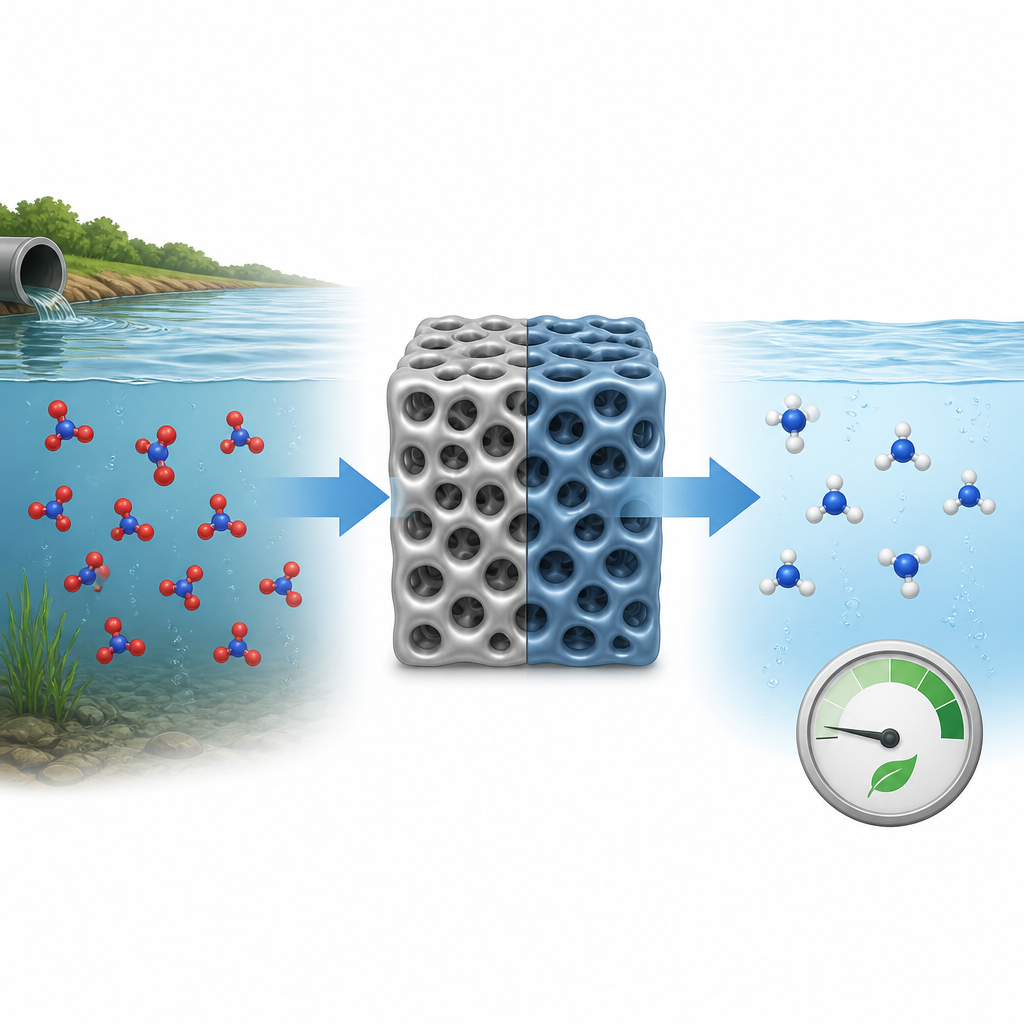
Why Ammonia and Nitrate Matter
Ammonia feeds billions of people through fertilizer and also serves as a potential clean fuel and industrial feedstock. The standard production route, however, accounts for a notable share of global carbon emissions and energy use. Nitrate, on the other hand, is a common contaminant in wastewater and agricultural runoff. Electrochemical devices powered by renewable electricity can, in principle, convert nitrate back into ammonia, closing the nitrogen loop. Existing systems can already produce ammonia at impressive rates, but they often waste energy and struggle to compete on cost with Haber–Bosch plants.
A New Catalyst that Behaves Like an Enzyme
The researchers designed a special solid catalyst made from silver and ruthenium metals arranged in a porous, three‑dimensional framework. Under the microscope, the silver forms a sponge‑like structure full of tiny cavities, while ruthenium coats the inner surfaces as an ultrathin layer. This layout mimics how enzymes guide molecules through narrow channels lined with different active sites. In this case, nitrate molecules first encounter silver regions that strip away oxygen and convert nitrate to nitrite, then travel to nearby ruthenium regions where they are further hydrogenated to ammonia. The team showed that silver and ruthenium remain as separate metallic phases sitting very close together, rather than mixing into a single alloy, which is key to their complementary roles.
Using Hidden Hydrogen for Efficient Conversion
A central idea of the work is to exploit a subtle form of hydrogen that sticks to metal surfaces at voltages more positive than those that usually produce hydrogen gas. This “underpotential” hydrogen acts as a ready store of protons on the ruthenium surface, which can be passed directly to nitrite and other reaction intermediates without wasting energy on bubbling hydrogen away. Experiments and computer simulations revealed that the electronic interaction between silver and ruthenium makes water split more easily on ruthenium, forming this surface hydrogen rapidly, while at the same time strengthening the binding of surface hydroxyl groups. Those hydroxyl groups help remove excess hydrogen by reforming water, keeping the ruthenium sites open just enough for nitrate and nitrite to land and react. 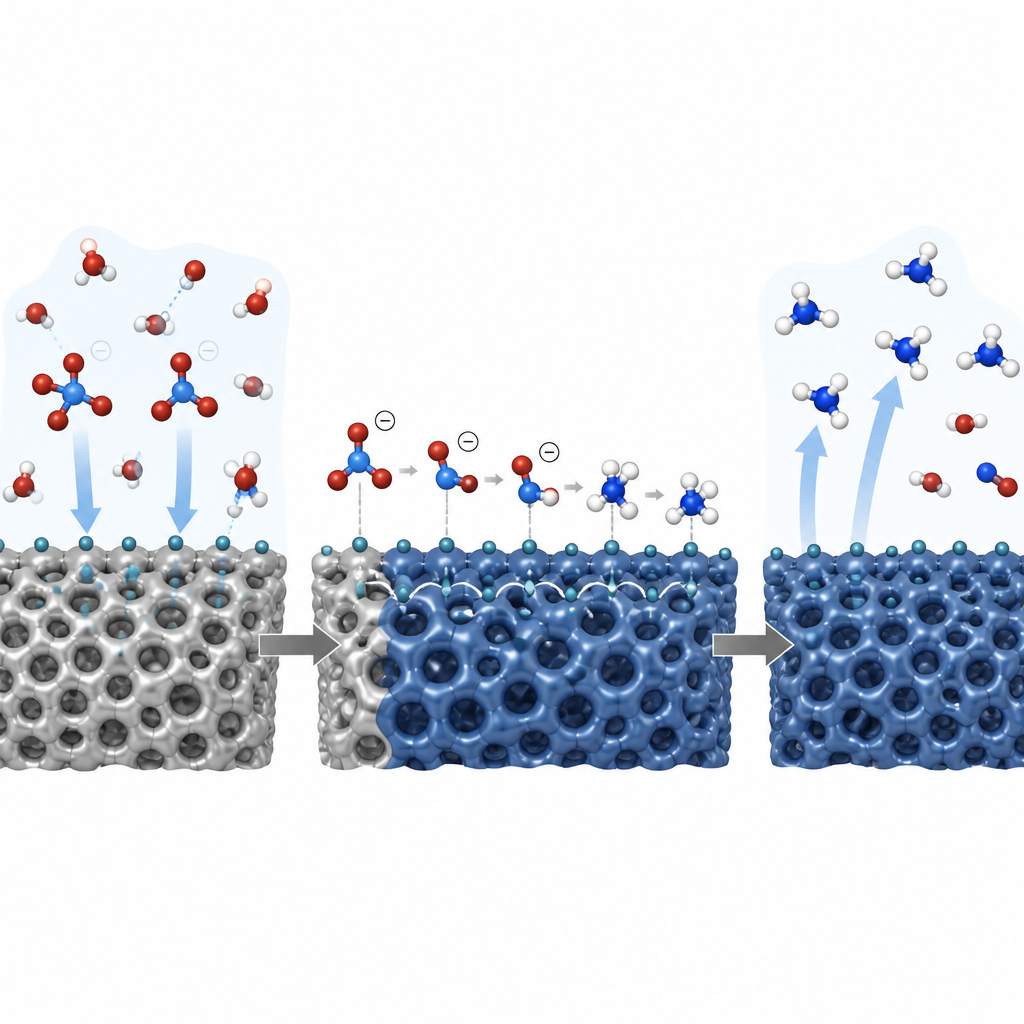
Performance in Clean Water and Wastewater
When tested in strongly alkaline solution, the silver–ruthenium catalyst achieved very high nitrate‑to‑ammonia conversion rates and nearly perfect selectivity toward ammonia across a wide range of nitrate concentrations, from trace levels to concentrated feeds. At modest applied voltages, the system reached a half‑cell energy efficiency of 53.7 percent, which is close to the benchmark set by the Haber–Bosch process, and sustained high performance even in complex simulated and real industrial wastewater. Pairing the nitrate‑reducing cathode with a hydrogen‑oxidizing anode in a flow cell allowed the device to run at industrially relevant current densities with low overall cell voltage, sometimes even with a slight net energy output when conditions were favorable.
Costs and Future Impact
Economic analysis indicates that, with the new catalyst and a hydrogen‑assisted cell design, the cost of electrochemically produced ammonia could fall below about 1.15 US dollars per kilogram, a typical price for conventionally produced ammonia. This holds over a wide range of operating currents and remains viable even when nitrate is collected from wastewater streams and hydrogen comes from natural gas, with or without carbon capture. By identifying how the strength of oxygen binding on ruthenium controls surface hydrogen use and nitrate adsorption, the study also proposes a practical guideline for designing better catalysts. For non‑specialists, the key message is that it may become possible to turn water‑borne nitrate pollution into valuable ammonia using electricity with competitive energy use and cost, helping to clean the environment while supplying an essential chemical.
Citation: Zhang, L., Liu, R., Liang, X. et al. Exploiting underpotential deposited hydrogen enables energy-efficient nitrate electroreduction to ammonia. Nat Commun 17, 4652 (2026). https://doi.org/10.1038/s41467-026-71299-x
Keywords: nitrate reduction, ammonia synthesis, electrocatalyst, silver ruthenium, wastewater treatment