Clear Sky Science · en
High-quality perovskite crystal for efficient and bright pure-blue light-emitting diodes with narrow emission
Why pure-blue light matters for screens
Every smartphone, TV, and laptop relies on tiny points of red, green, and blue light to create vivid images. While red and green pixels based on new perovskite materials already work very well, truly pure and bright blue light has remained a weak link. This study shows how carefully reshaping the tiny crystals inside perovskite light-emitting diodes can finally deliver sharp, efficient pure-blue light that is well suited for future high-quality displays.
From promising material to real-world blue pixels
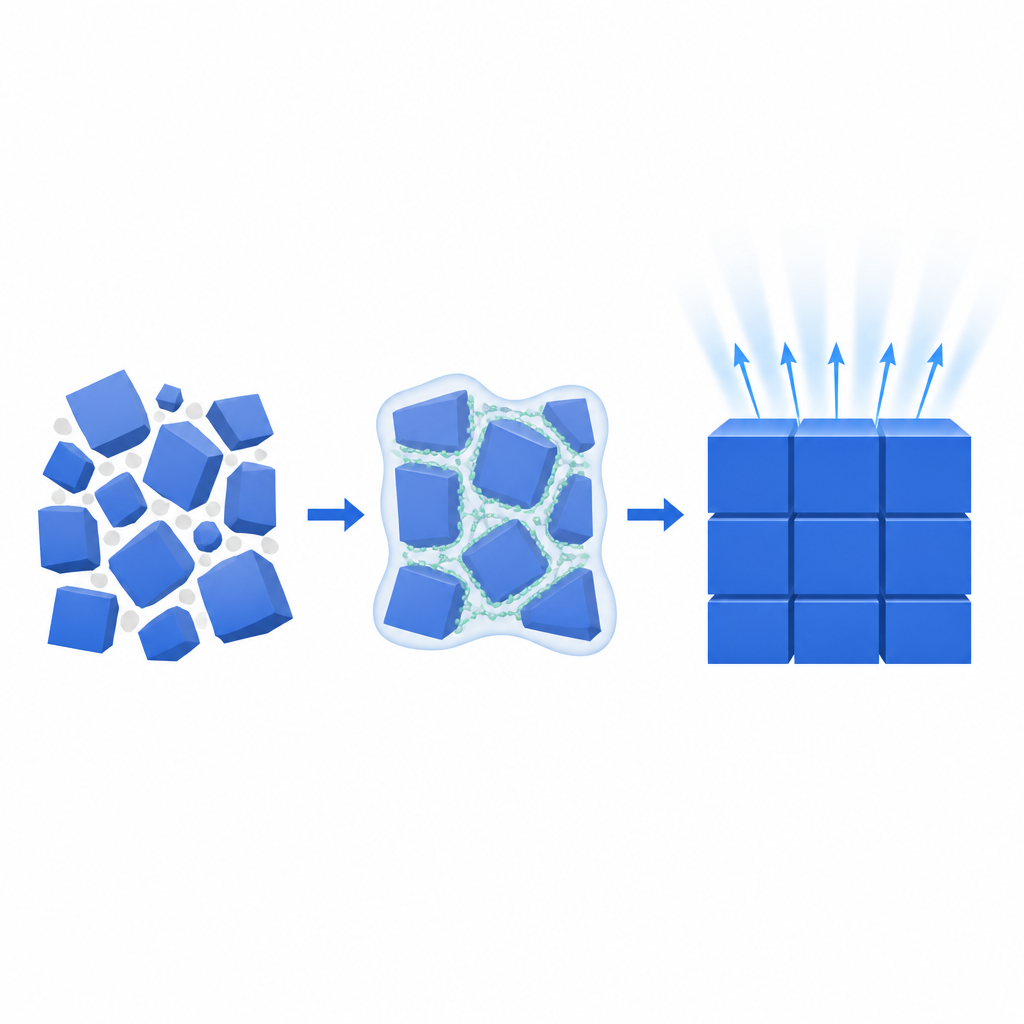
Metal halide perovskites are a class of materials that can be made from solution at low cost and can shine with intense, narrowly colored light. Green and red perovskite devices now rival commercial display technologies. Blue, however, is much harder. Conventional blue perovskite devices tend to be dimmer, less efficient, and their color often spreads over a wider range of wavelengths, which blurs color purity. The main culprit is the microscopic structure of the perovskite films, where random crystal faces and defects act as traps that waste energy and broaden the emitted light.
Guiding crystal growth in the right direction
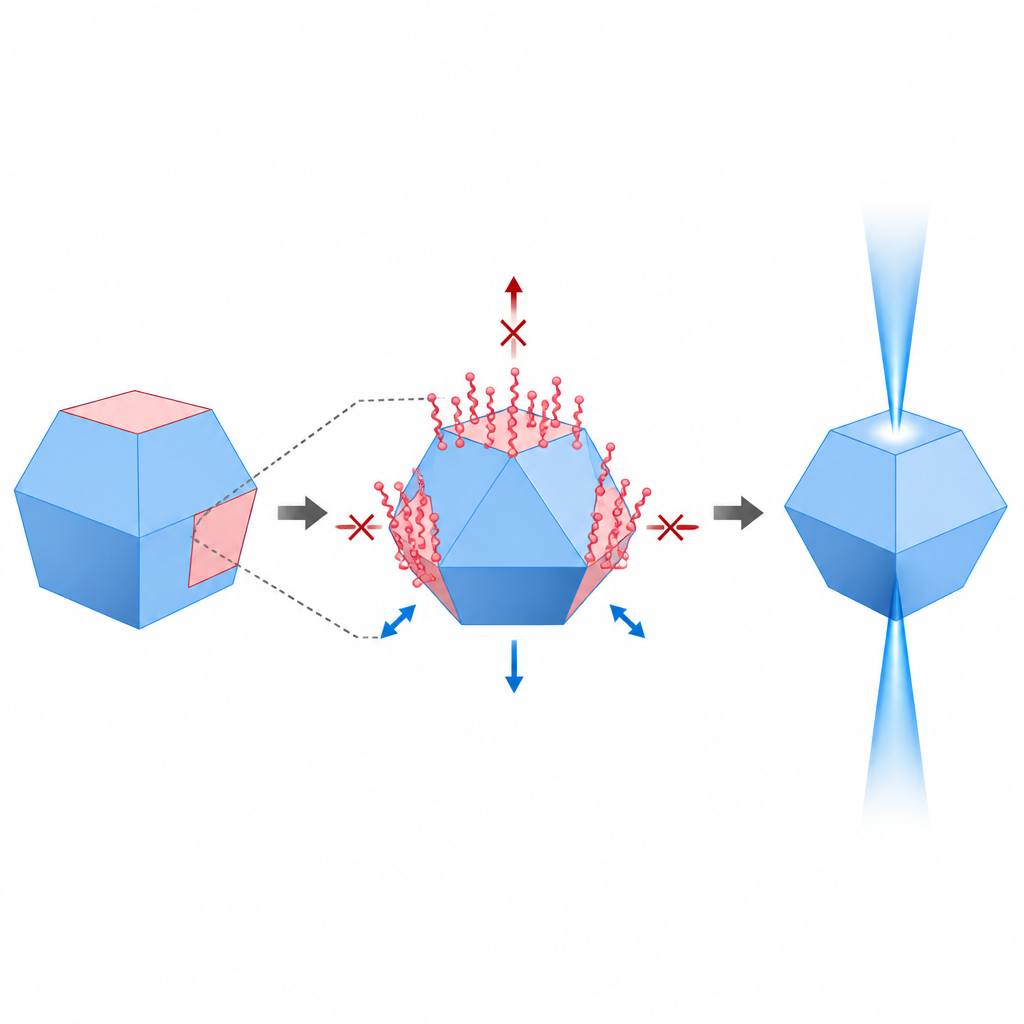
The researchers tackled this problem not by changing the basic recipe of the perovskite, but by guiding how its crystals grow. They introduced a helper molecule called BAPEG during film formation. This molecule sticks more readily to certain crystal faces that are prone to defects and leaves other faces, which naturally have fewer defects, more exposed to incoming building blocks. As the film crystallizes, growth along the defective faces is slowed, while growth along the more stable faces is favored. The result is a film made of more regular, cube-like grains whose surfaces are dominated by lower-defect faces, rather than a patchwork of irregular facets.
Cleaner crystals mean better blue light
To see whether this guided growth really improves the material, the team probed how light and charge behave inside the treated films. They found that light excited in these crystals survives much longer before fading, and that fewer charge carriers are lost to non-glowing traps. Measurements showed that the density of such trap states drops by more than three quarters compared with untreated films. At the same time, the bound pairs of charges that produce light become more stable, which encourages them to recombine by emitting photons instead of drifting apart. Together, these changes roughly double the fraction of absorbed energy that comes back out as light.
Turning improved films into brighter devices
When built into practical light-emitting diodes, the guided-growth films translate their cleaner physics into better performance. The pure-blue devices emit light centered around 473 nanometers with an exceptionally narrow color spread of only 14 nanometers, giving sharp color purity. They reach an external quantum efficiency of 14 percent at a relatively high brightness level and achieve peak brightness over 8,000 candelas per square meter, ranking among the best pure-blue perovskite devices based on three-dimensional crystals. The same strategy also boosts sky-blue devices, which show even higher efficiencies and brightness while keeping their emission narrow. The improved crystals also slow down degradation, extending the working lifetime and keeping the color stable over time.
What this means for future displays
For a non-specialist, the key message is that by teaching perovskite crystals to grow in a tidier way, the authors have turned a promising but troublesome material into a much more practical source of pure-blue light. Their facet-guided growth method sharply reduces energy-wasting defects and stabilizes the light-emitting states, leading to blue pixels that are bright, efficient, and color-true even at high brightness. This moves perovskite technology closer to powering next-generation displays with richer colors and lower power use.
Citation: Chen, H., Ren, Z., Yu, Y. et al. High-quality perovskite crystal for efficient and bright pure-blue light-emitting diodes with narrow emission. Nat Commun 17, 4697 (2026). https://doi.org/10.1038/s41467-026-71292-4
Keywords: perovskite LEDs, blue light, display technology, crystal growth, light-emitting diodes