Clear Sky Science · en
Light-induced bimerons in a chiral magnet
Writing Tiny Magnetic Whirls with Light
Modern computers move information using electric charges, which wastes energy as heat. Physicists are exploring new ways to store and move data using stable, swirling patterns of magnetism that behave like particles. This study shows that ultrafast laser flashes can reliably "write" a special kind of magnetic whirl, called a bimeron, into a thin crystal at room temperature, and that these whirls can be tuned with a modest magnetic field. The work points toward future low-energy memory and logic devices that are controlled by light instead of wires.
Little Magnetic Knots as Information Carriers
In some magnets, the tiny atomic magnets do not all line up; instead, they twist into miniature whirlpools called topological spin textures. Because the twists cannot be undone without a major rearrangement, these structures are unusually stable and can act like robust information bits. The best-known examples are skyrmions, which are round whirls in magnets whose preferred direction is out of the plane. In magnets where spins prefer to lie in the plane, related objects called merons and bimerons can form. A bimeron is effectively a bound pair of half‑whirls that together behave like a particle. They are attractive for future electronics and spintronics because they can, in principle, be moved by small electrical currents, packed densely, and used at the nanoscale without easily falling apart.
Using Laser Flashes to Create Magnetic Whirls
The researchers worked with thin plates of a chiral magnet made of cobalt, zinc, and manganese (Co8Zn8Mn4). In this material, an internal twisting interaction naturally favors spiral magnetic patterns, and the magnet remains ordered above room temperature. The team shaped thin slabs only 90–200 nanometers thick and observed their magnetism directly inside a transmission electron microscope that can image magnetic structures. They then fired single femtosecond (one‑quadrillionth of a second) laser pulses at the sample. Each pulse heated the magnet extremely quickly, temporarily disrupting its orderly pattern and driving it into a disordered, high‑energy state. As the sample cooled within billionths to millionths of a second, the magnetization re‑organized, and stable bimerons emerged as the system relaxed.
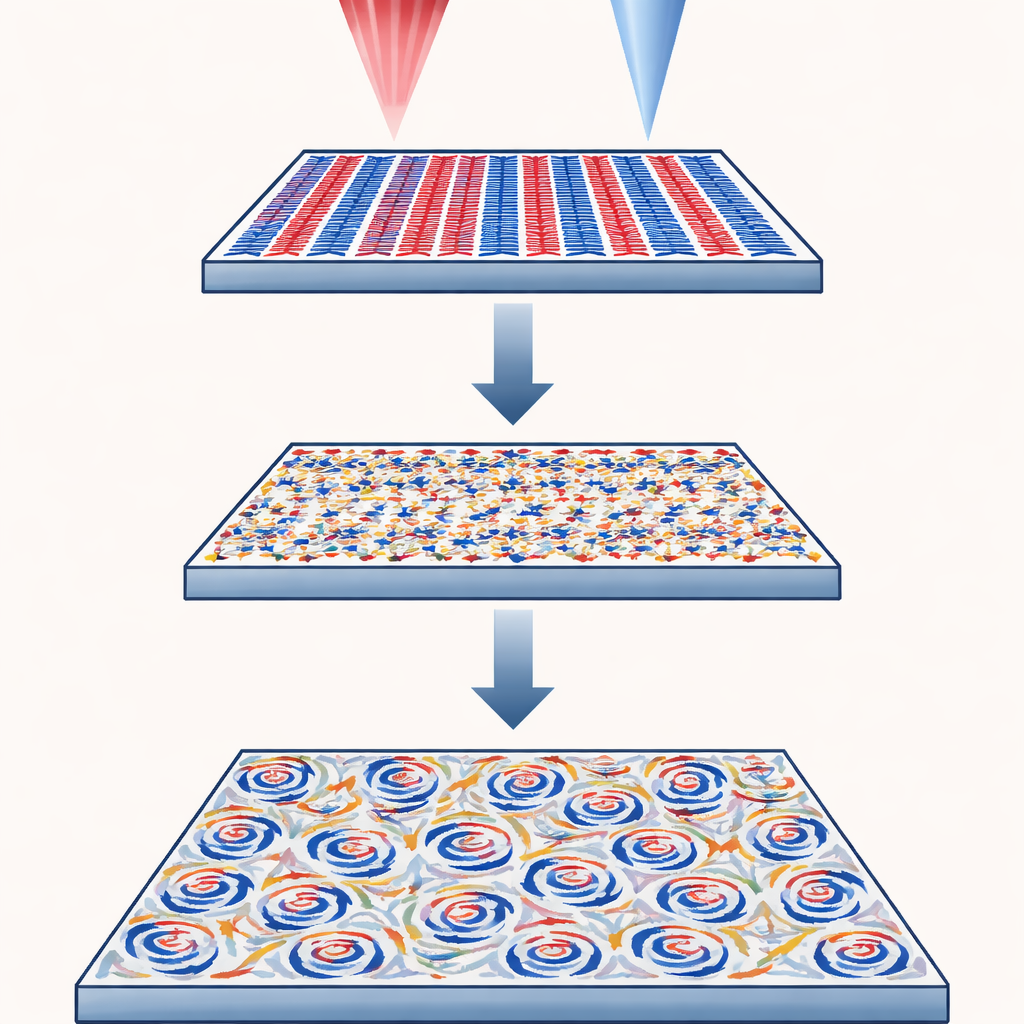
Tuning Bimerons with a Gentle Magnetic Field
By applying a small magnetic field perpendicular to the thin plate, the team could steer which type and how many bimerons formed. At zero field, the laser pulses produced a mixture of two mirror‑image bimerons. Even modest fields of only a few tens of millitesla tipped the energy balance so that one type became more favorable and dominated the pattern. As the field increased, the number of bimerons first grew to a maximum and then declined, disappearing beyond a threshold field. Careful experiments on plates of different thicknesses showed that, despite changes in how the patterns looked in the microscope, the underlying three‑dimensional magnetic twists were topologically the same. In other words, the essential “knot type” of the bimeron did not depend on how thick the plate was.
Zooming In on the Internal Magnetic Structure
Alongside the imaging, the team ran detailed computer simulations of the magnet’s behavior using a micromagnetic model that included the twisting interaction, ordinary magnetic stiffness, and the influence of sample shape. They also accounted for a thin, damaged surface layer created during fabrication, where the twisting interaction is reduced. Starting from a random arrangement of spins, the simulations relaxed toward low‑energy states and produced bimeron patterns that closely matched the experimental images, both in density and in contrast. The calculations revealed how each bimeron is built from two linked merons with different shapes, and how, as the field increases, the surrounding magnetic background gradually straightens from a tilted, cone‑like pattern toward a fully uniform state.
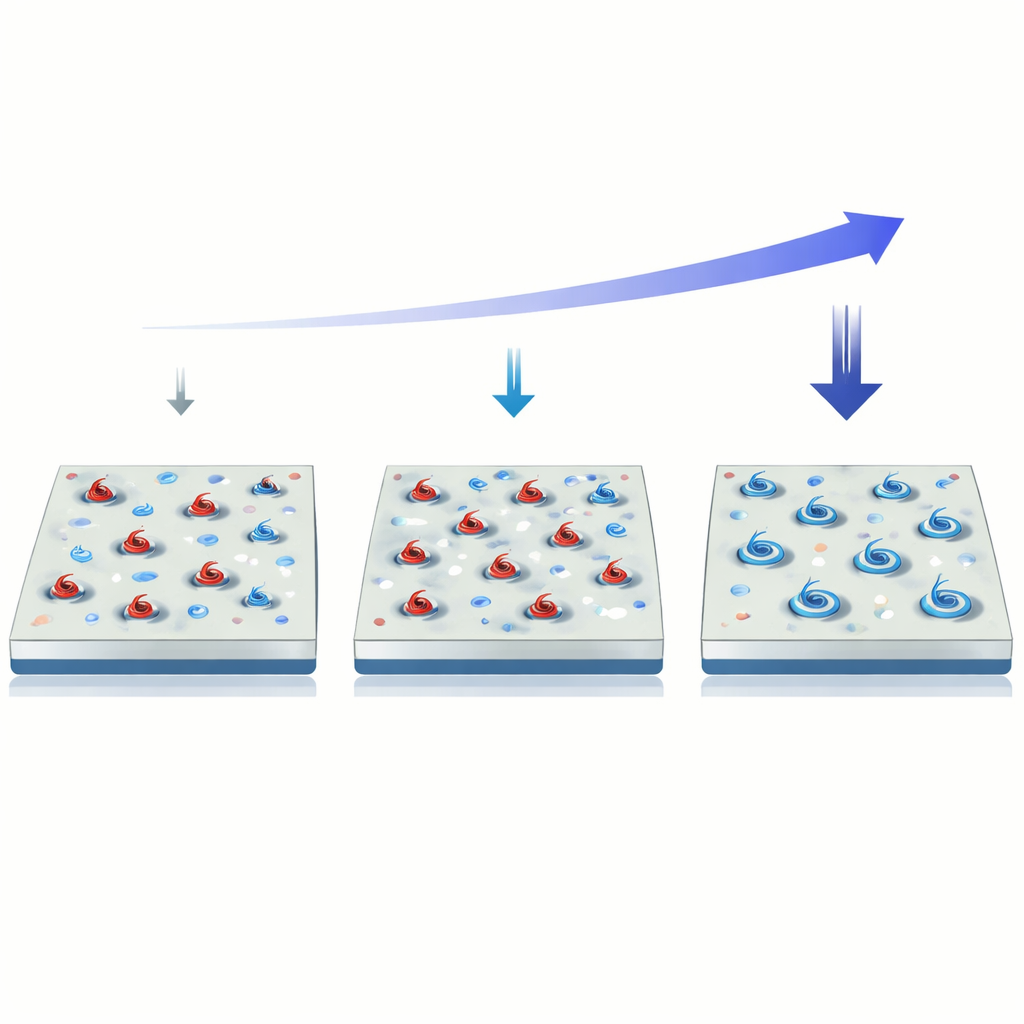
From Bimerons to Skyrmions and Future Devices
By pushing the magnetic field higher in the simulations, the researchers observed a smooth transformation from bimerons into more symmetrical skyrmions once the surrounding magnetization became fully aligned. In the real experiment at room temperature, thermal fluctuations caused the bimerons to collapse before this final transition could be seen, but the agreement between theory and measurement supports a unified picture that treats bimerons and skyrmions as closely related topological objects. Overall, the work demonstrates that a single ultrafast light pulse can reliably write controllable patterns of bimerons in an in‑plane magnetized film. This optical control of durable magnetic knots represents a key step toward future memory and computing technologies that use light and magnetism to process information with far less energy than today’s electronics.
Citation: Zhu, K., Rybakov, F.N., Wang, Z. et al. Light-induced bimerons in a chiral magnet. Nat Commun 17, 3185 (2026). https://doi.org/10.1038/s41467-026-71291-5
Keywords: bimerons, ultrafast laser, topological magnetism, spintronics, skyrmions