Clear Sky Science · en
High-mobility inertial domain walls driven by spin-transfer torque in a ferrimagnetic spinel oxide
Racing walls inside future memory chips
Modern gadgets depend on memory that can switch quickly while wasting as little energy as possible. This study explores a special magnetic material where invisible boundaries inside the magnet, called domain walls, can be pushed at record speeds by short electrical pulses. Understanding and controlling these tiny moving walls could lead to faster, cooler-running memory and logic chips that store and process information in new ways.
A new kind of magnetic racetrack
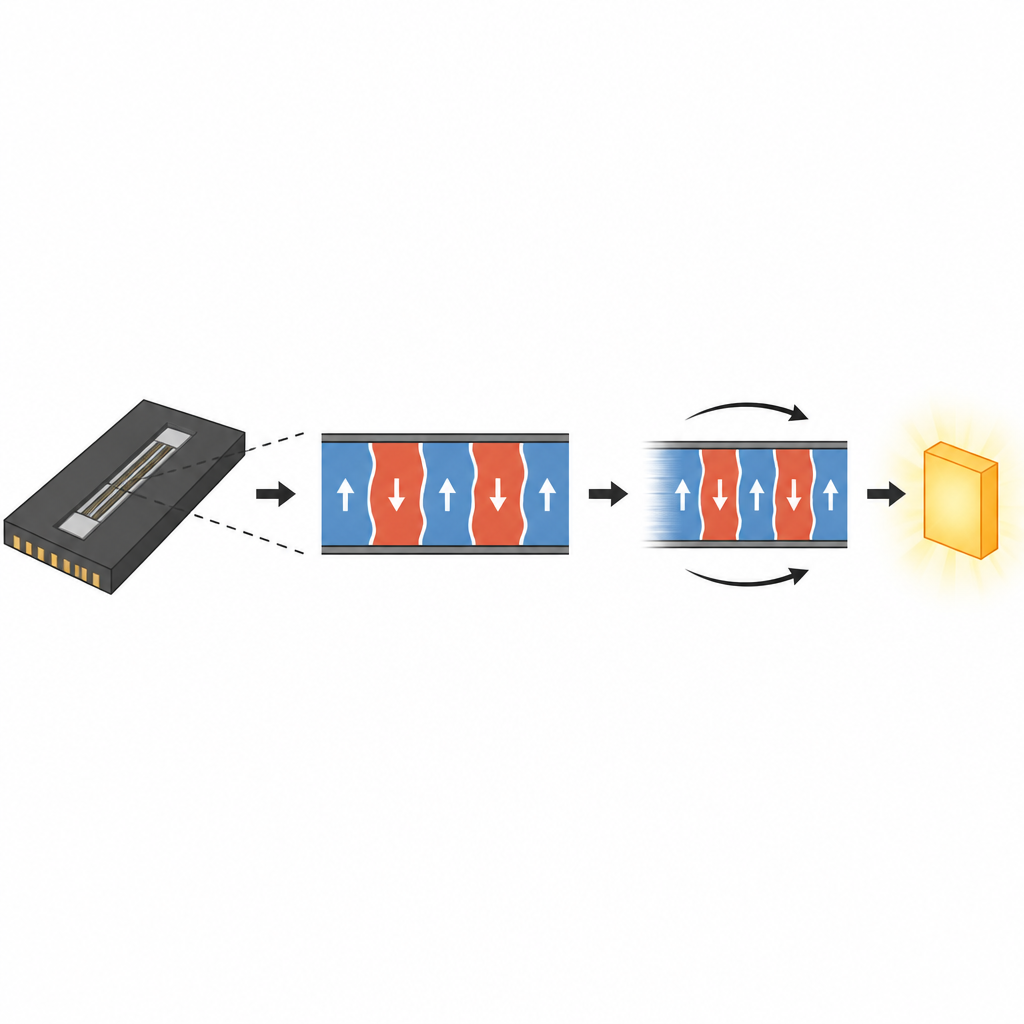
Engineers have long dreamed of “racetrack memory,” where bits of information are stored as magnetic regions along a narrow strip and are shifted back and forth instead of being physically moved. The challenge is to slide these regions quickly using modest electrical currents. In this work, the authors focus on a ferrimagnetic oxide called NiCo2O4, grown as an ultrathin film on a crystal substrate. This material combines low overall magnetization with high electrical conductivity and highly polarized electron spins, ingredients that theory predicts should allow domain walls to move swiftly with little energy loss.
Seeing the hidden magnetic boundaries
Before pushing the walls around, the team first needed to understand their shape and internal twist. They used a scanning sensor based on a single defect in diamond to map the tiny magnetic fields above the film with nanometer precision. By fitting these field maps, they found that the walls are of a Bloch type, meaning the magnetization turns sideways as one crosses the wall. The measurements also showed that another interaction that often twists walls into a different form is essentially absent here. This well-behaved wall structure helps make the motion more predictable when current is applied.
Pushing walls with gentle electric flows
To drive the walls, the researchers sent short current pulses along patterned strips of the material and watched the resulting motion with a microscope that detects small changes in reflected light. They observed walls moving in the direction of the current with speeds above one kilometer per second at a current density that is lower than in many competing materials. Even more striking, walls began to move at clearly measurable speeds under currents that are one to two orders of magnitude weaker than those typically required. By carefully comparing motion for opposite current directions and magnetic fields, the team showed that the walls are moved mainly by spin-transfer torque, a process in which the spins of the electrons in the current push on the local magnetization.
Inertia and efficient motion at the nanoscale
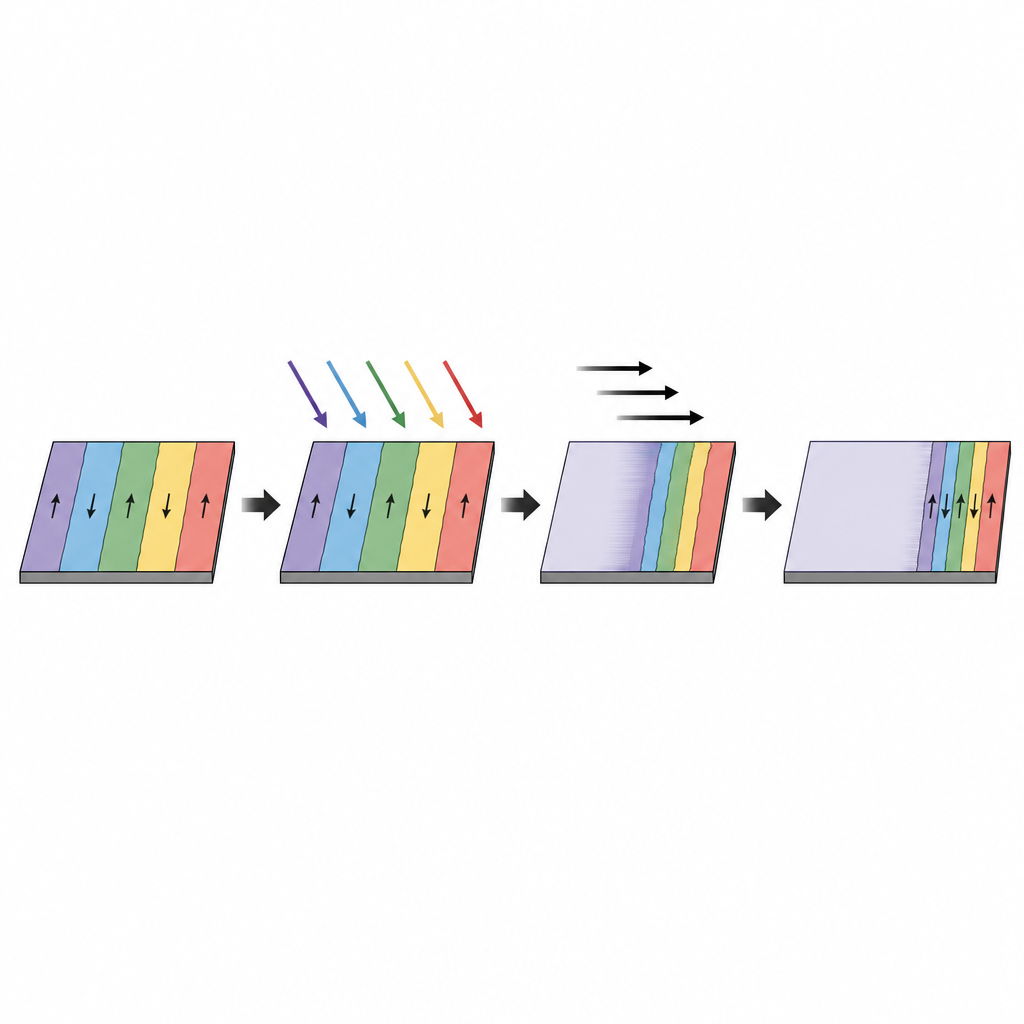
When the current pulse ends, the walls in this material do not stop instantly. Instead, they keep sliding for about a billionth of a second, a sign that they have inertia much like a tiny object with mass. By varying the pulse length, the researchers could see that shorter pulses actually produced higher average speeds, because much of the motion happened after the pulse was turned off. This behavior allowed them to estimate how quickly the walls accelerate and slow down, revealing a characteristic time of about one nanosecond, shorter than values seen in many ferromagnets. From these measurements they also extracted parameters showing that the non-adiabatic part of the torque, which is especially strong in ferrimagnetic systems, is unusually large in this oxide.
What this means for future devices
Putting these findings together, NiCo2O4 stands out as a material where domain walls move very fast under relatively low currents, and where their inertia and internal structure are now quantitatively understood. When compared with other metals and oxides used for similar devices, this spinel oxide offers an attractive balance between speed and energy cost for shifting bits along a magnetic racetrack. Because it also supports optical control with ultrafast laser pulses, this class of ferrimagnetic spinel materials could underpin future memory and computing technologies that blend electrical and optical control of magnetism.
Citation: Wu, M., Ding, S., van Schie, L. et al. High-mobility inertial domain walls driven by spin-transfer torque in a ferrimagnetic spinel oxide. Nat Commun 17, 4672 (2026). https://doi.org/10.1038/s41467-026-71290-6
Keywords: spintronics, domain wall motion, ferrimagnetic oxide, spin transfer torque, racetrack memory