Clear Sky Science · en
Synergistic dual anion regulation unlocks giant thermopower and power density in hydrogel
Turning Gentle Warmth into Useful Power
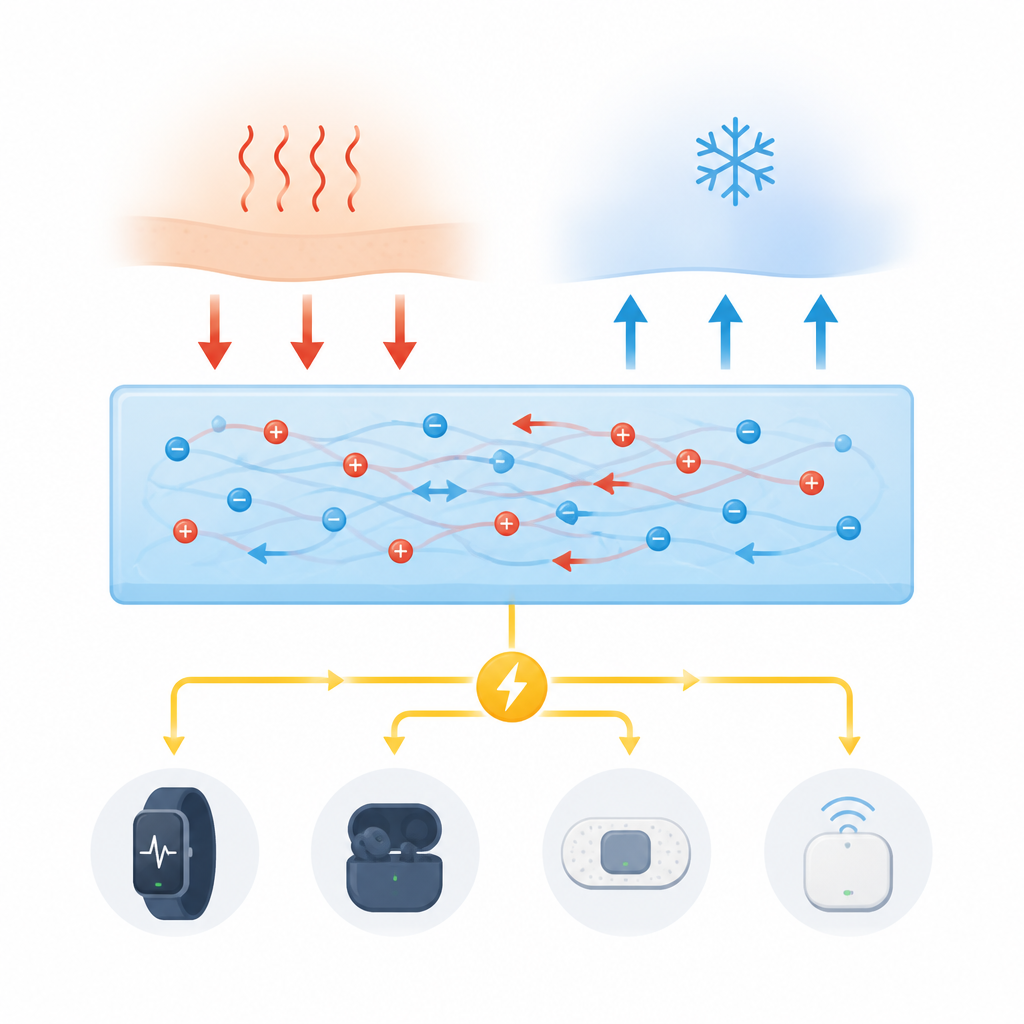
Warmth from your skin, a cup of coffee, or a sunlit window usually drifts away unused. This study shows how a soft, flexible gel can capture that mild heat and turn it into electricity strong enough to power small gadgets, opening doors for self-powered wearables and sensors that quietly run on everyday temperature differences.
Why Low-Level Heat Is Hard to Use
Low-grade heat, below the boiling point of water, is everywhere in homes, factories, and even inside our bodies. Yet most technologies struggle to convert it into electricity efficiently. Traditional solid-state thermoelectric materials are rigid, expensive, and often deliver only tiny voltages per degree of temperature difference. Liquid-based cells that rely on ions moving or changing their chemical state can do better, but they tend to leak, and their voltages are still modest. A big roadblock is that the ions in these systems are not selective enough, and the differences in their concentration across the device are usually small, limiting the electrical signal that can be harvested.
A Smart Gel That Grabs the Right Ions
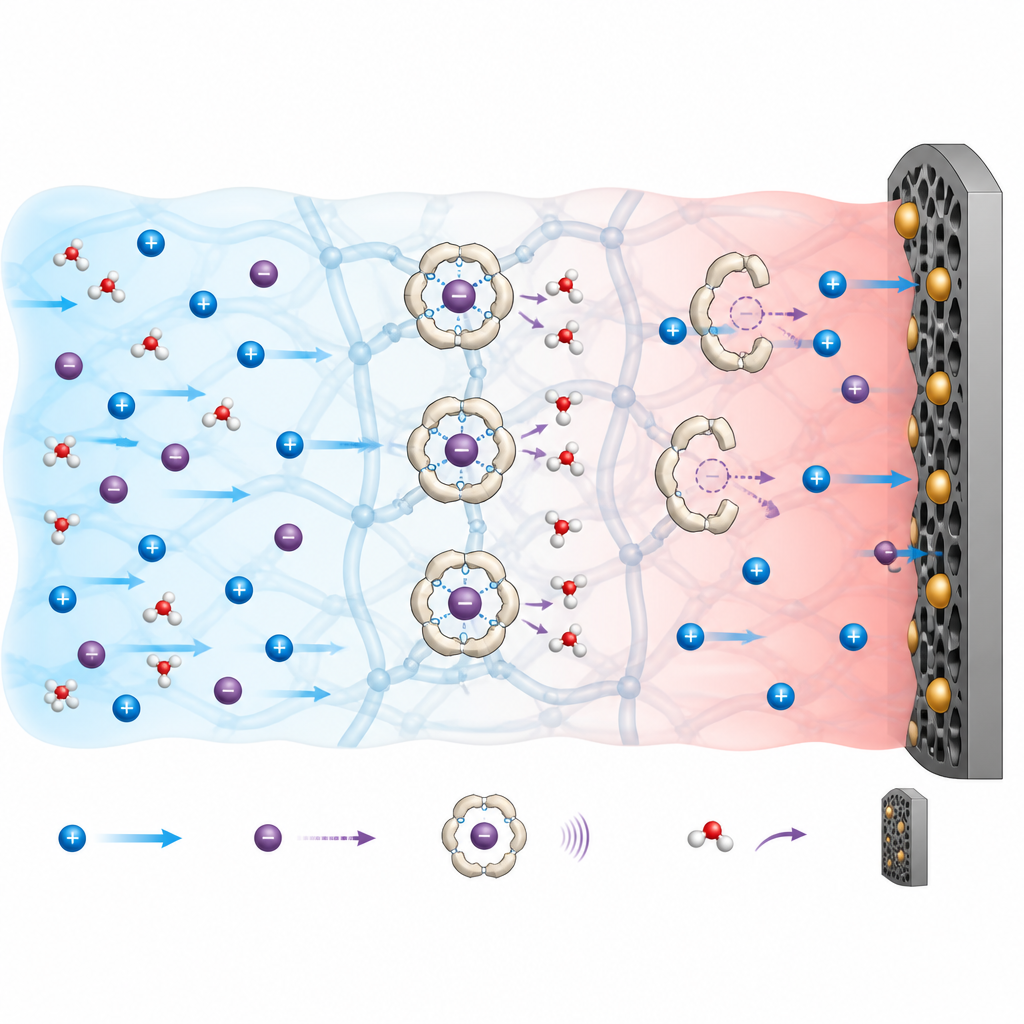
The researchers tackled this problem with a hydrogel, a water-rich, jelly-like material made from polyvinyl alcohol, into which they built a kind of molecular trap. These trap molecules, called calix[4]pyrroles, sit inside the gel and are tuned to grab specific negatively charged ions from a redox pair based on iron and cyanide, as well as simple chloride ions from salt. When a temperature difference is applied across the gel, these traps preferentially capture one partner of the redox pair and hold it in place. This changes both where the ions are located in the gel and how freely they can move, creating strong imbalances that the device converts into a much larger voltage than usual.
Two Heat-Driven Effects Working Together
Inside the gel, two key processes cooperate. First, when the traps bind to certain negative ions, they strip away some of the water that normally surrounds those ions. This “drying” step reshuffles the disorder in the system and increases the entropy difference between the two redox states, which directly boosts the voltage generated during the redox reaction at the electrodes. Second, by holding back specific negative ions while leaving the positive ions relatively mobile, the gel produces a strong mismatch between how fast each type of ion drifts under the temperature gradient. This enhanced imbalance strengthens the thermodiffusion contribution to the voltage. Experiments and computer simulations together show that chloride motion is slowed dramatically while potassium ions remain agile, and that these entropy and mobility changes track how the traps bind and release ions at the cold and hot ends of the device.
High Output from a Soft, Stable Device
By carefully balancing the salt content, the redox couple, and the number of trap molecules, the team created a quasi-solid cell that reaches a thermopower of 8.1 millivolts per degree Kelvin, several times higher than comparable systems. Power density increased roughly twenty-fold relative to a similar gel without the dual-ion control strategy. Because the traps also make the gel network tougher through extra bonding, the material stretches, lifts heavy weights, and survives repeated bending. Arrays of these gel blocks were built into wearable demonstrations: strips on a mask that sense breathing, small blocks that act as touch-driven human–computer interfaces, and patches that monitor changes in body temperature strongly enough to trigger a light as a fever warning. Larger arrays powered a temperature and humidity meter and light-emitting diodes using only a small temperature difference.
What This Means for Everyday Energy Use
In plain terms, the study shows that giving ions a carefully designed “traffic system” inside a soft gel can dramatically increase how much electricity we can squeeze out of small temperature differences. By trapping some ions while letting others move freely, and by using heat itself to switch this trapping on and off, the gel turns gentle warmth into a surprisingly strong and stable electrical output. This dual-control approach points toward practical, leak-free, and flexible thermoelectric materials that could one day help power sensors, wearables, and building components simply by using the low-level heat that already surrounds us.
Citation: Li, H., Gu, Z., Zhu, Y. et al. Synergistic dual anion regulation unlocks giant thermopower and power density in hydrogel. Nat Commun 17, 4592 (2026). https://doi.org/10.1038/s41467-026-71285-3
Keywords: ionic thermoelectric, hydrogel, low grade heat, wearable energy harvesting, thermogalvanic cell