Clear Sky Science · en
Reversible phase-transformation-induced thermal quenching in Mn(II) chlorides for high-precision information encryption and thermal energy storage
Glowing crystals that hide messages and store heat
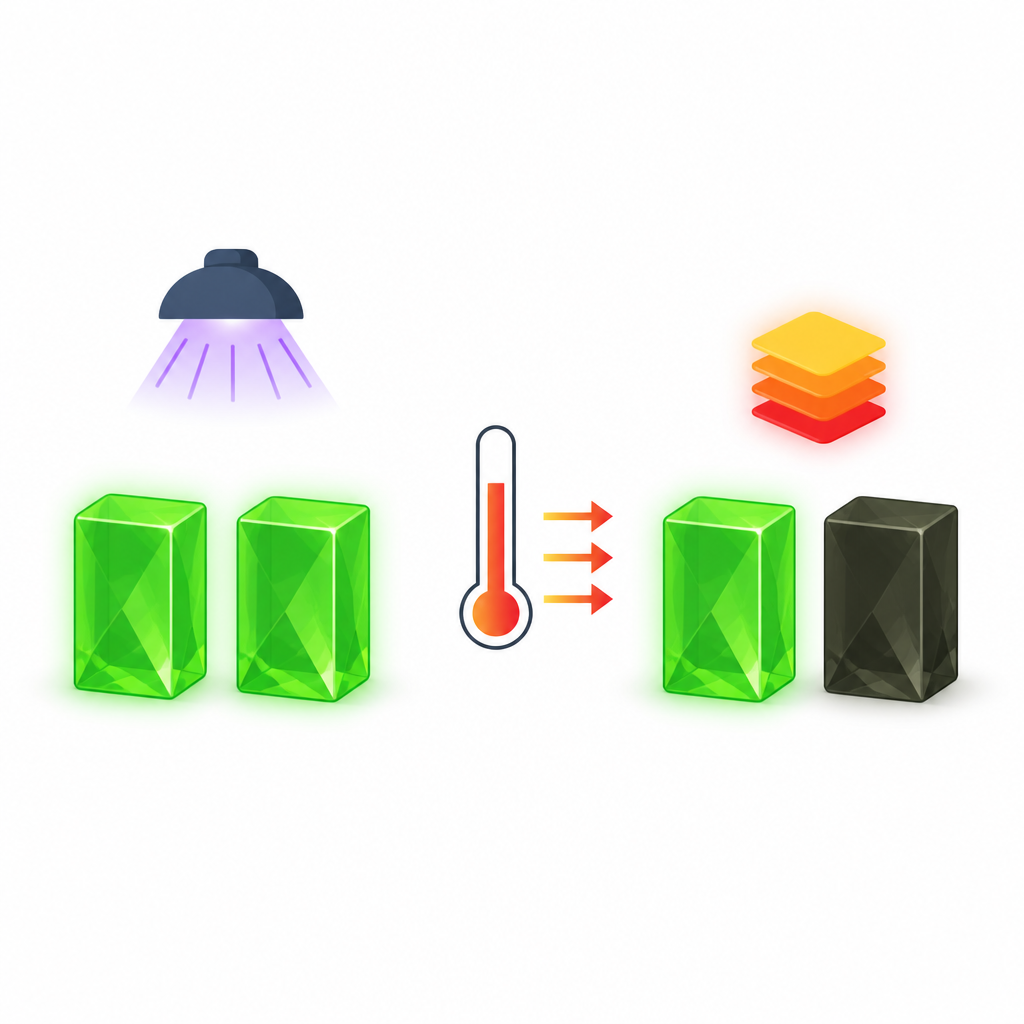
Imagine a material that glows bright green under ultraviolet light, turns dark at just the right warmth, and then lights up again when cooled. In this study, researchers create such crystals and show how they can both hide sensitive information in temperature-controlled patterns and visually signal when heat has been stored or released, offering a glimpse of future smart labels and energy devices.
Why secure messages need smarter light
As digital data and fake products spread across the globe, there is growing interest in simple, on-the-spot ways to check if something is genuine. One route uses glowing materials whose light can be switched on and off by outside triggers such as light, pressure, chemicals, or temperature. Many of these systems, however, need very careful control of lighting or show slow and fuzzy changes, which limits how much information they can safely encode. The authors set out to build a luminescent material whose response to temperature is sharp, repeatable, and easy to see with the naked eye.
Two nearly twin crystals with a crucial difference
The team designed and grew two closely related hybrid crystals that combine organic molecules with manganese and chlorine atoms. At room temperature, both crystals form well ordered structures where isolated manganese chloride units act as tiny light sources. Under ultraviolet light, each crystal shines a nearly identical bright green, with very high efficiency, so our eyes cannot tell them apart. By slightly lengthening the carbon chain of the organic part in one crystal, the researchers nudged its internal interactions and, as they discovered, its temperature at which a sudden structural change appears.
A narrow temperature window that turns light off
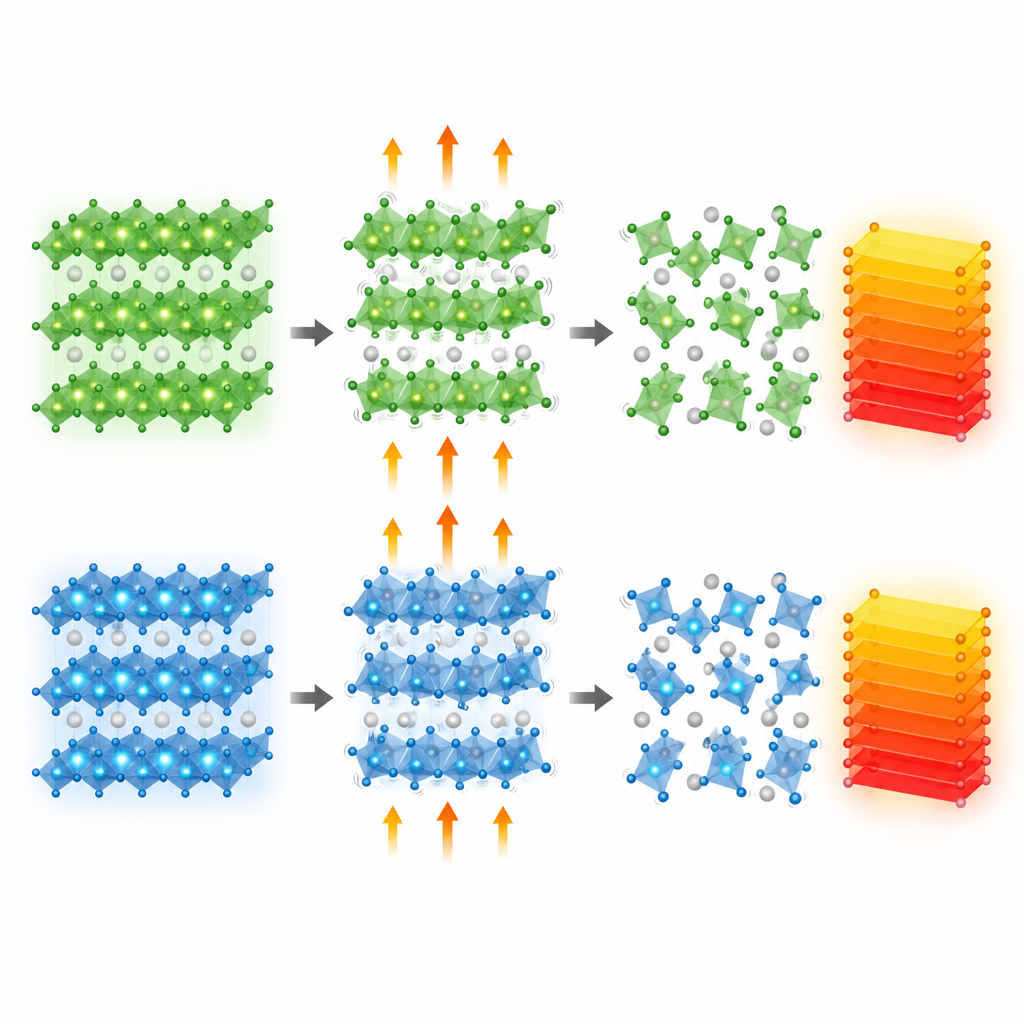
When the crystals are gently heated, their green glow first becomes stronger, then, at a specific point, collapses almost instantly. For one crystal, this abrupt “light off” point is around 60 degrees Celsius; for the other, it is about 10 degrees higher. Careful measurements show that this switch is tied to a reversible change from an ordered to a more disordered solid form, not to any chemical breakdown. As the internal order breaks, energy that once escaped as green light is instead lost as heat, quenching the glow. On cooling back to room temperature, the structure slowly regains order and the green emission returns, even after many repeated cycles.
Hiding codes and QR patterns in temperature
Because the two crystals stop glowing at slightly different temperatures, the researchers can arrange them in dots and squares that encode hidden patterns. Below the lower switching temperature, both types shine and any pattern looks uniformly bright. Within the narrow ten-degree window between the two switch points, one crystal goes dark while the other stays bright, revealing the true pattern or number sequence. Above the higher switching point, both again appear dark and the message disappears. The team demonstrated this idea with a temperature-controlled QR code that only becomes scannable when warmed to the right range, then vanishes on further heating and recovers slowly on cooling, making guessing and repeated trials difficult.
Seeing stored heat with your own eyes
The same structural change that turns off the light also absorbs a large amount of heat, which is later released as the structure reorders. The measured heat storage capacity rivals or exceeds that of many solid materials already studied for thermal energy storage. Because the light output switches cleanly between on and off at the phase change, the crystals themselves act as visual gauges of whether heat is still being absorbed or has been fully stored and is ready to be released. This direct link between glow and heat suggests new kinds of thermal “batteries” whose charge state can be checked at a glance.
What this means for future smart materials
In simple terms, the authors show that by fine-tuning the building blocks of these manganese-based crystals, they can engineer a tight temperature window where light is sharply switched off and back on, while also capturing and releasing heat. This twin function allows the same material to serve as a high-precision temperature key for secure optical codes and as a visual indicator for heat storage devices. The work points toward a new class of smart solids that merge information security and energy management in a single, easy-to-read platform.
Citation: Li, A., Chen, Z., Wang, Z. et al. Reversible phase-transformation-induced thermal quenching in Mn(II) chlorides for high-precision information encryption and thermal energy storage. Nat Commun 17, 4665 (2026). https://doi.org/10.1038/s41467-026-71277-3
Keywords: optical information encryption, thermo-responsive luminescence, phase change materials, anti-counterfeiting, thermal energy storage