Clear Sky Science · en
Ultrahigh energy-storage in lead-free ceramic capacitors via local structure design
Why tiny parts for big power matter
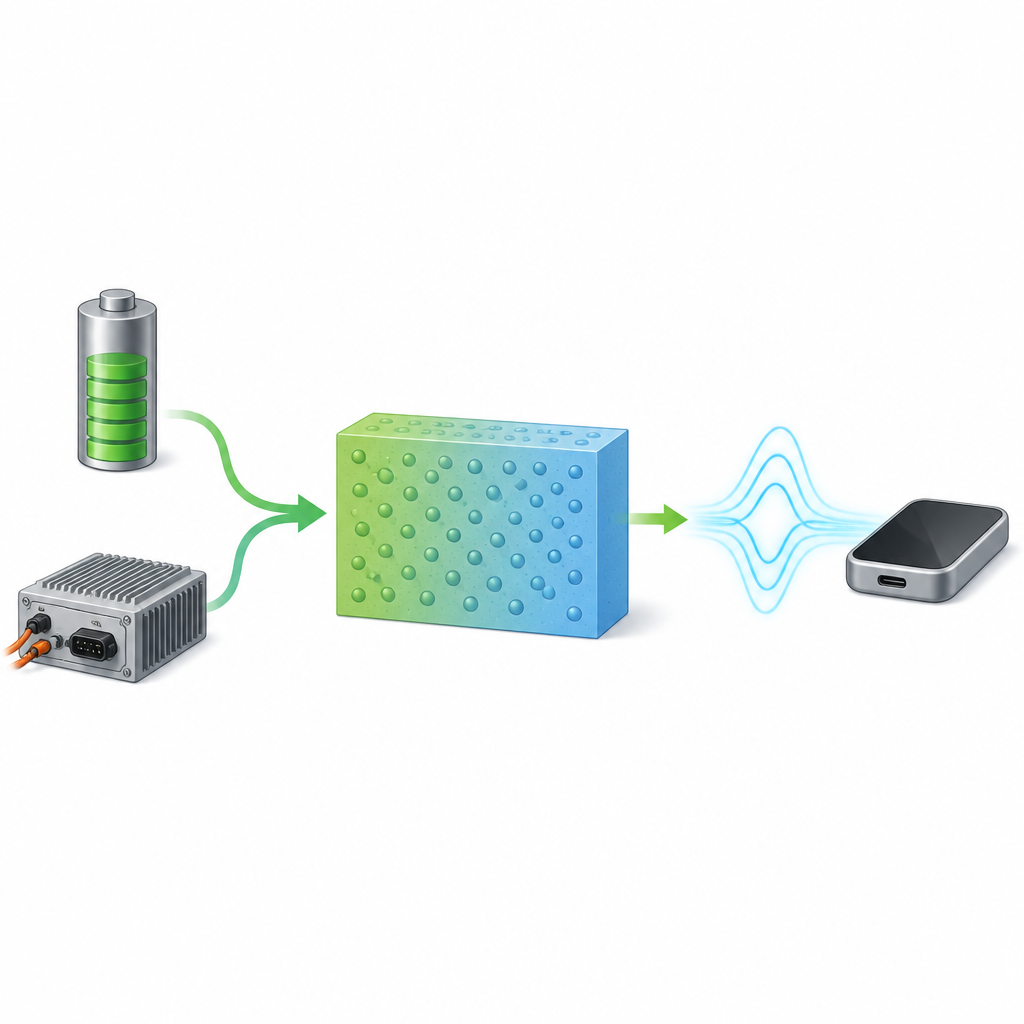
Modern gadgets, electric cars and power electronics all depend on components that can store and release bursts of electrical energy in a split second. This study reports a new lead free ceramic material for capacitors that can pack a large amount of energy into a very small volume while wasting little as heat, pointing toward smaller, safer and more efficient power systems.
From batteries to lightning fast capacitors
Unlike batteries, which rely on slow chemical reactions, dielectric capacitors store energy by slightly shifting electric charges inside a solid when a voltage is applied. This lets them charge and discharge extremely fast and handle high power, which is vital in devices like inverters and converters in hybrid vehicles. The challenge is that three key properties often work against one another: the maximum charge shift the material can reach, the leftover charge when the power is turned off, and the electric field the material can survive before breaking down. Improving one usually harms the others, limiting how much usable energy a capacitor can deliver efficiently.
Designing a smart internal landscape
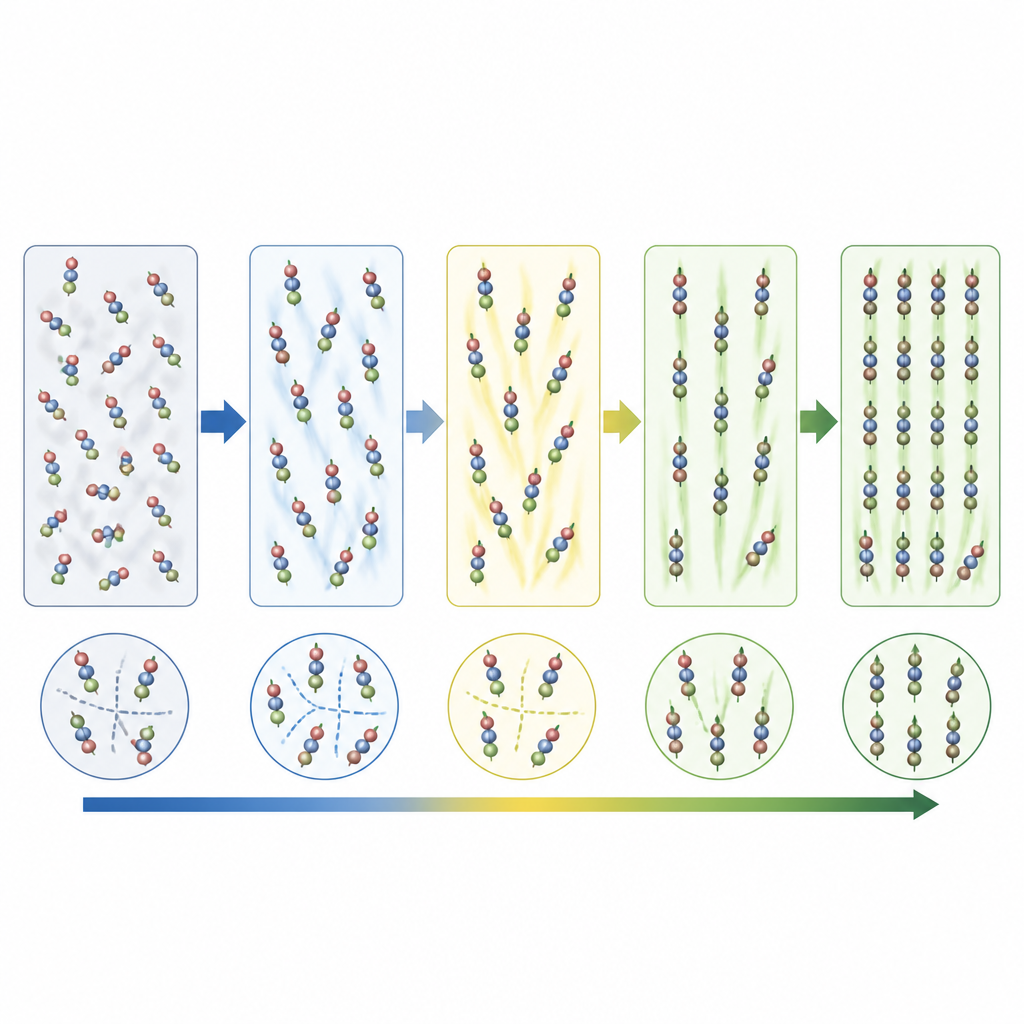
The researchers tackled this conflict by carefully designing the local structure inside a well known ceramic based on bismuth ferrite. They added a second ceramic, sodium niobate, and a trace of manganese oxide to create a material where tiny polar regions sit inside a weakly polar background. These nanometer sized regions can be strongly polarized when a field is applied but relax back almost completely when the field is removed. In a composition containing 14 percent sodium niobate, the material reached a very large difference between maximum and leftover polarization, a high breakdown field and thus an ultrahigh recoverable energy density of 14.5 joules per cubic centimeter with an efficiency of 88 percent, outperforming other similar lead free ceramics.
Seeing and simulating the hidden structure
To understand how this works, the team used advanced electron microscopes and neutron scattering to directly probe the arrangement of atoms. Instead of large, well formed domains typical of classic ferroelectrics, they observed a largely cubic average structure sprinkled with 1 to 4 nanometer polar clusters whose directions vary widely. Maps of atomic displacements showed a mix of local symmetries and strong off center shifts of certain atoms, especially bismuth and niobium. These findings reveal a patchwork of polar clusters embedded in a more weakly polar matrix, a hallmark of so called relaxor behavior that naturally favors slim, low loss polarization loops.
How local order boosts energy storage
Computer simulations of how polarization evolves under an electric field supported this picture. When a field is applied, the weak matrix aligns quickly, while the embedded polar clusters reorient more gradually, delaying saturation and allowing the overall polarization to grow to high values. Once the field is removed, the system easily falls back into a near random state with little residual polarization, meaning less energy is trapped and lost. At the same time, careful control of grain size, chemical makeup and insulating behavior raises the breakdown strength, so the material can safely operate at higher fields. Together these effects break the usual link between strong polarization and early breakdown, enabling both high stored energy and high efficiency.
What this means for future devices
In simple terms, this work shows that engineering the nanoscale arrangement of atoms inside a lead free ceramic can turn it into a compact, efficient energy reservoir. By building in strong but flexible local polar regions, the material can take in a large surge of electrical energy, give most of it back quickly, and withstand high voltages without failing. Such designs could help shrink capacitor banks in electric vehicles, pulsed power systems and other high performance electronics, offering a path toward more sustainable and space saving energy storage components.
Citation: Zhang, J., Li, Z., Wang, S. et al. Ultrahigh energy-storage in lead-free ceramic capacitors via local structure design. Nat Commun 17, 4660 (2026). https://doi.org/10.1038/s41467-026-71276-4
Keywords: lead free capacitors, ceramic energy storage, relaxor ferroelectrics, polar nanoregions, power electronics