Clear Sky Science · en
Structural and functional dissection of a higher-order oligomerization interface in yeast ceramide synthase
How cells keep a risky fat in balance
Ceramides are oily molecules that help build cell membranes and relay stress signals, but too much of them is linked to diabetes, heart disease, and even fungal infections. This study looks at how yeast cells fine-tune an enzyme that makes ceramides, revealing an unexpected control switch built into the enzyme’s own structure. Because ceramide-making machinery is broadly similar across life, these insights may eventually inform strategies to adjust lipid balance in human health and disease.
A key enzyme with a double life
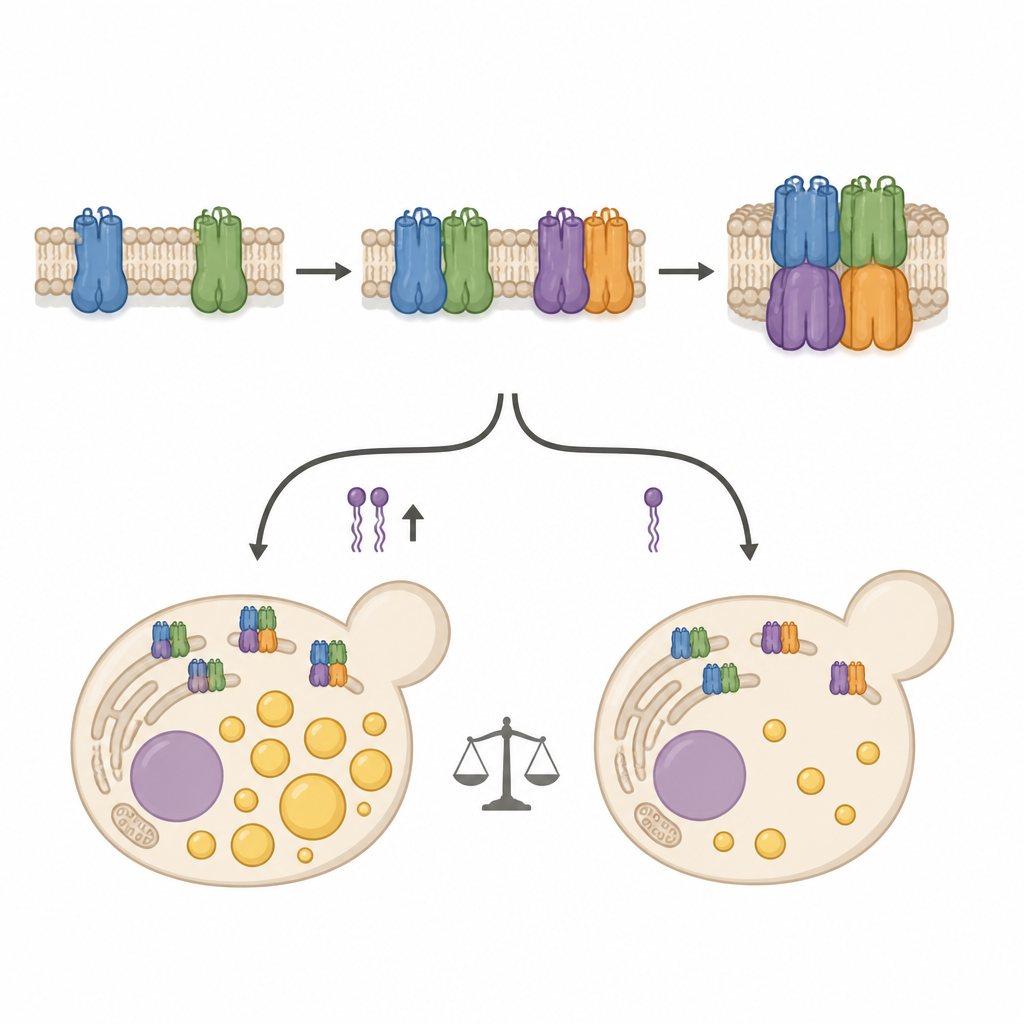
Inside cells, ceramide synthases sit in the membrane of a structure called the endoplasmic reticulum and join fatty acid chains to simple backbone molecules to make ceramides. Yeast uses a version built from two parts: Lac1, which does the chemistry, and Lip1, which helps regulate it. Earlier work showed that these pieces form a basic pair, a 2:2 complex, that actively produces ceramide. Yet biochemical experiments hinted that something larger was lurking: a heavier form of the complex that suggested multiple pairs were joining together into a higher-order assembly.
Zooming in on a molecular assembly
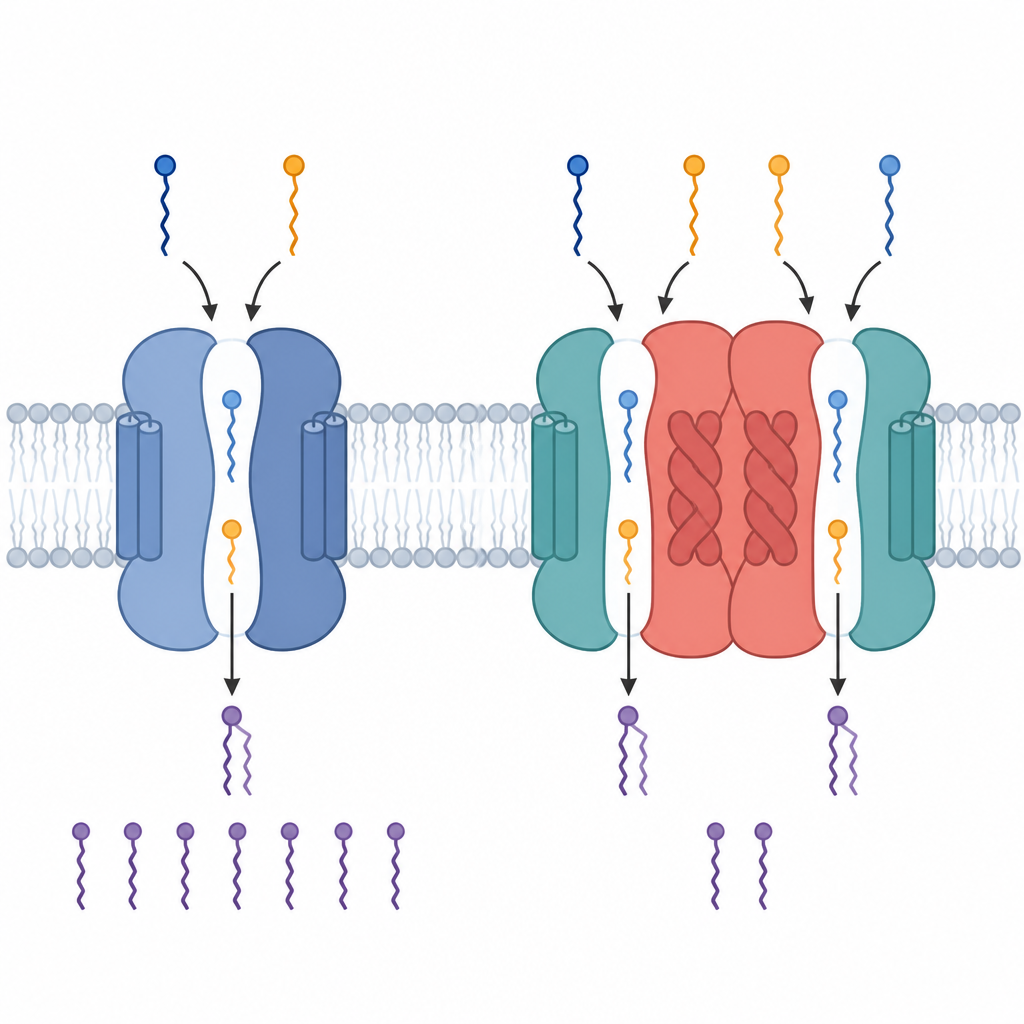
Using cryo-electron microscopy, the authors captured detailed 3D snapshots of this larger structure. They found that two active Lac1–Lip1 pairs can join side by side to form a four-unit, or 4:4, assembly. The key contact lies between two Lac1 molecules, where a membrane-spanning segment at the protein’s tail, called TM8, twists dramatically and slots into a groove on its neighbor. This twist pulls the tail over the opening of the catalytic chamber, physically blocking access for the fatty-acid carrying acyl-CoA molecules that are needed to make ceramide. Biochemical assays confirmed that preparations enriched in this larger assembly showed lower activity than those containing mostly the smaller pair, suggesting that part of the 4:4 complex is structurally turned down.
A control switch that is not just an off button
To test how important this interface is, the team mutated three oily amino acids in Lac1 that form the heart of the contact zone. These changes prevented formation of the 4:4 complex, leaving only the active pairs. In test-tube reactions, this mutant enzyme worked about as well as the normal version, confirming that its basic chemistry was intact. But in living yeast cells under stress from a drug that blocks downstream sphingolipid production, the story reversed expectations. Cells lacking the 4:4 interface actually accumulated less ceramide, especially species carrying very long fatty acids, and they grew better under stress than cells with the intact interface. Instead of simply shutting the enzyme off, the higher-order assembly appears to help cells adjust ceramide output to match changing conditions.
Untangling other possible control layers
The authors also asked whether previously known control features plug into this interface. Animal versions of ceramide synthase rely on a short DxRSDxE sequence near the tail to form dimers, and both yeast and mammals can tune activity by adding phosphate groups near this region. In yeast, however, swapping all seven residues of the DxRSDxE motif to alanine did not disrupt the 4:4 assembly, and mimicking either permanent or absent phosphorylation at nearby sites left the higher-order complex intact. These findings suggest that yeast and mammalian enzymes use different structural tricks to come together, and that the Lac1 tail interface is a distinct control node rather than the only way that phosphorylation affects activity.
What this means for lipid balance and disease
Taken together, the work reveals a built-in structural switch in yeast ceramide synthase, where two active enzyme pairs can dock into a larger assembly that partially blocks some catalytic sites. While this looks like self-inhibition in the test tube, the behavior in cells shows that the interface instead helps couple ceramide production to the broader state of the sphingolipid pathway, especially under stress. By uncovering how enzyme crowding and shape changes can fine-tune a potent signaling lipid, the study adds an important piece to the puzzle of how cells avoid both too little and too much ceramide, a balance that matters for metabolism, neurodegeneration, cancer, and antifungal strategies.
Citation: Fang, Q., Yang, C., Yao, N. et al. Structural and functional dissection of a higher-order oligomerization interface in yeast ceramide synthase. Nat Commun 17, 4656 (2026). https://doi.org/10.1038/s41467-026-71272-8
Keywords: ceramide synthase, sphingolipid metabolism, enzyme regulation, yeast membrane proteins, cryo electron microscopy