Clear Sky Science · en
Human-like cognitive generalization for large models via mental representation-guided supervision
Why teaching AI to think like us matters
Modern artificial intelligence can recognize faces, label photos, and write fluent text, yet it still struggles with the kind of flexible understanding people use every day. We can see one example of a bird and then recognize many kinds of birds, or tell that a hammock and a baby carriage both involve lying down to rest. This article explores a new way to help computer models move closer to that kind of human-like thinking by using brain activity itself as a teaching signal.
Where today’s smart machines fall short
Standard deep learning systems become more capable mostly by being made bigger and trained on more data. That recipe works well for concrete tasks such as recognizing socks, swans, or cars in pictures. However, the authors show that simply adding more model parameters brings little improvement in grasping abstract ideas such as clothing, birds, or the broader divide between living and non-living things. When the models were tested on one-shot learning tasks, they improved strongly on specific objects as they grew larger but barely improved, or even declined, on higher-level categories. Analyses of how the models internally separate concepts revealed that, unlike the human brain, they did not naturally group living creatures apart from tools and other objects.
Letting the brain guide the machine
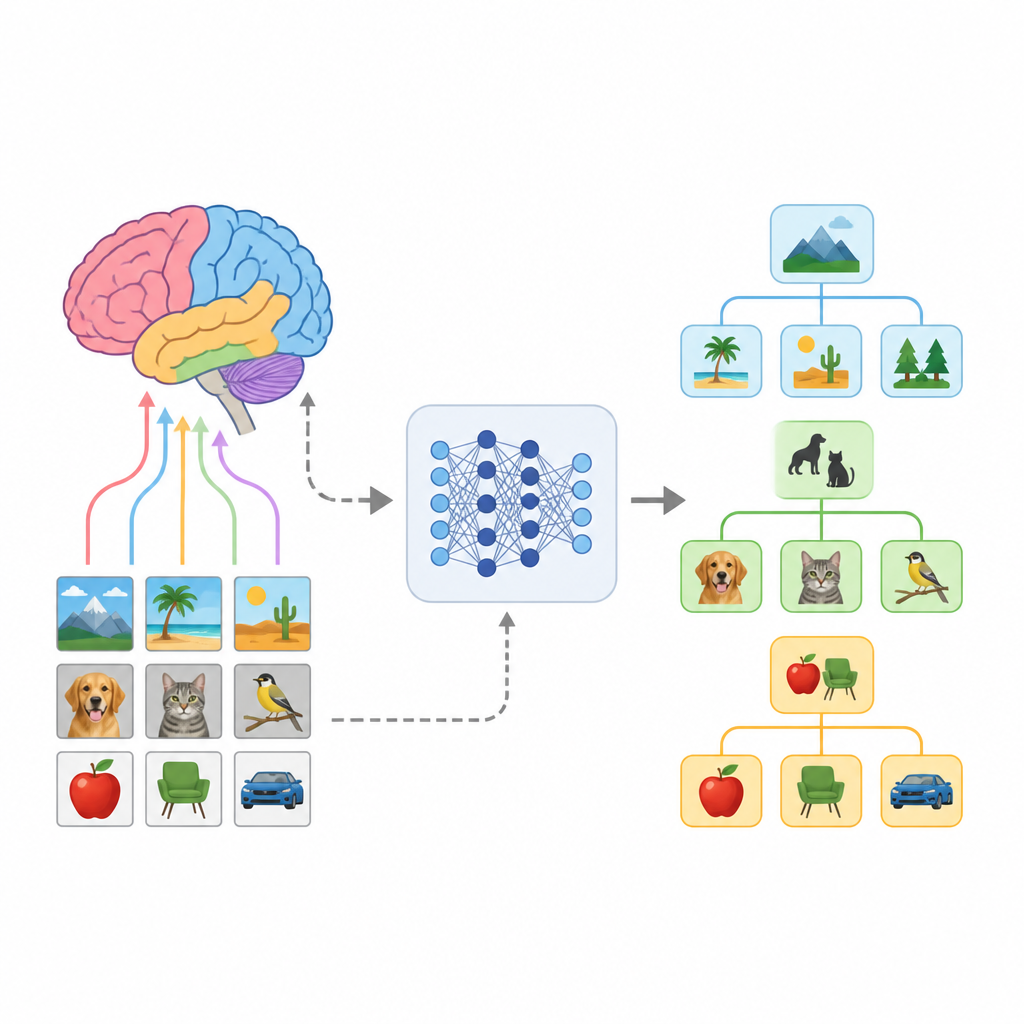
To tackle this gap, the researchers designed what they call mental representation-guided supervision. Volunteers lay in a brain scanner while viewing many natural images. From these recordings, the team extracted activity patterns in areas of the visual cortex that are known to encode rich, high-level information about what we see. At the same time, an artificial network processed the same images. The key idea was to force the network’s internal structure of similarities and differences between objects to line up with the structure found in the brain. The authors treated both brain and model as graphs of interconnected concepts and used an iterative graph-matching procedure to bring them into closer alignment.
How brain-aligned models behave
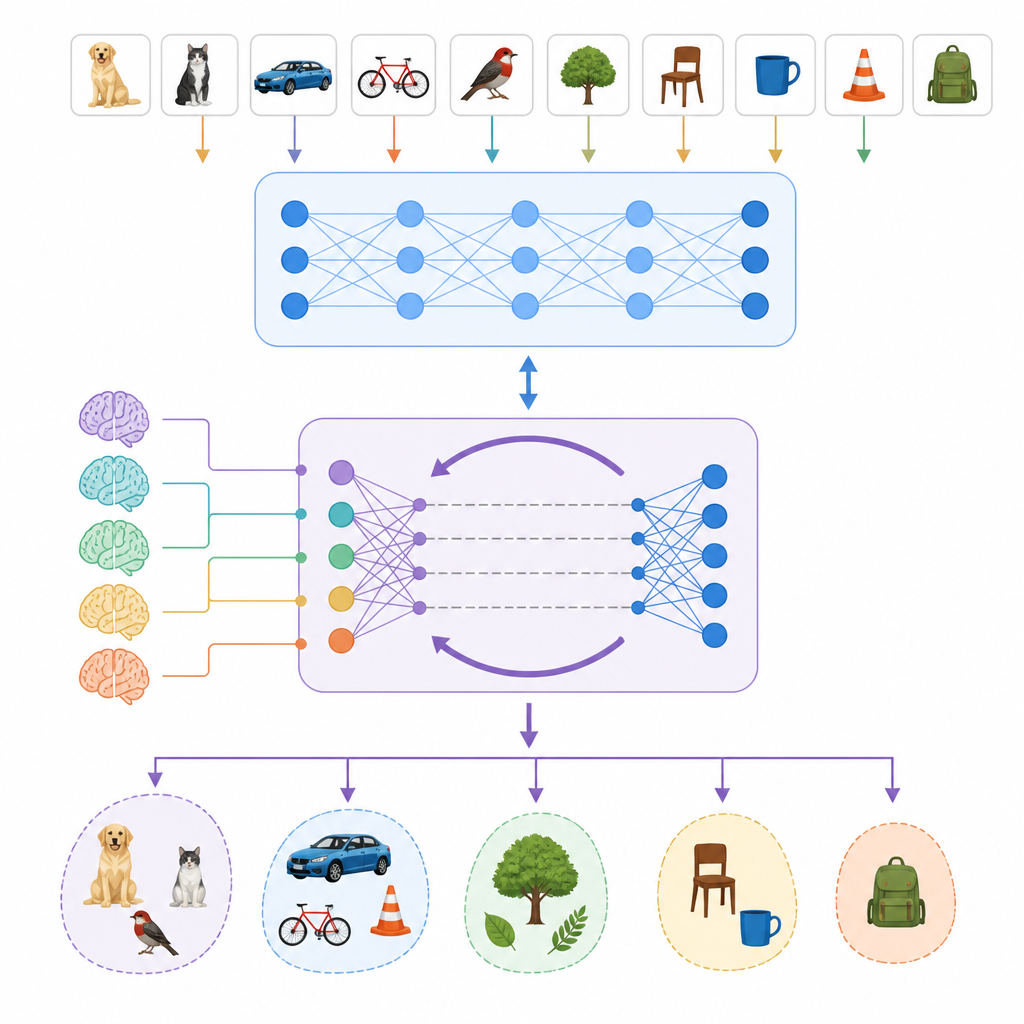
After this special training, the models did not just memorize the supervised images. Instead, they developed a more human-like map of concepts that generalized to many new objects never paired with brain data. The improved models became much better at one-shot learning for abstract categories, showing tighter clusters for concepts like animal, vehicle, or musical instrument. Their internal hierarchies came to resemble WordNet, a hand-built database of how English words relate to each other, even though the models were never explicitly trained on that structure. When asked to pick the “odd one out” among three images, the brain-guided models chose in ways that more closely matched large sets of human judgments. They also proved harder to fool with small, carefully crafted distortions to images, hinting at a deeper and more robust grasp of what objects are.
A window into a more human-like concept space
The authors went further and examined the “conceptual manifold,” or low-dimensional map, underlying the brain-guided models. By moving around this map and decoding points into natural language descriptions, they showed that nearby positions corresponded to semantically related ideas, such as different kinds of clothing or vehicles. Interpolating between regions produced smooth transitions, like sliding from electronic devices toward animals and landing on horses when crossing between vehicles and hoofed mammals. The system could also summarize multiple related images into a single meaningful sentence and perform simple “concept arithmetic,” adjusting captions by adding or subtracting elements such as horse or motorcycle in a way that aligned with human intuition.
What this means for future AI
In everyday terms, this work suggests that giving AI systems a nudge from the human brain can help them move beyond pattern matching toward something closer to our own way of organizing knowledge. Instead of just making models bigger, the study shows that shaping their internal concept space to mirror brain structure can boost their ability to handle new, abstract, and unusual situations. While the approach still depends on detailed brain scans from individual people, expanding such brain-informed training could lead to artificial systems that are more adaptable, interpretable, and aligned with how humans perceive and reason about the world.
Citation: Chen, J., Qi, Y., Wang, Y. et al. Human-like cognitive generalization for large models via mental representation-guided supervision. Nat Commun 17, 4709 (2026). https://doi.org/10.1038/s41467-026-71267-5
Keywords: brain guided learning, abstract concepts, deep neural networks, concept hierarchy, cognitive generalization