Clear Sky Science · en
Photo-electrochemical reduction of PFAS in complex water matrices
Why stubborn “forever chemicals” matter
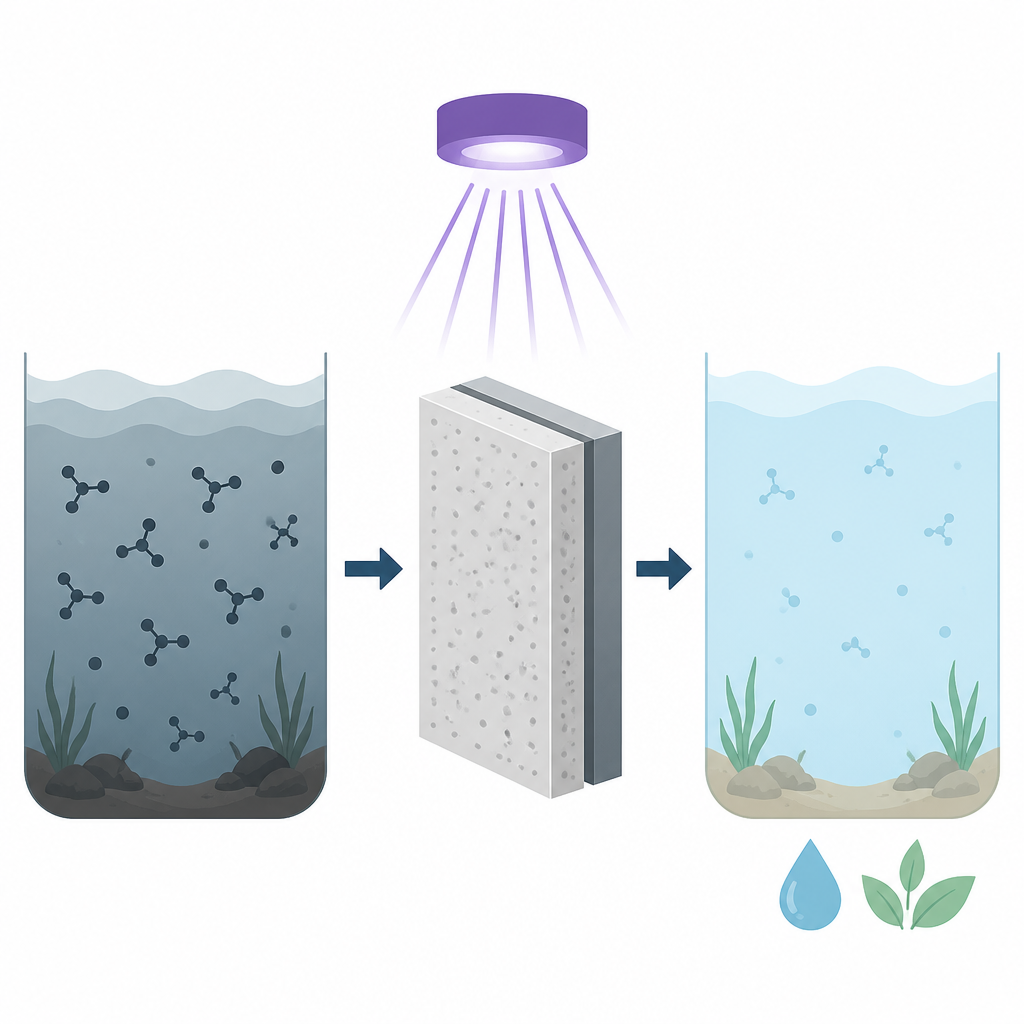
Per- and polyfluoroalkyl substances, or PFAS, are often called “forever chemicals” because they barely break down in the environment. They have been used for decades in firefighting foams, nonstick pans, stain resistant fabrics, and many other products, and they now contaminate drinking water and wastewater worldwide. Getting rid of PFAS is hard; many current methods either use extreme heat and pressure or risk creating new harmful byproducts. This study explores a gentler, electricity and light driven way to actually break PFAS apart in real world waters, including tough wastes like reverse osmosis concentrate and firefighting foam rinses.
A new type of treatment surface
The researchers built a special cathode, the negatively charged side of an electrochemical cell, by decorating titanium dioxide with tiny particles of the metal palladium. Titanium dioxide is a common, stable material often used in pigments and photocatalysts. Here it acts as a sturdy scaffold that helps PFAS molecules latch on when a modest electric current is applied. The palladium particles respond to ultraviolet light by generating very energetic electrons. Together, the two materials form a cooperative surface that first attracts PFAS and then helps tear apart their famously strong carbon fluorine bonds.
Making PFAS stick where they should not
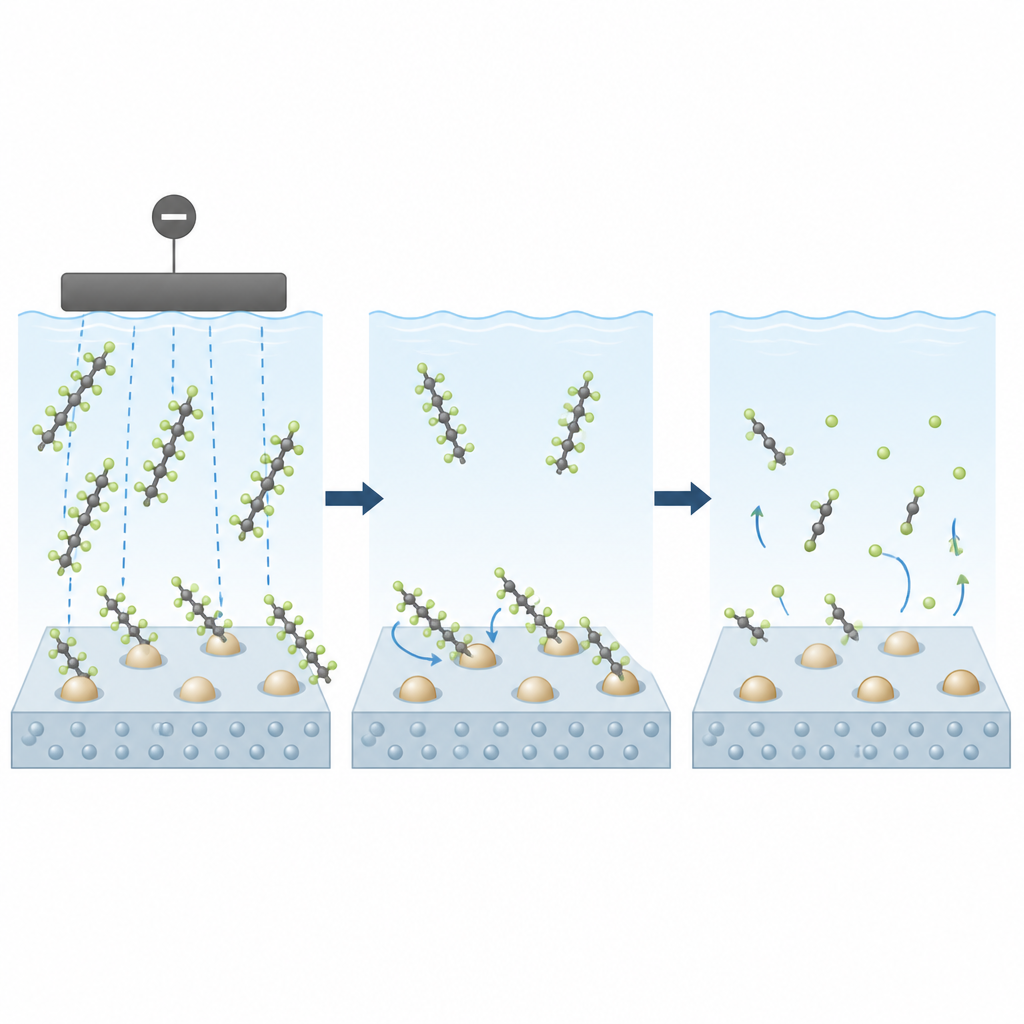
Under normal conditions, PFAS carry a negative charge in water and are pushed away from a negatively charged cathode. Surprisingly, when the team ran current through their titanium dioxide surface, a significant fraction of PFAS molecules began to adsorb onto it. Experiments using infrared light showed that the PFAS chains lay flat along the surface, and computer simulations confirmed that specific sites on titanium atoms form strong bonds with the PFAS head group once nearby water molecules are nudged aside. This cathodic “pulling in” step is crucial because it concentrates PFAS right where the reactive electrons will appear.
How light and electrons crack “forever” bonds
When the palladium decorated cathode was illuminated with low pressure ultraviolet lamps while current flowed, the behavior changed from simple sticking to true destruction. The UV light excited electrons inside palladium, creating short lived “hot” electrons with far more reducing power than ordinary ones. Some of these hot electrons directly attacked PFAS chains bound near palladium, while others escaped into the surrounding water as hydrated electrons, a highly reactive form that also targets carbon fluorine bonds. Together, these two electron pathways chopped off the sulfonate head group, shortened the fluorinated tails, and released fluoride ions, clear signs that the once inert PFAS molecules were being dismantled.
Working in messy, real waters
Beyond clean laboratory solutions, the system was tested in waters that resemble real treatment challenges. The team built single chamber reactors with either a tube or mesh style cathode wrapped around a UV lamp, designs that better use light and are easier to scale. These reactors removed a wide mix of PFAS from reverse osmosis concentrate produced during wastewater reuse, as well as from diluted firefighting foam rinses, while also increasing the level of free fluoride. Other common ions and natural organic matter slowed the process but did not stop it, and the electrodes maintained their performance over repeated runs, using less energy than many existing light driven reduction methods.
Toward complete cleanup of PFAS laden water
The study shows that pairing electric current with light on a carefully engineered surface can both capture and break down stubborn PFAS, even in complex water mixtures, without adding chemicals. On its own, the photo electrochemical step removes most PFAS and avoids forming problematic oxygen rich byproducts. When followed by a conventional electrochemical oxidation step, it can drive defluorination close to completion. For a lay reader, the key message is that the “forever” in forever chemicals is not absolute: by cleverly guiding where PFAS land and how electrons reach them, it is possible to design practical systems that chip away at their toughest bonds and help clean contaminated water streams.
Citation: Guan, Y., Jain, A., Xu, X. et al. Photo-electrochemical reduction of PFAS in complex water matrices. Nat Commun 17, 4550 (2026). https://doi.org/10.1038/s41467-026-71263-9
Keywords: PFAS, water treatment, photoelectrochemistry, defluorination, wastewater