Clear Sky Science · en
The genomic impact of population connectivity and decline in Africa’s elephants
Why elephant DNA matters for the future of the savanna
African elephants are more than charismatic giants; they are living bulldozers and gardeners that shape entire landscapes. Yet they are disappearing fast under pressure from ivory poaching and shrinking habitats. This study dives inside their DNA to ask two urgent questions: how have past movements and mixing between elephant populations shaped their genomes, and what does today’s human-driven fragmentation mean for their long‑term survival?
Two kinds of African elephants, deeply divided yet still connected
Scientists now recognize two African elephant species: the larger savanna elephant roaming grasslands and woodlands, and the smaller forest elephant living under dense tropical canopies. By sequencing 232 high‑quality genomes from 17 African countries, the authors show that these species split millions of years ago and are genetically very distinct. Forest elephants carry more genetic variation overall and historically had larger, more stable populations. Savanna elephants, in contrast, show more inbreeding and a heavier burden of harmful genetic changes. 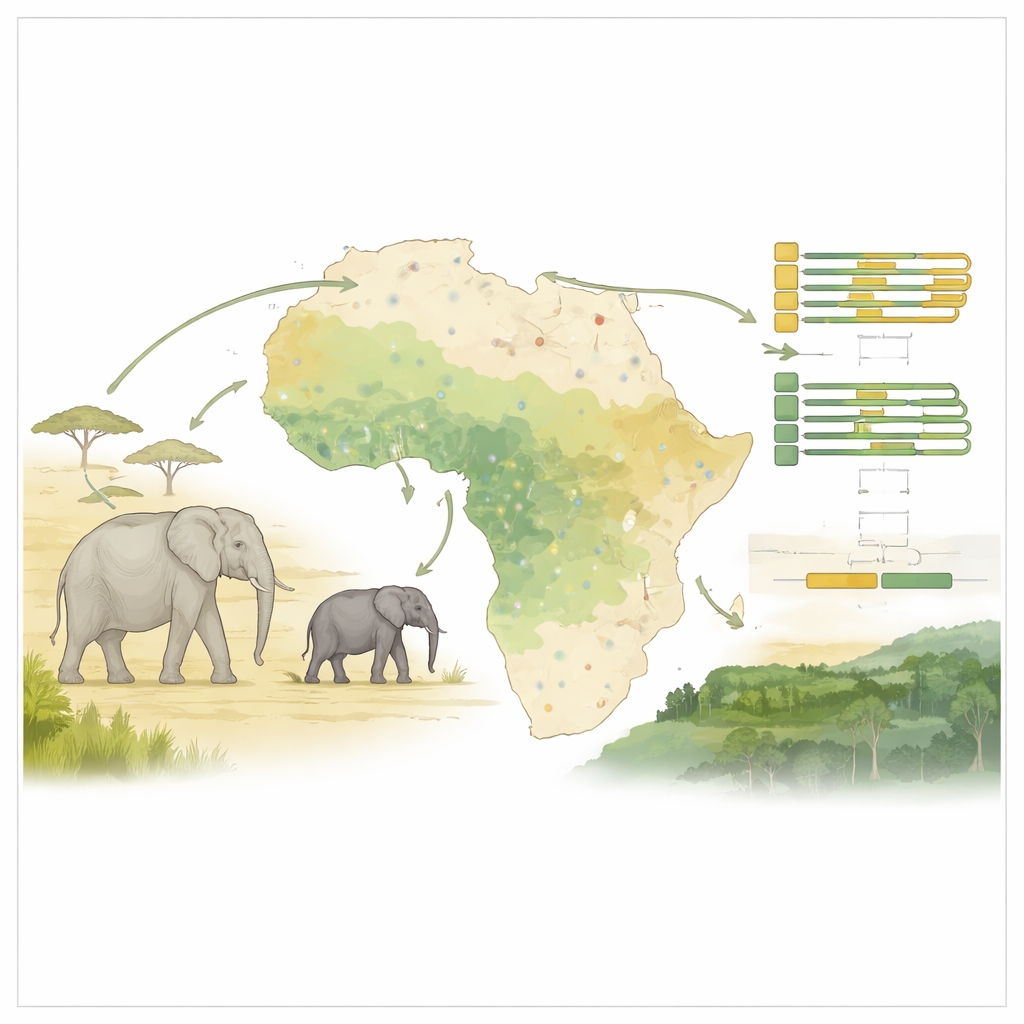
Hidden traces of mixing written across the continent
Hybrid elephants are rare on the ground, but their genetic fingerprints are widespread. Using several statistical approaches, the researchers detect tiny amounts of forest‑elephant DNA scattered through many savanna populations, even far from today’s forest edge. Some savanna herds in Uganda, Tanzania, and Zambia carry about half a percent of forest ancestry; others in Mali and Cameroon retain much higher levels. The strength of this signal gently fades with distance from the Congo–Guinean rainforests, suggesting that, over thousands of years, forest and savanna elephants met and mingled as climates shifted, forests expanded and shrank, and elephants roamed long distances. These exchanges likely helped maintain genetic diversity, even as the two species followed separate evolutionary paths.
When movement stops, genomes bear the scars
Within each species, the study finds surprisingly little genetic partitioning across huge areas, consistent with elephants’ ability to travel long distances and swap genes between distant herds. But human activity is starting to unravel this natural connectivity. In regions where elephant ranges have collapsed into small, isolated pockets—such as Eritrea, Ethiopia, Namibia, and parts of West Africa—the genomes show clear warning signs: reduced diversity, long stretches of identical DNA reflecting recent inbreeding, and the fingerprints of random genetic drift. By contrast, elephants in large, well‑connected landscapes such as the Kavango–Zambezi region of Botswana, Namibia, Zambia, Zimbabwe, and Angola remain genetically healthy and well mixed, underscoring how vital wildlife corridors and cross‑border conservation areas are for maintaining resilient populations.
Genetic burdens and surprising good news for forest elephants
Beyond cataloguing diversity, the team examined “genetic load”—the accumulation of potentially harmful mutations that can reduce fitness. Theory suggests that species which were once abundant but have recently crashed may carry many hidden damaging variants, putting them at risk of a downward spiral as numbers fall. Forest elephants fit this demographic profile: historically numerous, now sharply reduced by poaching. Yet the genomes tell a more hopeful story. Compared to savanna elephants, forest elephants actually carry fewer harmful mutations in the forms most likely to cause trouble in future generations. Some isolated savanna populations show patterns consistent with inbreeding having already exposed and purged the worst mutations, but at the cost of losing overall diversity. 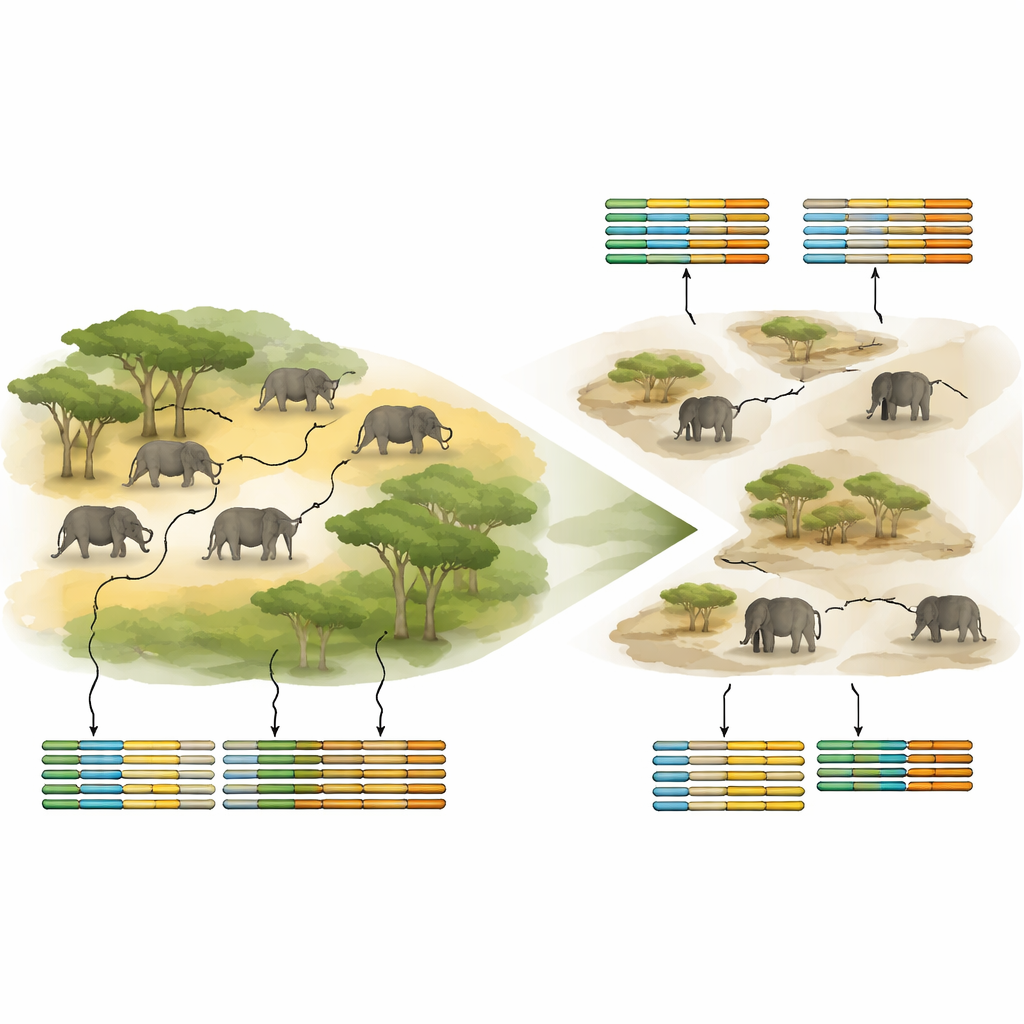
What this means for saving Africa’s giants
Together, these findings paint a picture of elephants as naturally mobile animals whose evolution has been shaped by long‑distance movements and occasional mixing between species. Human‑driven habitat loss and fragmentation are now cutting those genetic lifelines, especially at the edges of their range. The authors provide a continent‑wide genetic baseline from the 1990s—before the most recent poaching crisis—against which future surveys can be compared. For a lay reader, the takeaway is clear: keeping elephant populations large, connected, and able to move across the landscape is just as important as stopping poaching. If we maintain corridors and protect strongholds, both forest and savanna elephants still have the genetic tools they need to weather a rapidly changing world.
Citation: Pečnerová, P., Ishida, Y., Garcia-Erill, G. et al. The genomic impact of population connectivity and decline in Africa’s elephants. Nat Commun 17, 3223 (2026). https://doi.org/10.1038/s41467-026-71262-w
Keywords: African elephants, population genetics, habitat fragmentation, hybridization, conservation genomics