Clear Sky Science · en
Understanding and modelling ammonia partitioning and transport across reverse osmosis membrane
Turning Farm Waste into Useful Resources
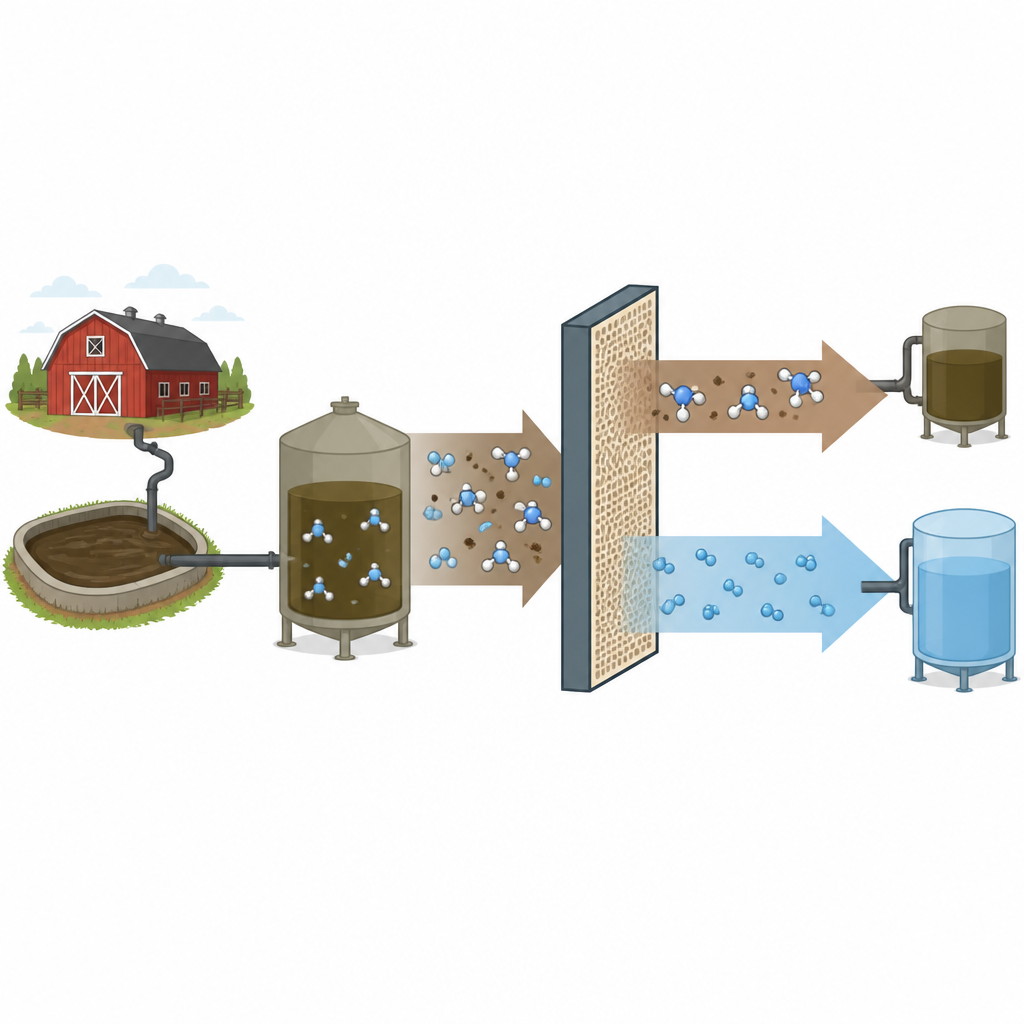
Across the world, livestock farms generate vast amounts of watery manure that contains valuable nitrogen in the form of ammonia. If this ammonia is not captured, it can pollute air and water and waste the energy used to make it in the first place. This study explores how to better recover ammonia while producing clean water, using reverse osmosis membranes similar to those in desalination plants, and explains why a simple change in water acidity, or pH, can make the difference between strong and weak ammonia removal.
Why Ammonia in Wastewater Matters
Modern agriculture relies on synthetic ammonia fertilizer, produced by the energy-hungry Haber–Bosch process that consumes a few percent of global energy and contributes to greenhouse gas emissions. After fertilizer is used to grow animal feed, much of the nitrogen ends up in manure lagoons and treatment systems. Because manure is dilute and bulky, it is expensive to move to where crops need nutrients. Technologies that concentrate ammonia and recover clean water can save energy and cut pollution. Reverse osmosis, which pushes water through a thin plastic membrane while leaving most salts behind, has become a leading option for treating ammonia-rich waste streams from manure digesters and advanced wastewater plants.
Ammonia’s Two Faces in Water
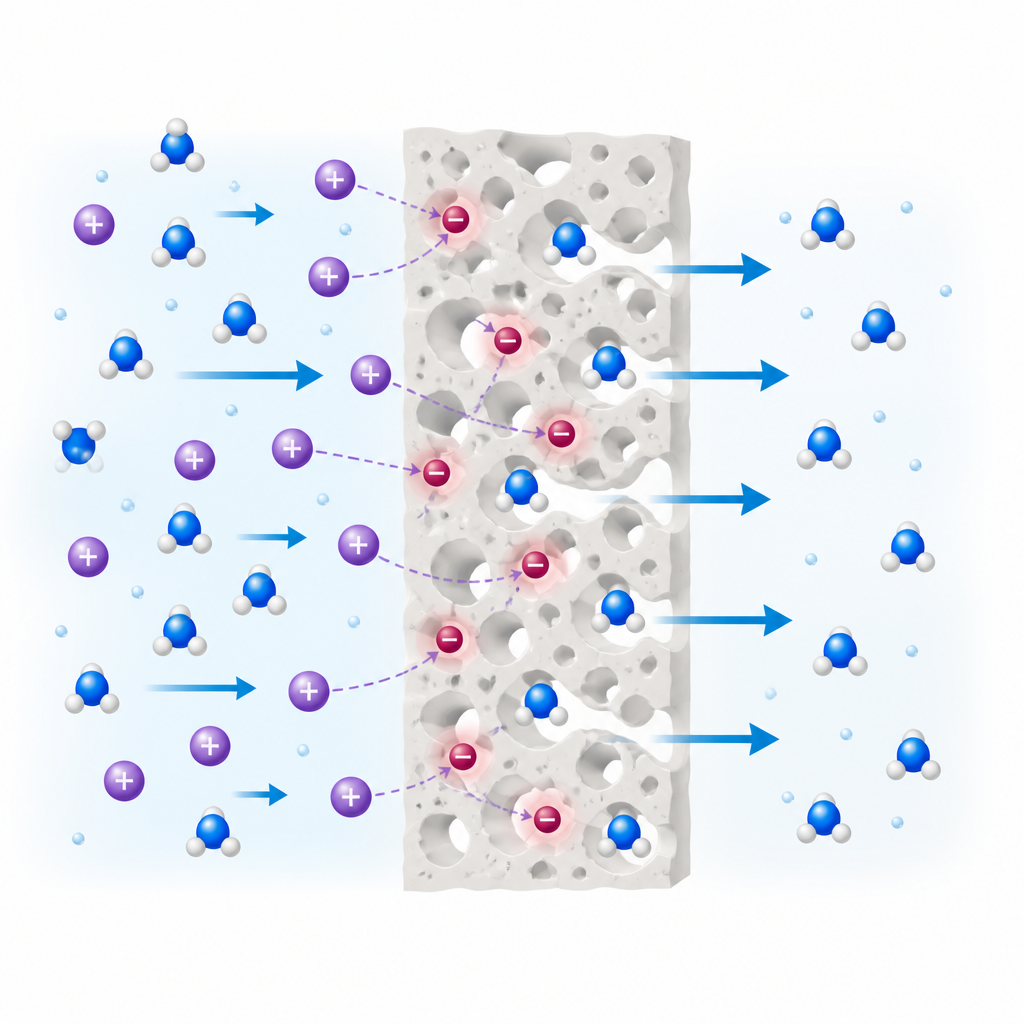
In water, ammonia appears in two closely related forms: a neutral gas-like molecule and a positively charged ion. The balance between these forms depends strongly on pH. At higher pH, more of the neutral form is present; at lower pH, the charged form dominates. Reverse osmosis membranes are very effective at holding back charged ions but much less effective at stopping neutral molecules, which can slip through the tiny water-filled channels more easily. Earlier studies showed that ammonia removal could vary from almost nothing to nearly complete removal, but they lacked a clear, quantitative explanation that linked these swings to both ammonia speciation and the changing electrical charge on the membrane surface.
A New Way to Describe Movement Through the Membrane
The authors developed an “ammonia partitioning and transport” model that tracks how neutral ammonia and its charged cousin move separately across the reverse osmosis layer. The model includes three ways particles can move: being carried along with flowing water, spreading from high to low concentration, and being pushed or pulled by electrical forces. It also represents how the membrane itself becomes more negatively charged as pH rises, which strengthens its ability to repel positive ions. Laboratory tests under controlled pressure, concentration, and pH showed that water flow stayed almost constant, but ammonia behaved quite differently. Overall ammonia removal was best, close to 90 percent, near neutral pH and dropped off at both lower and higher pH values, forming an arch-shaped curve that the model reproduced well.
What Really Happens to Ammonia Inside the Membrane
By separating the behavior of the two forms of ammonia, the model reveals why pH has such a strong effect. The neutral form crosses the membrane easily and is barely influenced by pH or membrane charge, so its removal stays low. The charged form, in contrast, feels the membrane’s negative charge: it is drawn into the membrane but also pushed back by electrical forces, which creates a high energy barrier to crossing. As the pH rises above about 8, more ammonia switches to the neutral form, so total ammonia leaks through more readily even though the membrane is more highly charged. Computer simulations at the molecular scale back up this picture, showing that the charged ion sticks strongly to negatively charged sites and faces much larger energy barriers than the neutral molecule when trying to pass through the dense polymer network.
From Clean Streams to Real Manure
The researchers tested their model not just with simple salt solutions, but also with real and simulated wastewaters from a dairy farm that contained mixtures of other ions. In all cases, the same set of model parameters could reproduce how ammonia removal changed with pH, and the best performance consistently appeared near pH 7. In more complex solutions, other ions slightly altered details of transport, but the key trends remained the same: the charged form was easier to reject, and the neutral form dominated leakage at higher pH. This suggests that the model can serve as a practical tool for predicting ammonia behavior in real treatment plants, and could eventually be built into design software for engineers.
What This Means for Cleaner Water and Lower Emissions
For a layperson, the main message is that getting the water’s pH “just right” is crucial when using reverse osmosis to clean up ammonia-rich waste. Running the process near neutral pH keeps most ammonia in a charged form that the membrane can hold back, without becoming so acidic that the membrane loses its helpful charge. The study also shows that neutral and charged ammonia do not behave the same way inside the membrane, and that this difference is rooted in their electrical interactions with the material. With these new insights, operators can tune pH and choose membrane properties to better retain ammonia, making it easier to capture as a fertilizer ingredient while producing cleaner water and reducing the energy burden on agriculture.
Citation: Wang, Z., Yang, K., Mahajan, S. et al. Understanding and modelling ammonia partitioning and transport across reverse osmosis membrane. Nat Commun 17, 4649 (2026). https://doi.org/10.1038/s41467-026-71260-y
Keywords: ammonia recovery, reverse osmosis, wastewater treatment, membrane transport, pH effects