Clear Sky Science · en
Asymmetric hydrophilicity-driven fast water diffusion enabling heterogeneous hygroscopic gels toward high-yield atmospheric water harvest
Turning Air into a Hidden Water Source
Many dry regions sit under skies filled with water vapor that rarely falls as rain. This study explores a new sponge like material that can pull that invisible moisture from the air and release it as clean liquid water using only sunlight. The work shows how a carefully layered gel can soak up large amounts of water and give it back quickly, pointing toward simple devices that might one day supply drinking water where conventional sources are scarce. 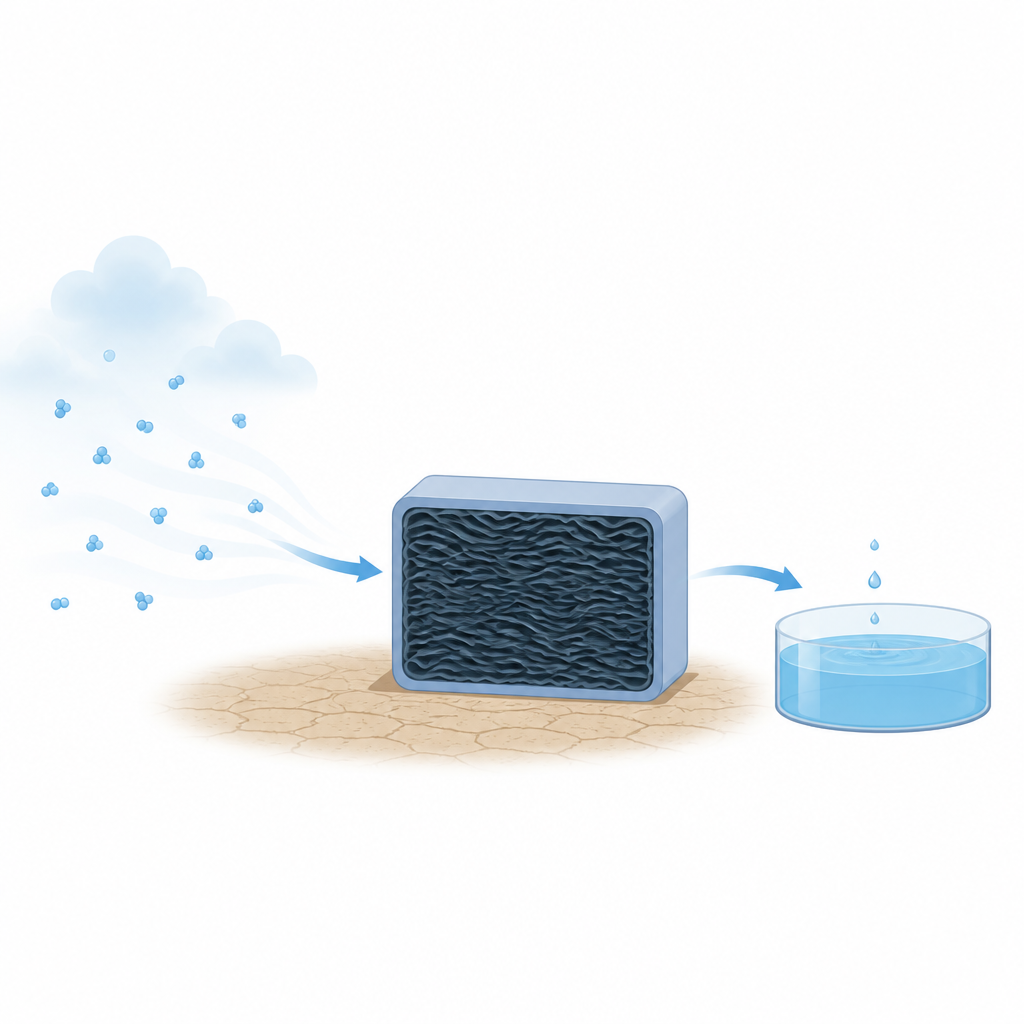
Why Harvesting Water from Air Is Hard
Water harvesting materials must do two opposite jobs at once: they must grab water strongly enough to collect it, yet let it go easily when heated. Traditional gels achieve good uptake by packing many water loving chemical groups into a single uniform network. That same stickiness, however, slows the movement of water through the material, so the outer surface clogs while the inner regions sit empty. Engineers have tried to fix this with fancy pore structures, but it is difficult to tune the size and shape of the pores so that both water capture and release work well.
A Layered Sponge with Different Jobs
The researchers break this deadlock by building a "heterogeneous" gel in which different layers have different roles. The outer shell is made from pectin, a plant based polymer also used to set jams. It is rich in chemical groups that readily bind water, so it acts as a front line where vapor from the air turns into liquid. Inside this shell sit several thin sheets of graphene oxide, a carbon material with wrinkled surfaces and fewer water loving sites. The entire stack is filled with glycerol, a safe, syrupy liquid that helps pull water inward. This design separates where water is captured from where it is stored and moved, allowing each part to be optimized for its task.
How Water Rushes In and Flows Out
When moist air touches the gel, the pectin shell quickly binds vapor and condenses it into tiny droplets. Glycerol then acts like a molecular conveyor belt, dragging these droplets into the gaps between the graphene oxide sheets. Because the sheets are relatively smooth and less sticky, water is less tightly held there and can move rapidly through narrow channels formed by the wrinkles. Computer simulations and nuclear magnetic resonance experiments show that, unlike in a uniform gel, a large fraction of the water inside this layered structure behaves like free flowing liquid rather than being locked in place by strong bonds. 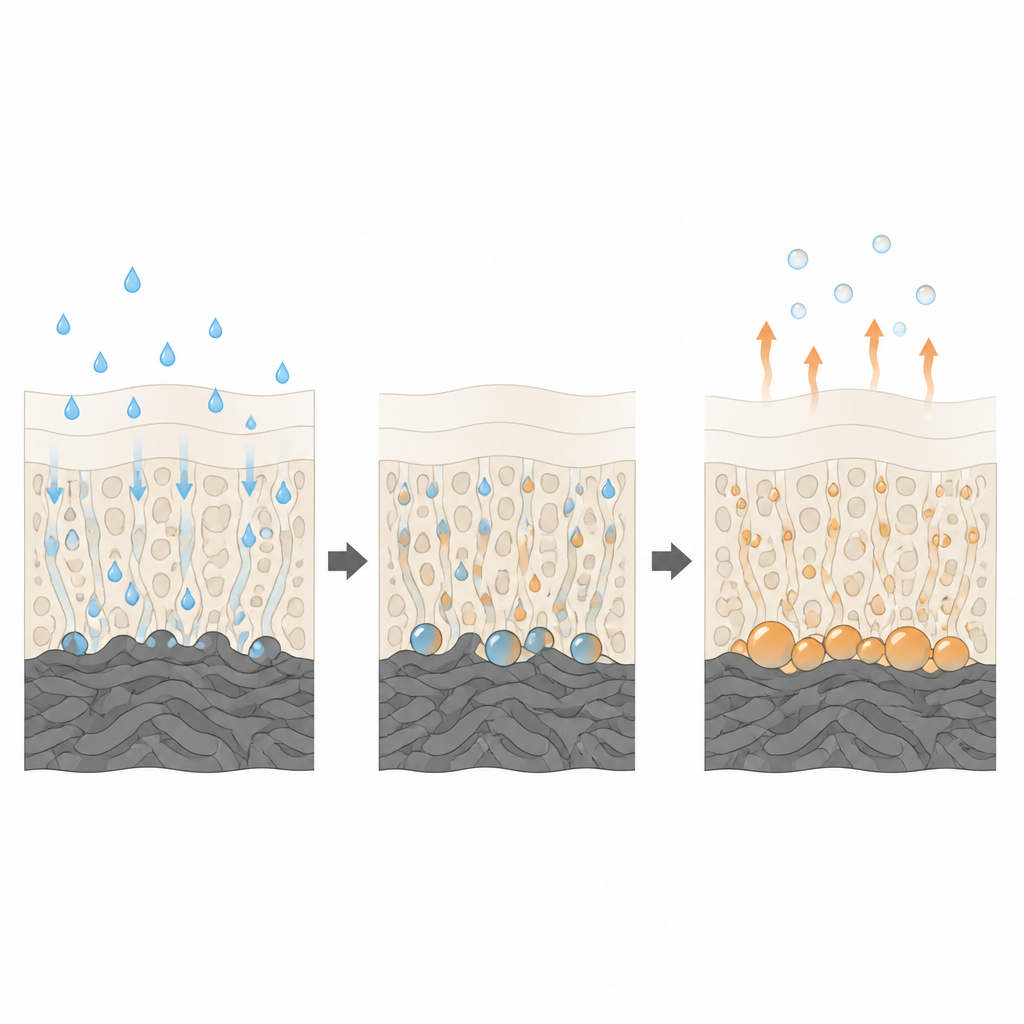
High Yields under Real Sunlight
The graphene oxide sheets do double duty by also acting as efficient solar heaters. Under ordinary sunlight they absorb a broad range of wavelengths and warm the surrounding water. Heat spreads from the inner sheets outward, driving water molecules back toward the surface, where they evaporate and then condense on a cooler cover to be collected. Tests show that the gel can take up between about its own weight and almost seven times its weight in water, depending on humidity, and can release more than 90 percent of the stored water in under an hour. Outdoor trials in different climates produced several liters of water per kilogram of gel per day, and the collected water met international purity guidelines.
What This Means for Future Water Supplies
By deliberately mixing more and less water friendly regions in one material, this work challenges the common belief that simply making a material more hydrophilic always improves performance. Instead, the study shows that giving different layers different jobs can boost both how much water is captured and how fast it moves. The biodegradable outer shell and reusable carbon core also point toward systems that are not only effective but kinder to the environment. While more engineering is needed before such gels become everyday devices, the concept offers a clear path toward practical systems that quietly pull fresh water from the air wherever sunlight is available.
Citation: Han, R., Wu, X., Zhu, Y. et al. Asymmetric hydrophilicity-driven fast water diffusion enabling heterogeneous hygroscopic gels toward high-yield atmospheric water harvest. Nat Commun 17, 4571 (2026). https://doi.org/10.1038/s41467-026-71259-5
Keywords: atmospheric water harvesting, hygroscopic gel, graphene oxide, solar desalination, freshwater from air