Clear Sky Science · en
Wavelength-responsive in situ redox chemistry enables stable CO2 photocatalysis
Turning Light into Cleaner Fuels
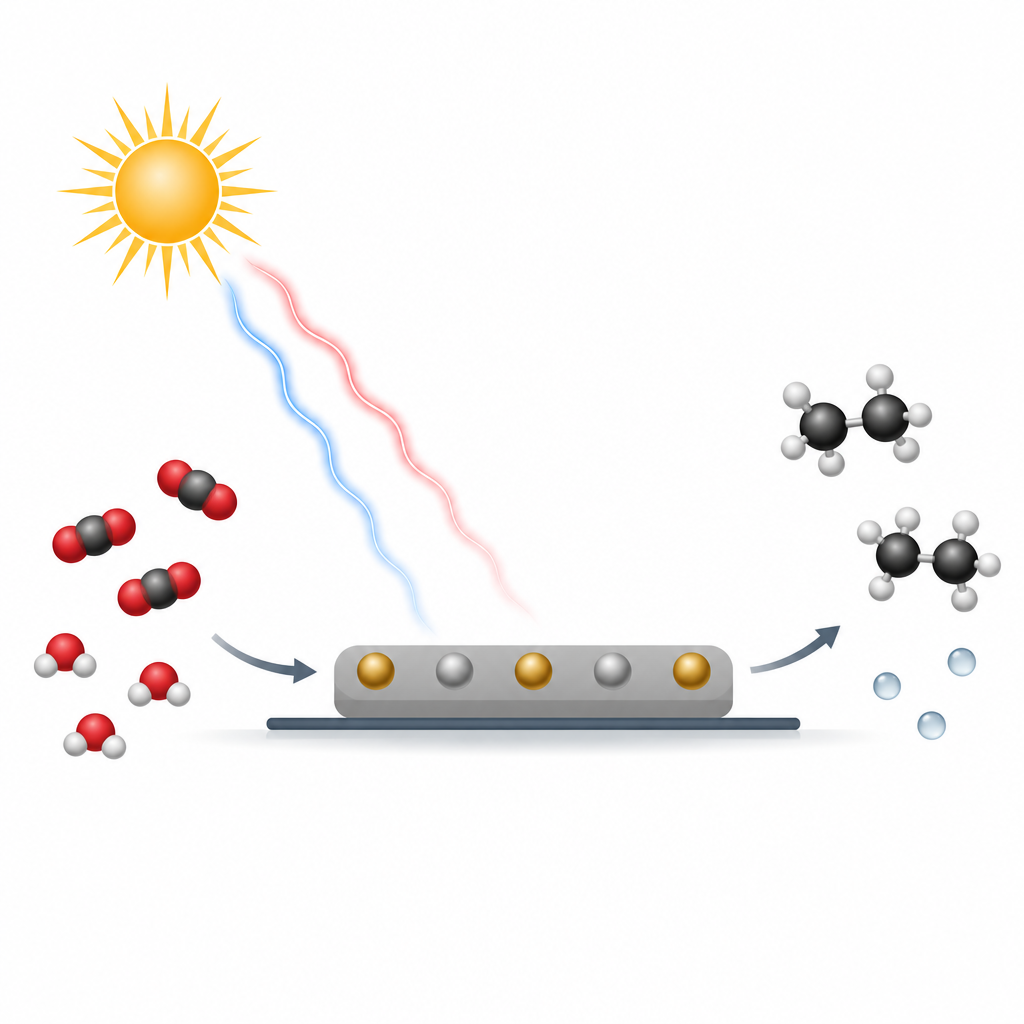
Finding ways to turn carbon dioxide, a major greenhouse gas, into useful fuels is one of today’s big scientific challenges. This study explores a new kind of light-driven chemistry that not only converts CO2 into a higher value fuel, ethane, but also keeps the catalyst from wearing out by using different colors of light as a sort of on and off switch for its activity.
Why Catalyst Fatigue Is a Problem
Photocatalysts use light to drive reactions, but they often lose their strength over time because their active sites change in unwanted ways. Most research has focused on how light-created charges interact with the molecules being transformed, such as CO2, while largely ignoring how these charges can quietly reshape the catalyst itself. When active sites slowly turn into less useful forms, performance drops and the system becomes impractical for long-term use.
A Two-Color Catalyst Design
The researchers designed a catalyst that responds differently to two key regions of light: ultraviolet and visible. The material is built from tiny gold particles sitting on a solid mixture of cerium and copper oxides shaped like nanorods. In this structure, the oxide part mainly absorbs higher energy ultraviolet light, while the gold particles are tuned to visible green light through a phenomenon known as a plasmon effect. Together they create two types of energized electrons that can be controlled by picking the right wavelength of light.
From CO2 to Ethane
In tests that used only ultraviolet light, the catalyst converted CO2 and water into several products, with ethane, a two-carbon fuel, standing out when copper was present. Under these conditions, the system achieved a high ethane production rate and good selectivity, meaning most of the electrons went into making ethane rather than other byproducts. However, the performance quickly faded: the amount of ethane dropped while simpler products like carbon monoxide became more common, signaling that the special copper sites responsible for joining carbon atoms together were being altered during use.
Using Light as a Repair Tool
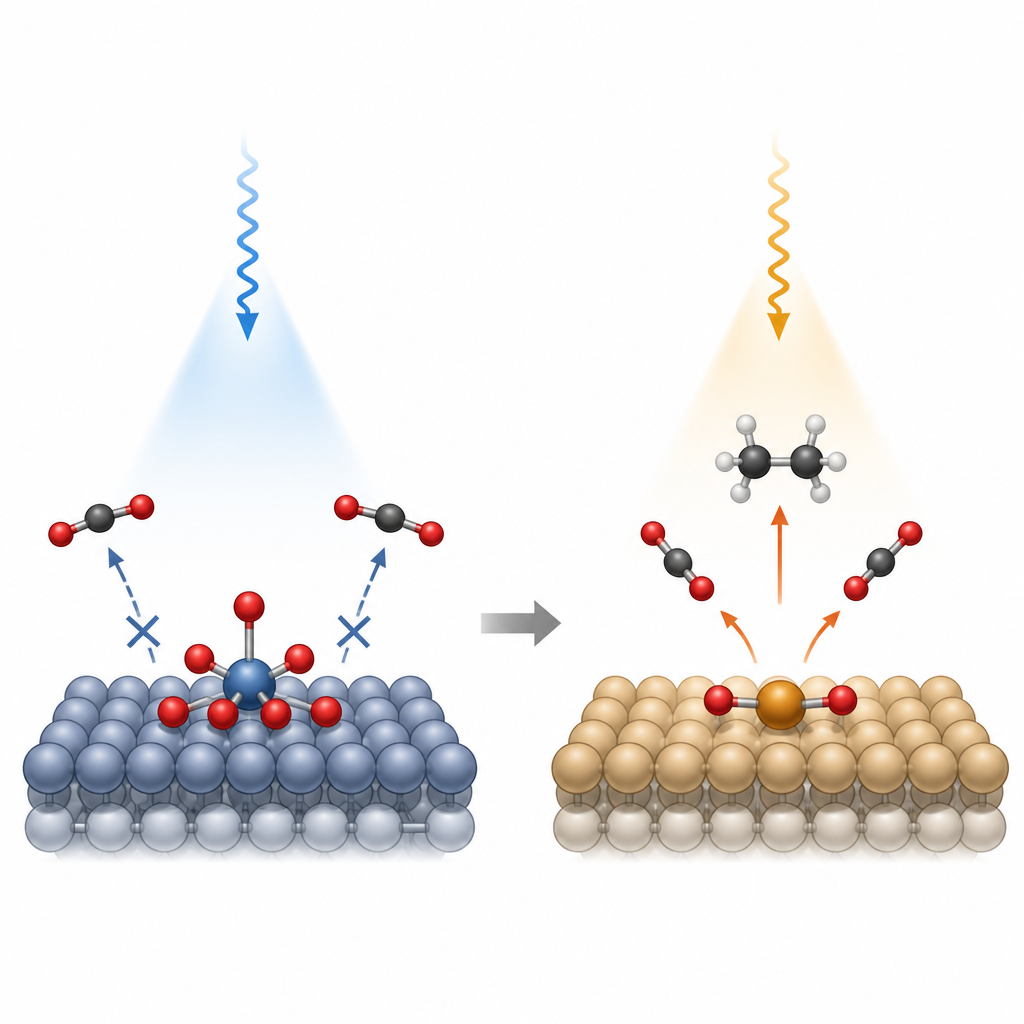
Detailed measurements showed that under ultraviolet light, a particular copper site that is very good at grabbing CO2 and helping two carbon units come together binds extra oxygen atoms that come from the CO2 molecules themselves. This transforms the site into a more crowded and less active form. When the team then shone green light that mainly excites the gold particles, high-energy electrons flowed from the gold into the copper. These electrons both reduced the copper back to a more active state and loosened some of the extra oxygen bonds, restoring the original, more open copper site. By cycling between ultraviolet and green light, the catalyst surface repeatedly shifted between deactivated and reactivated structures in a controlled way.
A Stable Light-Driven CO2-to-Fuel Cycle
When both ultraviolet and green light were used together, the repair process ran continuously, so that the active copper sites were regenerated as they were being used. Under this combined illumination, the catalyst maintained nearly its full ethane production rate for two days, and it also worked stably under simulated sunlight. To a non-specialist, the key message is that the authors have turned light itself into a tool not just for driving a reaction, but also for continually healing and reshaping the catalyst so it can keep working. This wavelength-responsive “self-refreshing” behavior points to new ways of building durable systems that turn CO2 and water into useful fuels with the help of carefully chosen colors of light.
Citation: Huang, Z., Zhu, Y., Liu, Q. et al. Wavelength-responsive in situ redox chemistry enables stable CO2 photocatalysis. Nat Commun 17, 4700 (2026). https://doi.org/10.1038/s41467-026-71257-7
Keywords: CO2 photocatalysis, light-driven catalysis, ethane fuel, plasmonic gold, catalyst stability