Clear Sky Science · en
Reentrant superconductivity in a naturally occurring Josephson junction array tuned by radio-frequency power
Electric currents that flow without a push
Most of the time, when electricity moves through a wire it wastes energy as heat. Superconductors are special materials where current can flow without this loss, but they usually work only under very strict conditions of low temperature and low magnetic field. This study explores an unusual twist on this behavior, where a superconductor seems to switch off and then switch back on again as you change conditions, revealing rich hidden physics that could help design future quantum devices.
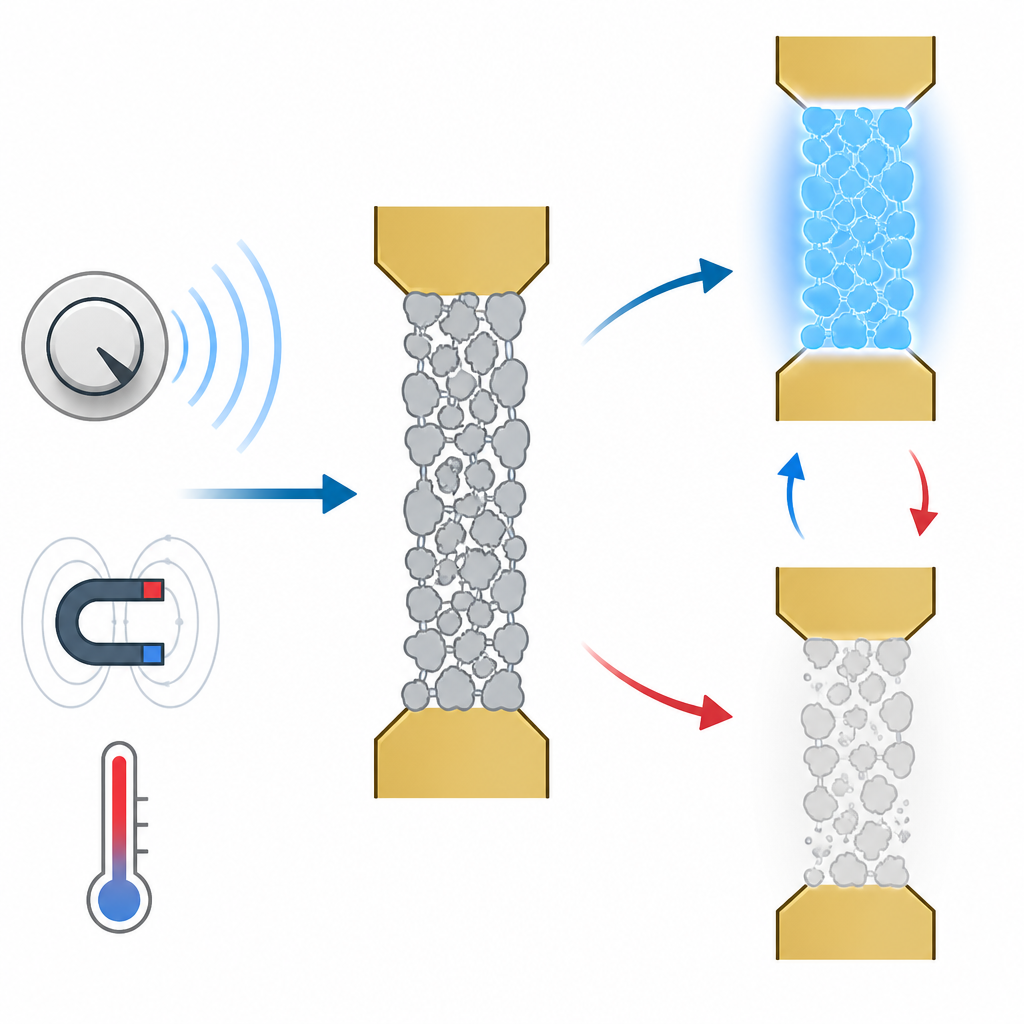
A simple material with a hidden network
The researchers focus on granular aluminum, a thin film made of countless tiny superconducting metal grains separated by thin insulating barriers. Together these grains form a natural network of weak links for electrons, known to physicists as a Josephson junction array. Although each link is simple, the entire network can show complex collective behavior. Granular aluminum is attractive because its grains are extremely small, which makes quantum effects strong and lets the scientists tune how easily electrons move between grains.
Using radio waves as a tuning knob
Instead of rebuilding the material each time they wanted to change its properties, the team used radio frequency power as a remote control. They sent a radio signal through the device while also passing a small direct current and adjusting temperature and magnetic field. By gradually increasing the radio power, they could push the system from a smooth, fully superconducting state into an insulating one, where current is strongly blocked and the resistance becomes ten times higher than in the ordinary, non superconducting metal state. At low temperatures they also saw large plateaus in the voltage as they varied current, known as giant Shapiro steps, which reveal that many weak links in the network act in lockstep like a single, well coordinated junction.
A superconductor that leaves and comes back
The most striking effect appeared when the team mapped how the resistance changed with both temperature and radio power. At a certain radio power, the material starts out superconducting at very low temperature, then turns insulating as the temperature is raised, and then, quite unexpectedly, becomes superconducting again at a higher temperature before finally turning into a normal metal. In other words, the perfect conduction disappears, reappears, and then disappears once more as the sample warms. A similar return of superconductivity also shows up when magnetic field is applied under the right conditions.
Many particles acting together
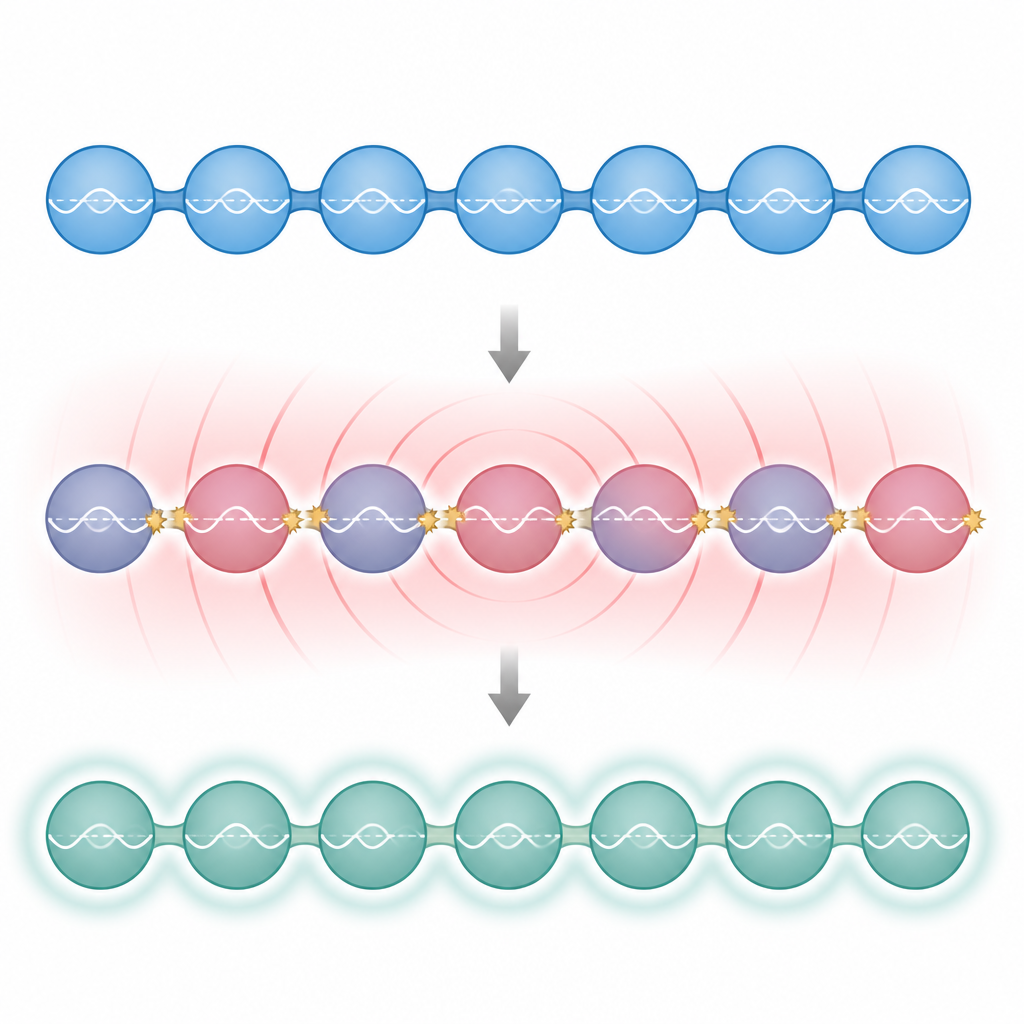
To make sense of this puzzling return of superconductivity, the authors compare their findings with a theoretical picture developed for networks of weak links. In that view, not only the ease of current flow between grains matters, but also how strongly electric charge is locked in place on each grain. At higher temperatures, mobile charged particles in the array can screen, or soften, the repulsion between charges, effectively lowering the penalty for moving charge from grain to grain. Even though higher temperature usually harms superconductivity, in this network it can actually favor the cooperative state by reducing this locking effect. This many particle behavior goes beyond what a single weak link can show.
Why this matters for future technology
Together, the measurements and modeling show that a simple looking granular metal can act as a controllable playground for complex quantum states. By adjusting radio power, temperature, and magnetic field, the same device can be switched between a stiff superconducting state, an insulating state dominated by quantum fluctuations, and a reentrant superconducting state driven by many body screening. This versatility suggests that granular superconductors could serve as building blocks for new quantum circuits and as model systems for exploring how large networks of quantum elements give rise to surprising collective behavior.
Citation: Avraham, S., Sankar, S., Sandik, S. et al. Reentrant superconductivity in a naturally occurring Josephson junction array tuned by radio-frequency power. Nat Commun 17, 4734 (2026). https://doi.org/10.1038/s41467-026-71256-8
Keywords: reentrant superconductivity, granular aluminum, Josephson junction array, radio frequency tuning, quantum phase transition
See more on the researcher's website: https://daganlab.sites.tau.ac.il/