Clear Sky Science · en
Reconstitution of spermatogenesis and continuous generation of functional haploid germ cells in mouse testicular organoids
Why Growing Mini Testes Matters
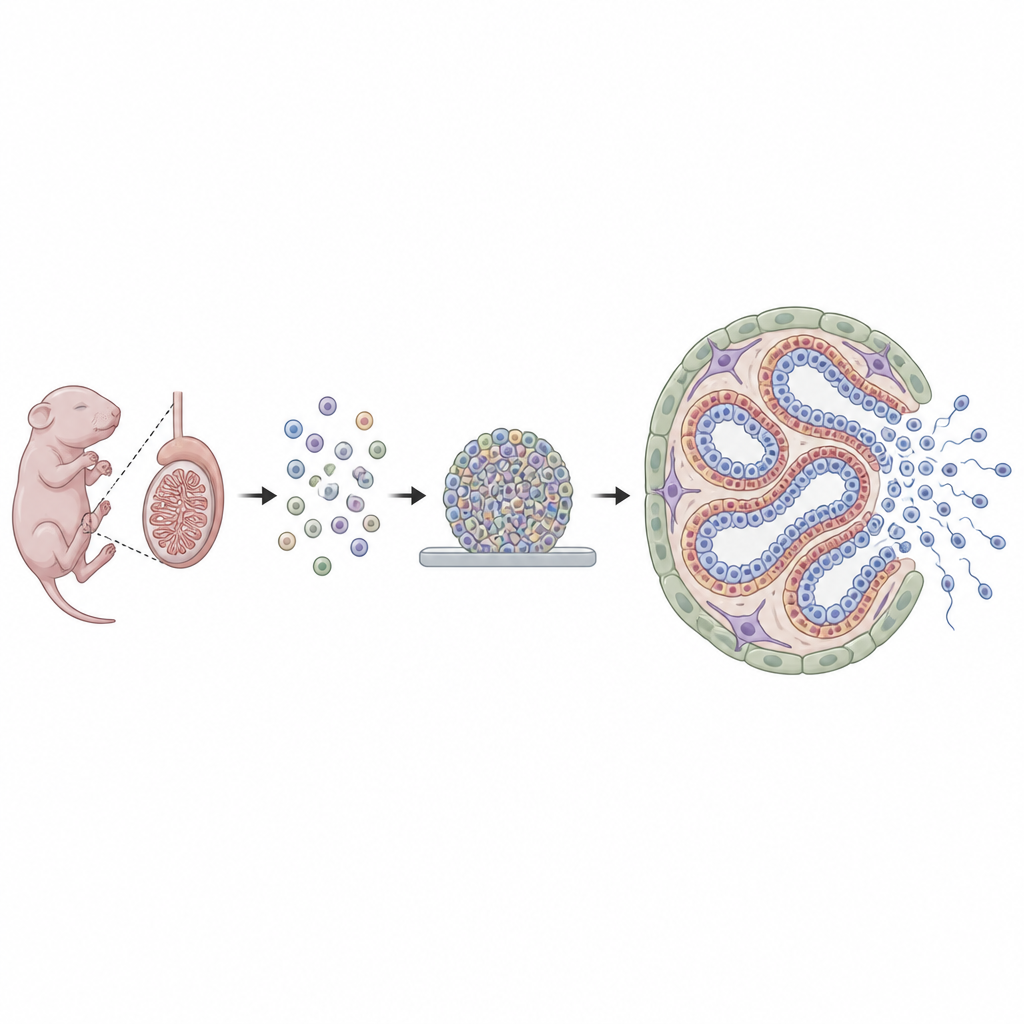
For men who cannot produce sperm, current options to have genetically related children are very limited. This study describes a way to grow tiny, lab-made “mini testes,” called testicular organoids, from newborn mouse cells. These organoids can carry out much of the complex process of sperm production and even generate round sperm-like cells that create healthy offspring in mice. The work offers a powerful new tool for studying male infertility and for testing drugs that might protect or restore fertility.
Building a Mini Testis in a Dish
The researchers began with testicular cells taken from newborn mice and encouraged them to clump together into small spheres. They then used a two-stage recipe of culture liquids: an initial “formation” stage that helps cells assemble proper structures, followed by a “differentiation” stage that supports later development. This stepwise method produced optimized testicular organoids, or O-Torgs, that grew in size over several weeks and formed tube-like patterns resembling the seminiferous tubules where sperm normally develop in the body. Compared with earlier culture methods, these organoids built more regular tubules and contained all the key supporting cell types.
Copying the Structure and Hormones of the Real Testis
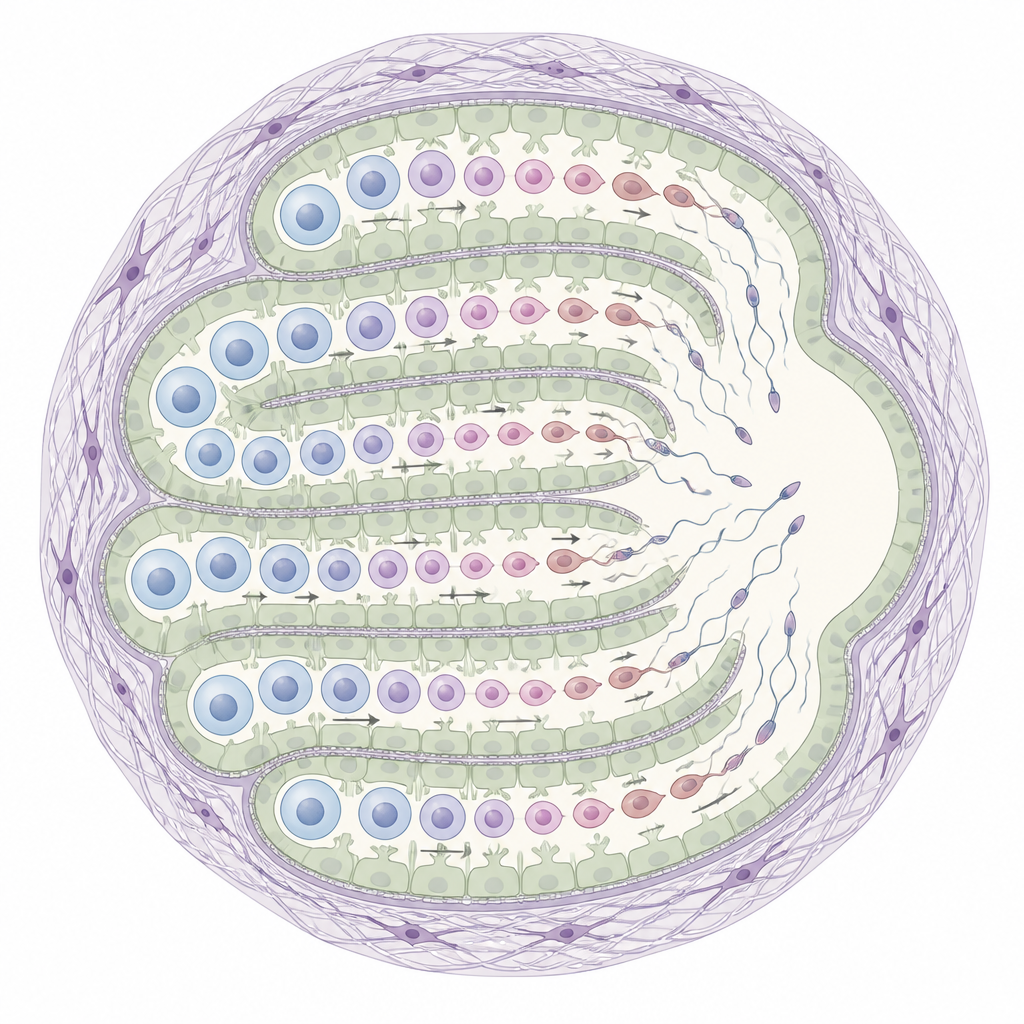
Closer examination showed that the organoids recaptured many hallmarks of a functioning testis. Microscopy revealed layers of support cells wrapped around the tubules and a clear inner space, much like in natural tissue. A barrier between blood and the interior of the tubules, crucial for protecting developing germ cells, also formed. Inside the tubules, the team observed a full range of germ cells, from early stem-like cells through dividing cells to round sperm-like cells. The organoids produced testosterone in patterns that closely tracked normal testis development, and the hormone level rose further when stimulated, indicating active hormone-producing cells.
From Lab-Grown Germ Cells to Healthy Offspring
To test whether the round spermatids made in the organoids truly functioned as male germ cells, the scientists injected them directly into mouse eggs, a technique related to assisted reproduction. Organoids maintained sperm production for up to 90 days, an unusually long period for lab culture. Spermatids collected at different times could fertilize eggs and develop into healthy pups. These offspring grew normally, were fertile, and their own young also showed normal growth and reproductive organs. Chemical tests on DNA confirmed that important imprinting marks, which help control gene activity passed from parents, were similar to those seen in natural sperm.
How the Supporting Scaffold Shapes Success
Why did the two-stage culture work so well? A key factor was the extracellular matrix, the protein-rich scaffold that surrounds cells. During the early formation stage, the chosen medium increased matrix components linked to tube formation and cell organization. When the team deliberately disrupted this scaffold with enzymes or other compounds, the organoids formed fewer and less regular tubules and produced fewer spermatids later on. Single-cell RNA sequencing showed that support cells in O-Torgs communicated more effectively with germ cells, strengthened the protective barrier, and more strongly activated genes involved in the critical steps of meiosis, where cells halve their chromosomes.
Using Mini Testes to Model Infertility and Test Drugs
The organoids also served as a model for chemotherapy-induced infertility. When exposed to the cancer drug busulfan, O-Torgs shrank and lost many germ cells, mimicking the damage seen in treated patients. The researchers then added various compounds reported to protect fertility and found that several increased the number of sperm-like cells in damaged organoids. One molecule, BTT-3033, not only improved germ cell numbers in the dish but also helped busulfan-treated mice regain larger testes, more sperm, and more normal-looking tubules. Gene studies suggested it works in part by reducing inflammation and cell death in the testis.
What This Means for Future Fertility Care
This study shows that carefully staged culture conditions can coax mouse testicular cells to self-organize into mini organs that continually produce functional sperm-like cells. While the work is still in mice and does not yet apply to human treatment, it offers a realistic testbed to explore why sperm production fails and to screen drugs that might shield or restore fertility, especially in boys and men facing cancer therapy. In the long run, refining such organoids may help bridge the gap between basic reproductive biology and safer, more effective fertility-preserving strategies.
Citation: Wan, C., Li, Q., Yao, Z. et al. Reconstitution of spermatogenesis and continuous generation of functional haploid germ cells in mouse testicular organoids. Nat Commun 17, 4610 (2026). https://doi.org/10.1038/s41467-026-71254-w
Keywords: testicular organoids, spermatogenesis, male infertility, germ cells, drug screening