Clear Sky Science · en
Interplay of urbanization and agricultural modernization shapes nitrogen use in global croplands
Why cities and farms share the same story
As more people move into cities, it is easy to forget that their food still comes from distant fields. This study looks at how growing cities quietly change the way farmers around the world use nitrogen fertilizer, a key ingredient that boosts crop yields but can also pollute air and water. By tracking six decades of data from 139 countries, the authors show that there is no single path toward both feeding people and protecting the environment. Instead, the impact of city growth on farming depends on how modern the farms already are and how rich the country has become.
How nitrogen became both helper and hazard
Modern agriculture relies on nitrogen fertilizer to grow more food from each hectare of land. Since 1961, the amount of nitrogen fertilizer used on global cropland has risen more than sevenfold, and average crop nitrogen harvested per hectare has tripled. This boom has helped secure food supplies in many regions, especially in China, India, Europe, and North America, where improved crop varieties and better management supported rising yields. But fertilizer use often grew faster than harvests, so a smaller share of applied nitrogen ended up in crops. Global nitrogen use efficiency fell from about 45 percent in the 1960s to roughly 35 percent in the 1990s before climbing back to around 45 percent in the 2020s, largely due to better management in wealthier countries. 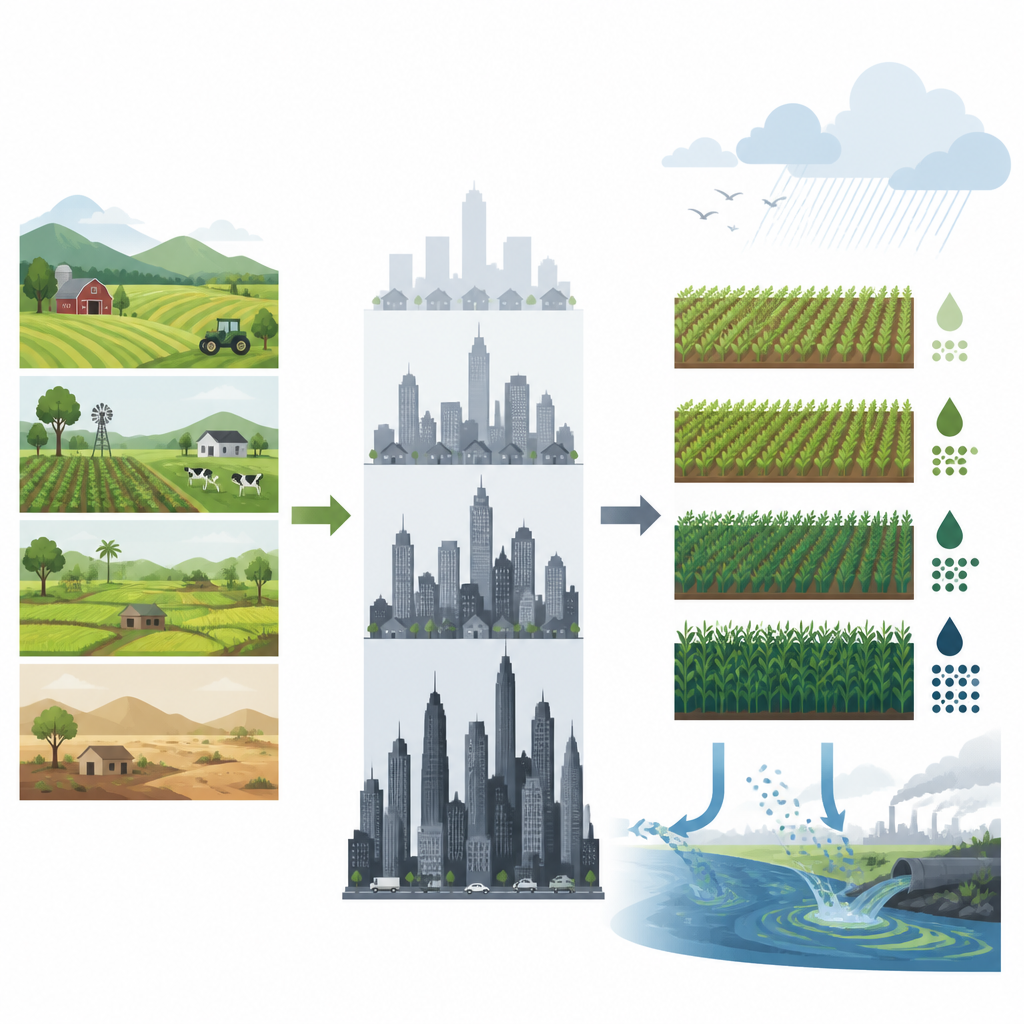
Uneven progress across the world
Behind these global averages lie very different regional stories. In parts of Central Asia, crop nitrogen yields stagnated or even dropped after the collapse of Soviet-era farm systems, as subsidies vanished and irrigation networks deteriorated. In contrast, countries such as Denmark and the Netherlands managed to raise crop nitrogen yields while cutting fertilizer use by adopting precision farming. Rapidly industrializing countries like China and India saw fertilizer use surge faster than yields for long periods, which pushed efficiency down and increased nitrogen losses. These patterns highlight how urban growth, economic transitions, and local policies can either strengthen or weaken the link between fertilizer inputs and useful harvests.
When city growth helps or hurts farm performance
The authors move beyond simple averages to ask how the effects of urbanization change as countries grow richer and farms modernize. Using a dynamic statistical framework, they tease apart the direct influence of rising urban populations from the indirect roles of farm size, machinery use, and irrigation. In poorer countries, each step of urban growth tends to raise fertilizer use without clearly improving yields or efficiency. As people leave the countryside and fields fragment, small farms struggle to afford machinery and other technology, so more fertilizer brings only modest gains. Larger farm sizes can soften these early losses by making mechanization worthwhile, but this benefit is limited when credit, infrastructure, and markets are weak.
Modern tools change the rules
In countries that reach middle-income levels, the picture shifts. Here, better irrigation and mechanization begin to reduce fertilizer needs and can improve nitrogen use efficiency, but trade-offs emerge. Investments in irrigation often help farmers use nitrogen more effectively and cut fertilizer demand, yet they can also slow yield growth if not paired with the right machinery and management. In already wealthy nations, where farms are generally large and well equipped, further expansion of farm size offers little extra benefit and may even harm yields and efficiency. Instead, fine-tuned technologies such as advanced machinery and efficient irrigation become the main tools that allow highly urbanized societies to keep nitrogen losses in check while maintaining output.
No single recipe for sustainable farming
The study’s central message is that urbanization does not automatically help or harm agriculture; its effects depend on timing, income level, and how modernization unfolds. In poor countries, policies that combine modest land consolidation with access to appropriate machinery and inputs can keep early urban growth from undermining harvests. Middle-income countries need balanced strategies that use irrigation and mechanization to cut fertilizer waste without sacrificing yields. Wealthy nations should focus less on making farms bigger and more on precision technologies and recycling nutrients. In all cases, smart combinations of land management, machines, and water control can turn the growth of cities into a force that supports both secure food supplies and cleaner environments. 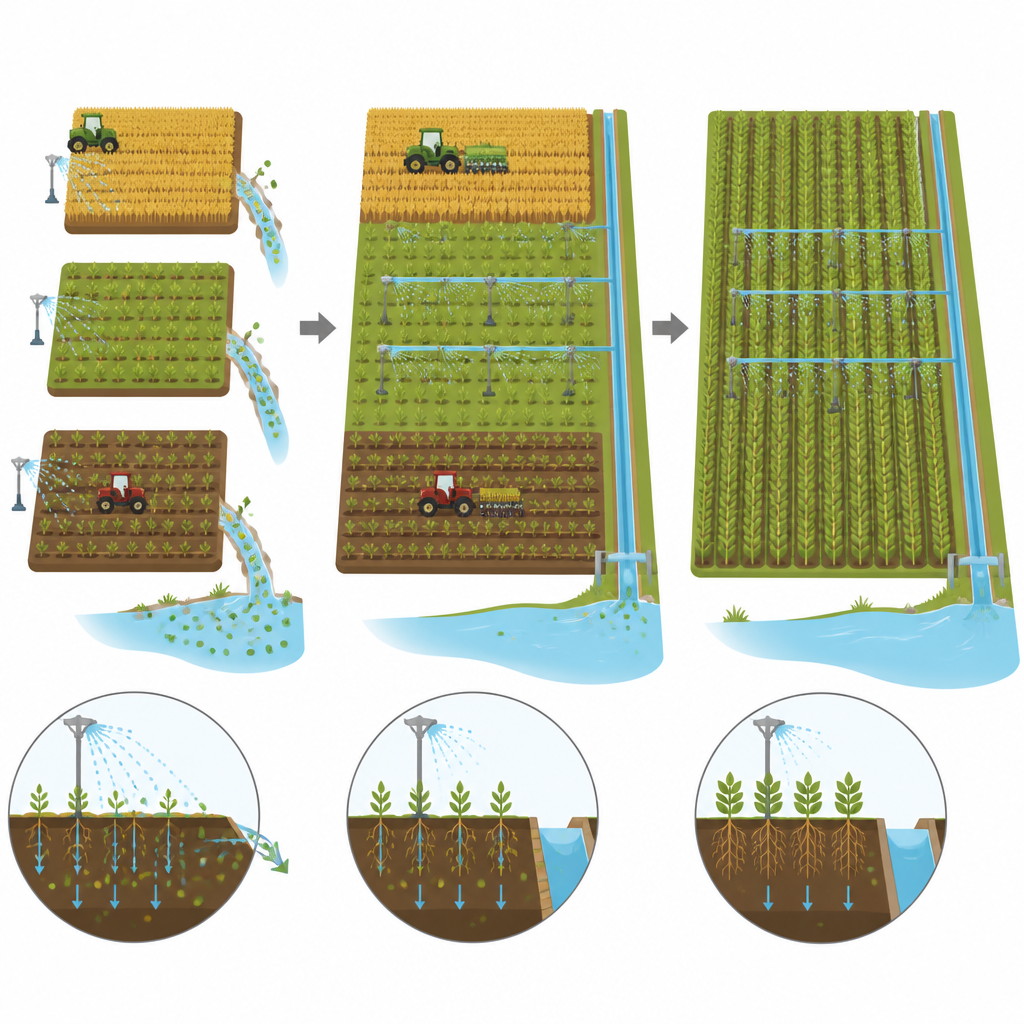
Citation: Wang, S., Zhang, X., Deng, O. et al. Interplay of urbanization and agricultural modernization shapes nitrogen use in global croplands. Nat Commun 17, 4524 (2026). https://doi.org/10.1038/s41467-026-71251-z
Keywords: urbanization, nitrogen fertilizer, crop yields, agricultural modernization, food systems