Clear Sky Science · en
In-fibre logic and memory via tuneable passivation–corrosion
Smart clothes that can think
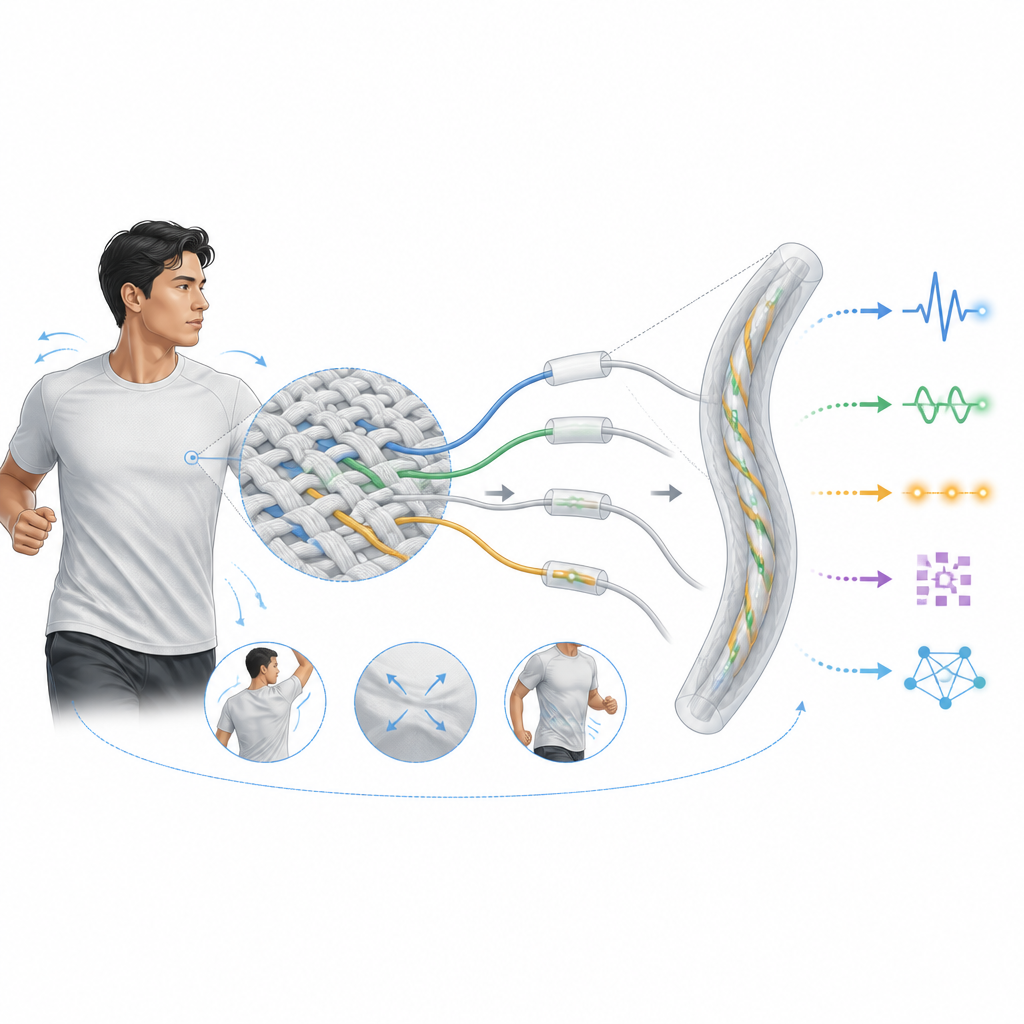
Imagine pulling on a T shirt that not only tracks your movements and health, but also quietly thinks and remembers without any hard plastic gadgets sewn in. This study shows how a single soft fibre, almost as thin as ordinary sewing thread, can be turned into a tiny building block for computing and memory inside everyday textiles.
Why rigid chips do not fit soft fabrics
Today’s wearable gadgets mostly rely on the same stiff silicon chips used in phones and laptops. These chips are much harder and less bendable than cloth, so when they are added to clothing they create lumps, pressure points, and weak spots that can break during bending, stretching, or washing. Current textile electronics often hide small circuit boards on pockets or patches, which makes it difficult to truly blend technology into fabric so that the user barely notices it. To achieve clothing that really behaves like a computer, the electronics must share the softness, stretch, and fine threadlike shape of normal yarns.
Turning a single fibre into logic and memory
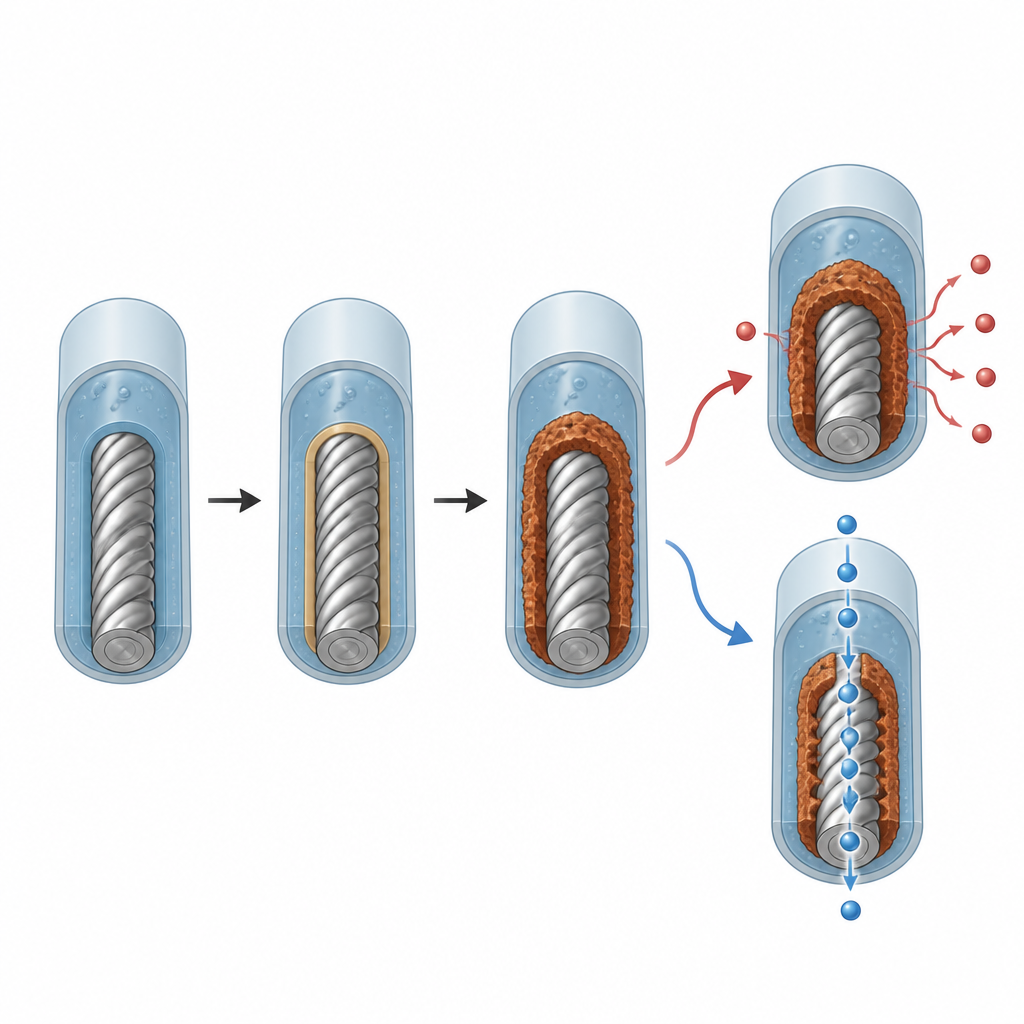
The researchers designed a fibre called FLAME that can act as both a logic element, like a diode, and a memory element, like a memristor. The fibre has three main parts: a thin aluminium wire twisted into a springlike helix at the centre, a soft water based gel surrounding it, and an elastic silicone shell on the outside. By briefly applying specific voltages after the fibre is made, the team can change the surface of the aluminium inside the gel. Under mildly acidic conditions, the metal grows a tight, insulating film that can either partially or fully cover it. Under mildly basic conditions, a looser, easily removed layer forms. These subtle surface changes control how electric current can pass, letting the same fibre be “reprogrammed” to behave as a one way valve for current or as an element whose resistance remembers past signals.
How chemistry controls switching and memory
The heart of the approach is a controlled dance between passivation and corrosion on the aluminium surface. In an acidic gel, a positive voltage builds a dense oxide film that slowly spreads; if it covers the metal only partly, each pulse adds more oxide and gradually alters the current response, giving memristor like behaviour. If the treatment continues, the film blankets the surface and largely blocks chemical reactions, so the fibre acts like a diode that allows current more easily in one direction. In a basic gel, a rough layer of aluminium hydroxide grows under positive bias. A later negative bias can partly dissolve or strip away this layer, exposing fresh metal and changing how current flows. By choosing the gel’s acidity and carefully tuning the strength, sign, and duration of the pre applied voltages, the researchers map out regions where the fibre behaves like a diode, like a memristor, or like a combination of both.
Building fabric logic and brainlike functions
Because the fibre is soft and stretchable up to about half its length, it can be threaded through a standard sewing needle and woven on commercial looms just like ordinary yarn. In diode mode, it cleanly rectifies alternating signals at voltages much higher than many previous soft fibre devices and remains stable over thousands of cycles and long test periods. By stitching pairs of these fibres together with stretchable resistive threads, the team built simple “OR” and “AND” logic gates directly inside fabric that continue to work even when the cloth is stretched. In memristor mode, the fibres mimic aspects of biological synapses: repeated voltage pulses can strengthen or weaken their conductance, their response fades or persists over time, and arrays of crossing aluminium and carbon threads sprayed with gel can store patterns. A 6 by 6 textile grid could “write” and “erase” simple shapes and letters by locally changing the conductance at chosen crossing points.
What this means for future clothing
This work shows that by steering basic metal surface chemistry inside a soft fibre, it is possible to pack both decision making and memory into threads that feel and behave like normal textile yarns. While more engineering is needed to scale up production and protect the gel in real world conditions, the approach points toward clothes that host hidden, reconfigurable computing networks, bringing sensing, simple processing, and data storage directly into the fabric itself.
Citation: Li, Y., Yang, W., Shokurov, A.V. et al. In-fibre logic and memory via tuneable passivation–corrosion. Nat Commun 17, 4666 (2026). https://doi.org/10.1038/s41467-026-71249-7
Keywords: textile computing, wearable electronics, memristor, soft logic devices, smart fabrics