Clear Sky Science · en
Induction and regulation of reversible suspended animation in C. elegans
A Pause Button for Tiny Animals
Imagine being able to press pause on life, stay safely dormant through hard times, and then pick up right where you left off. This study explores exactly that kind of “pause button” in tiny roundworms called C. elegans, revealing how simple conditions can push an animal into a deep, reversible stillness that could one day inform organ preservation, emergency medicine, and even long space travel.
How Worms Slip into Stillness
The researchers discovered that C. elegans enter a dramatic quiet state when many worms are left crowded together in a simple salt solution that matches their internal salt level. In this liquid, at high population density, worms across almost all life stages stop developing and moving, yet remain alive. The team calls this condition liquid-induced suspended animation, or LISA. Unlike a specialized larval “dauer” stage or states triggered by lack of oxygen, LISA is easy to induce, works from early youth through adulthood, and does not require complex equipment. Worms in LISA keep their basic body structure, can stay paused for many hours, then recover in a synchronized way when returned to food-rich plates, resuming growth and crawling almost as if nothing happened. 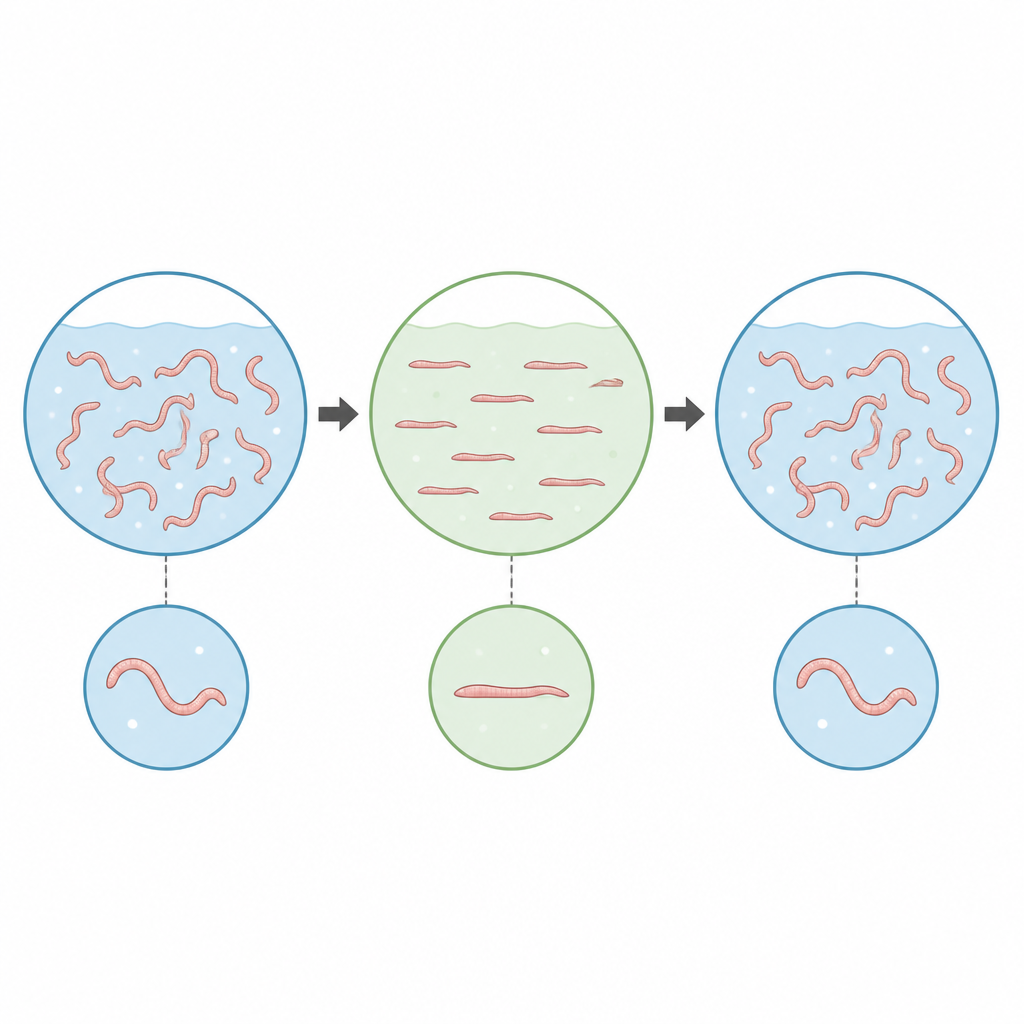
A Body Running on Low Power
To understand what happens inside the paused worms, the scientists measured gene activity, cell structures, and hundreds of chemical metabolites. They found that LISA rewires the worms’ biology into a low-power mode. A family of stress-related genes, especially small heat-shock proteins known as hsp-16, becomes strongly activated, but the corresponding proteins surge mainly after the worms wake up, suggesting that LISA prepares cells for the stressful restart rather than reacting to the pause itself. Energy factories inside cells, the mitochondria, shift from long networks to more fragmented shapes and show reduced calcium levels, consistent with a hypometabolic, energy-saving state. Chemical profiles of key fuels and redox molecules also change in ways that indicate slower energy use and adjusted metabolism designed to conserve resources during the pause.
Cell Recycling Systems Keep Paused Worms Alive
The team next asked which genes help worms survive long stretches in LISA. Using random mutagenesis and targeted gene knockdowns, they found mutants that turned on stress reporters more strongly and survived longer in suspended animation. Two genes stood out: daf-21, which encodes the chaperone protein Hsp90, and lin-61, a chromatin regulator. In these mutants, stress-protective programs were already partly engaged, giving the worms extra resilience. Key stress regulators HSF-1 and DAF-16 cooperated to support survival, especially through the cell’s recycling and waste-handling system: the lysosomes and related autophagy machinery. Under LISA, lysosomes in the intestine became more tubular, a shape linked to boosted breakdown and recycling. When crucial recycling genes were disrupted, worms died more readily in LISA, showing that robust clean-up and resource recovery are essential to ride out this deep pause.
How the Nervous System Restarts Movement
Suspended animation ends with an orderly awakening, and the researchers uncovered a neural circuit that controls this return to activity. Specific sensory neurons called AFD and their partner interneurons AIY are required for timely recovery; when these neurons are missing or impaired, worms wake slowly. A sleep-promoting neuron known as RIS, by contrast, delays awakening, acting as a brake. Communication molecules called neuropeptides, particularly PDF and its receptor, link this circuit to the motor system that drives crawling. Calcium imaging showed that AFD and AIY neurons fall quiet during LISA, then gradually increase activity after worms are placed back on food. Boosting a common internal signal, cAMP, either by genetics or by light-activated enzymes, causes worms to wake faster, while removing this pathway slows their return. Together, these findings suggest that awakening is an active decision managed by a balance between arousal-promoting and sleep-like signals. 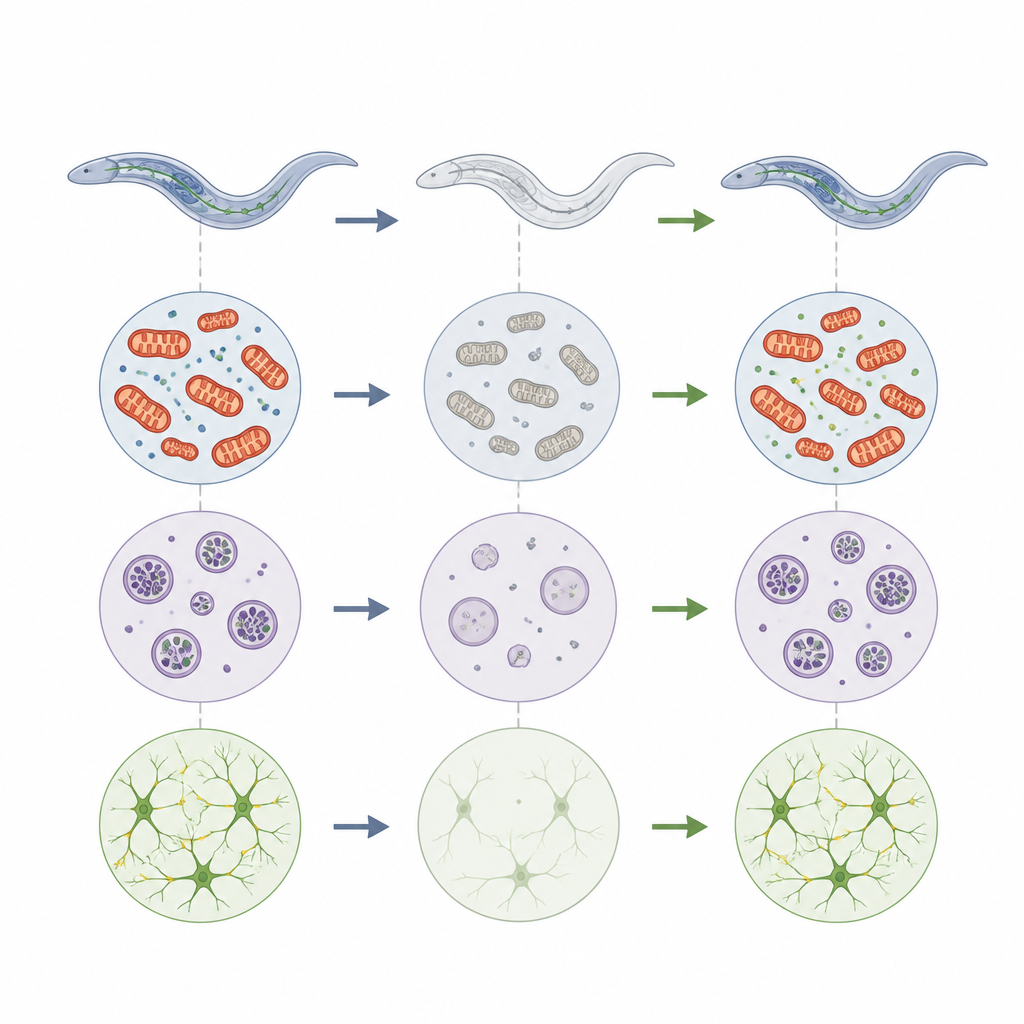
Why This Matters Beyond Worms
By defining LISA, this work provides a simple, controllable system in which whole animals can be pushed into and pulled out of a reversible life pause. The study shows that success in this state depends on a coordinated blend of stress-protective genes, powerful recycling systems, tuned-down energy use, and a dedicated brain circuit that times awakening. While humans do not naturally enter suspended animation, the core themes uncovered here energy conservation, cellular clean-up, and neural control of arousal are shared across animals. Understanding how worms safely pause and restart life may help guide future strategies for protecting tissues, extending viability of organs outside the body, or designing safer forms of induced metabolic slowing.
Citation: Liu, J., Wang, B., Leon Catrow, J. et al. Induction and regulation of reversible suspended animation in C. elegans. Nat Commun 17, 4627 (2026). https://doi.org/10.1038/s41467-026-71247-9
Keywords: suspended animation, C. elegans, metabolic suppression, stress resilience, neural awakening