Clear Sky Science · en
Preventing peritendinous adhesions using lubricious supramolecular hydrogels
Why keeping tendons moving matters
When a tendon in a hand or ankle is repaired after injury, scar tissue can form between the tendon and its surroundings, tethering the moving tissue in place. These sticky bands, called adhesions, can rob people of finger movement or ankle flexibility and often require more surgery. This study explores a simple gel that surgeons can spread around a repaired tendon to keep it sliding smoothly while it heals, with the goal of preserving motion and reducing pain.
A common problem after tendon surgery
Each year, millions of people suffer tendon injuries that demand surgical repair, especially in the flexor tendons of the hand. After surgery, the body’s normal wound response can create fibrous bridges between the tendon and nearby tissue, limiting range of motion and grip strength. Current options are limited: intense rehabilitation must start almost immediately, and if adhesions still form, surgeons may need to cut them away. Existing barrier products are hard to use in cramped spaces like finger pulleys, can be difficult to manufacture at scale, or are not widely approved. Clinicians and patients need a barrier that is easy to apply, safe, and long lasting enough to protect the tendon during the critical first weeks of healing.
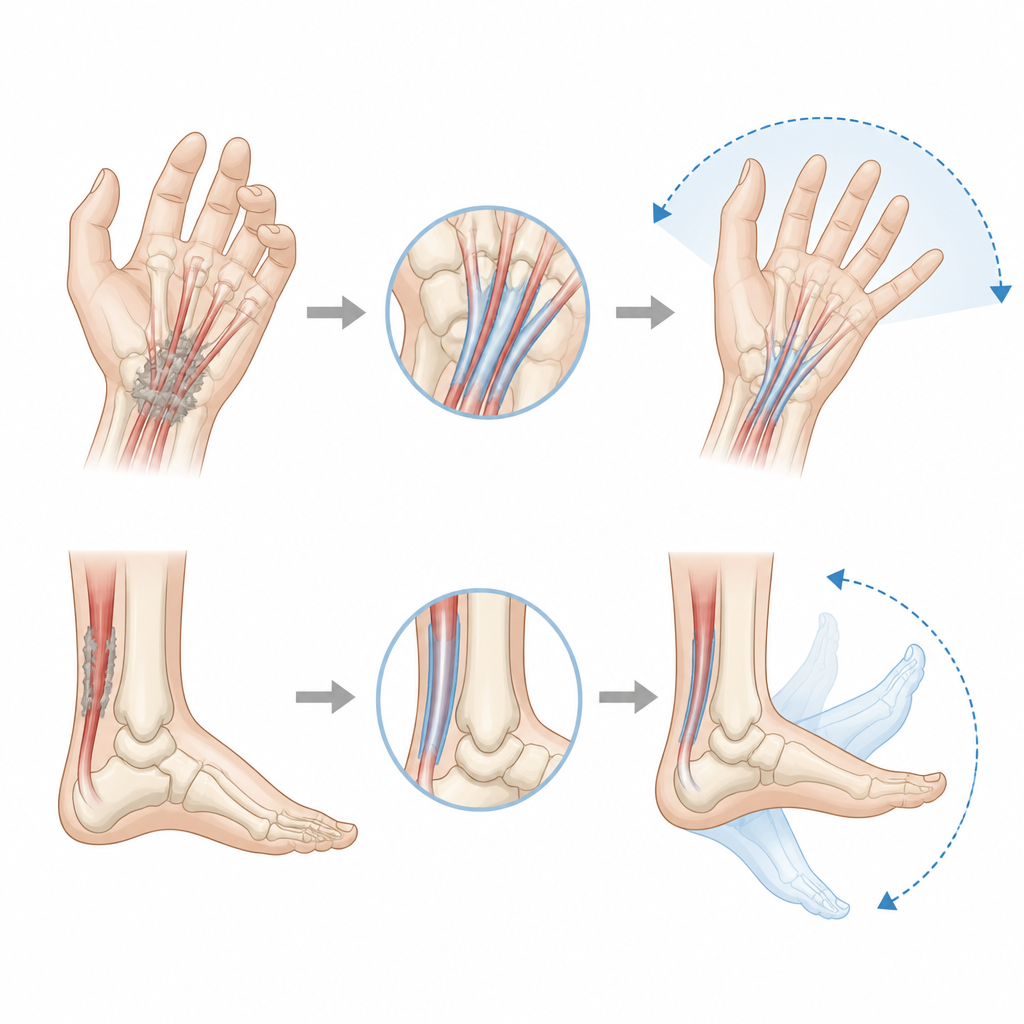
A soft gel that flows, sticks, and then disappears
The researchers designed a new hydrogel made from two familiar ingredients: a cellulose-based thickener used in medicines and a common surfactant. Mixed in water, they self-assemble into a soft solid that behaves in a special way. Under stress, such as being pushed through a thin needle or squeezed by moving tissue, the internal links in the gel temporarily break so it can flow. When the stress eases, those links quickly reform, and the gel becomes solid-like again. Tests showed that this material can be injected through very small needles, then recover its structure, and that its key mechanical properties remain stable from refrigerator temperatures to body heat. It also hardly swells in water, so it is unlikely to squeeze on delicate structures as it gradually dissolves.
How the gel behaves on real tissues
For a barrier to work around a tendon, it must stick to the tissue surface without peeling away, yet still allow the tendon to glide. Using mechanical tests on human and mouse tissues, the team found that the gel tends to fail inside itself rather than at the tissue surface when stretched or sheared. In practical terms, the gel clings to skin and tendon while yielding within its bulk, preserving a thin lubricating layer between moving surfaces. In donated human hands, surgeons recreated typical hand tendon injuries, repaired them, and then coated the repair with the gel. Measurements of the force needed to flex the fingers showed that the gel did not make motion harder, and inspection after repeated bending confirmed that the gel stayed in place around the repaired tendon without harming its structure.
Recovering motion in an animal model
To test performance in living tissue, the team used a rat model in which the Achilles tendon is fully cut and repaired. In some animals the surgeons added no extra material, while in others they coated the repair with a version of the gel tagged with a near-infrared dye. Imaging over three weeks showed that most of the gel remained around the tendon through the early inflammatory phase of healing, then slowly waned. Detailed video-based gait analysis revealed that rats treated with the gel lost less ankle range of motion and, by eight weeks, had better dorsiflexion—the motion of bringing the toes toward the knee—than untreated animals. At the same time, mechanical tests showed that maximum strength and stiffness of the healed tendons were similar with and without gel, and microscopic examination found no extra inflammation or abnormal tissue patterns linked to the material.
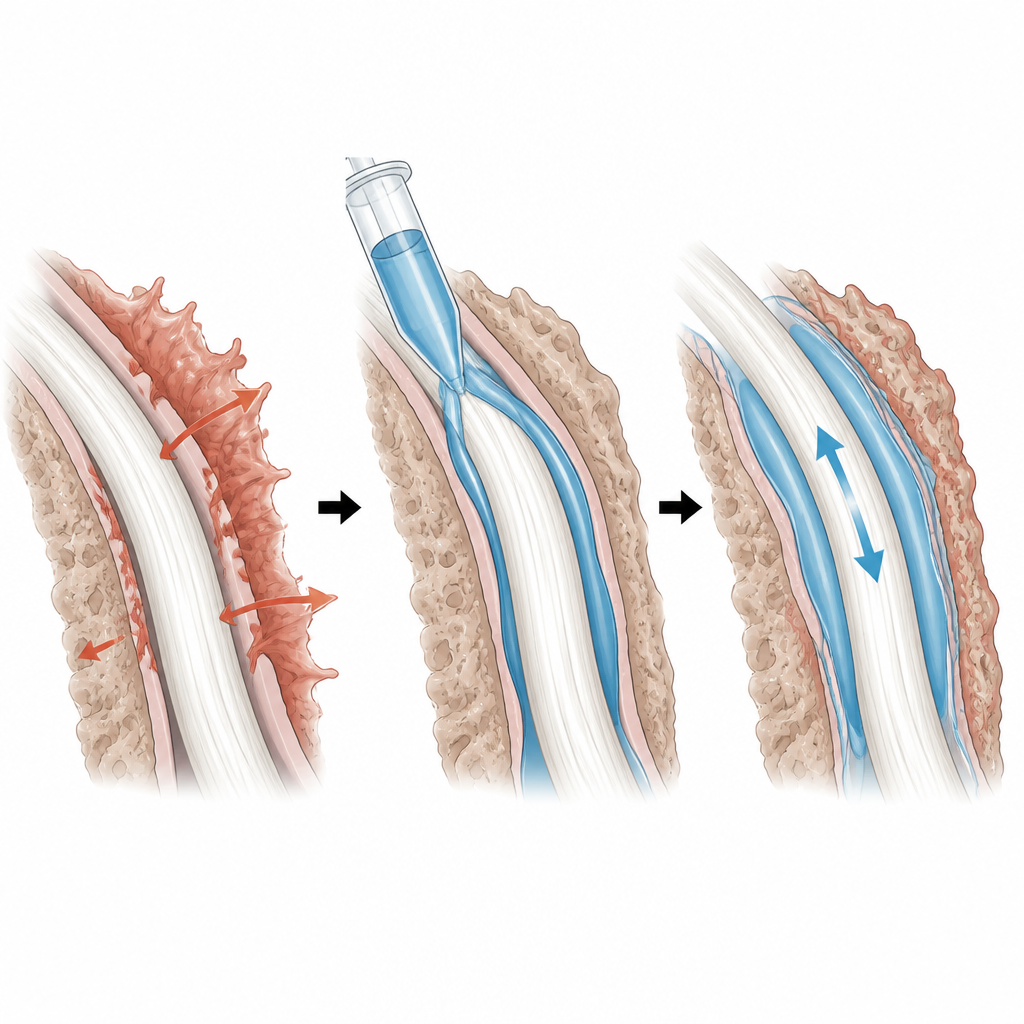
What this could mean for patients
To a patient, the most important question is whether their finger or ankle will move well again. This work suggests that a simple, injectable gel applied once during surgery can create a temporary, slippery sleeve around a repaired tendon, helping it glide while scar tissue forms in less harmful ways. The material is based on components already used in medicine, is straightforward to manufacture, and does not appear to weaken healing tendons in animals. While more studies in larger models and people are needed, this dynamic hydrogel points toward a future where fewer patients are left with stiff, painful joints after tendon repair.
Citation: Meany, E.L., Williams, C.M., Song, Y.E. et al. Preventing peritendinous adhesions using lubricious supramolecular hydrogels. Nat Commun 17, 4663 (2026). https://doi.org/10.1038/s41467-026-71244-y
Keywords: tendon adhesions, hydrogel barrier, tendon repair, range of motion, tissue healing