Clear Sky Science · en
Marine heatwaves shift ocean net primary productivity from the tropics toward the poles
Why ocean heatwaves matter for sea life and people
Recent bursts of extreme ocean warmth, known as marine heatwaves, are not just uncomfortable for sea creatures. They are quietly rearranging where the ocean produces most of its life-sustaining plant matter. This study shows that during these hot spells, the engine of marine food webs shifts away from the tropics and toward the poles, with important implications for fisheries, carbon storage, and coastal communities that depend on the sea.
Hidden engines of life in the sea
At the base of the ocean food web are tiny drifting plants called phytoplankton. Together they perform net primary production, the process of turning sunlight and nutrients into organic matter that feeds everything from small fish to whales while helping regulate Earth’s carbon cycle. This productivity is unevenly distributed. Coastal regions and areas where deep, nutrient-rich waters rise to the surface are especially productive, and many of these zones overlap with large marine ecosystems, the busy coastal seas that support almost all global fish catches.
What happens when the ocean heats up
Marine heatwaves are long-lasting episodes when surface waters become much warmer than usual. Using satellite records from 1998 to 2018 and ocean reanalysis data, the authors compared “ordinary” warm periods to true marine heatwaves. They examined how temperature, light, and nutrients combine to alter ocean productivity, and they separated changes directly tied to temperature from those driven by other factors such as shifting currents, plankton communities, or nutrient supplies. This approach let them see not only how much productivity changed, but also what types of processes were most responsible.
A global tilt from tropics to poles
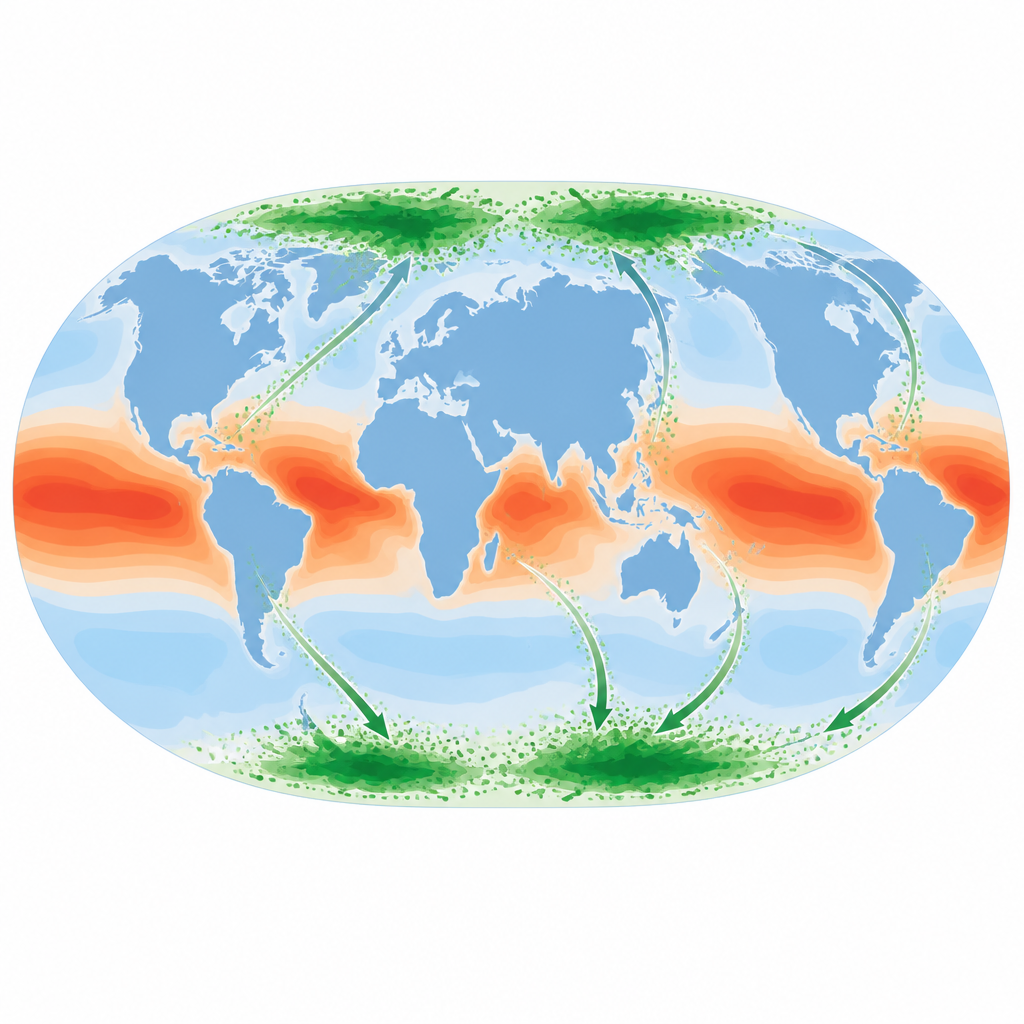
The analysis revealed a striking pattern. During marine heatwaves, productivity consistently drops in low-latitude tropical and subtropical waters yet rises at higher latitudes and in many coastal regions. Overall, low-latitude oceans lose 4 to 10 percent of their typical productivity, while high-latitude waters gain 4 to 21 percent. Large marine ecosystems respond especially strongly, with productivity anomalies nearly twice the global average. This means that, during extreme warming events, the ocean’s “green belt” of activity temporarily shifts poleward, redistributing the regions that most strongly fuel marine food webs and support fisheries.
Why different regions react in opposite ways
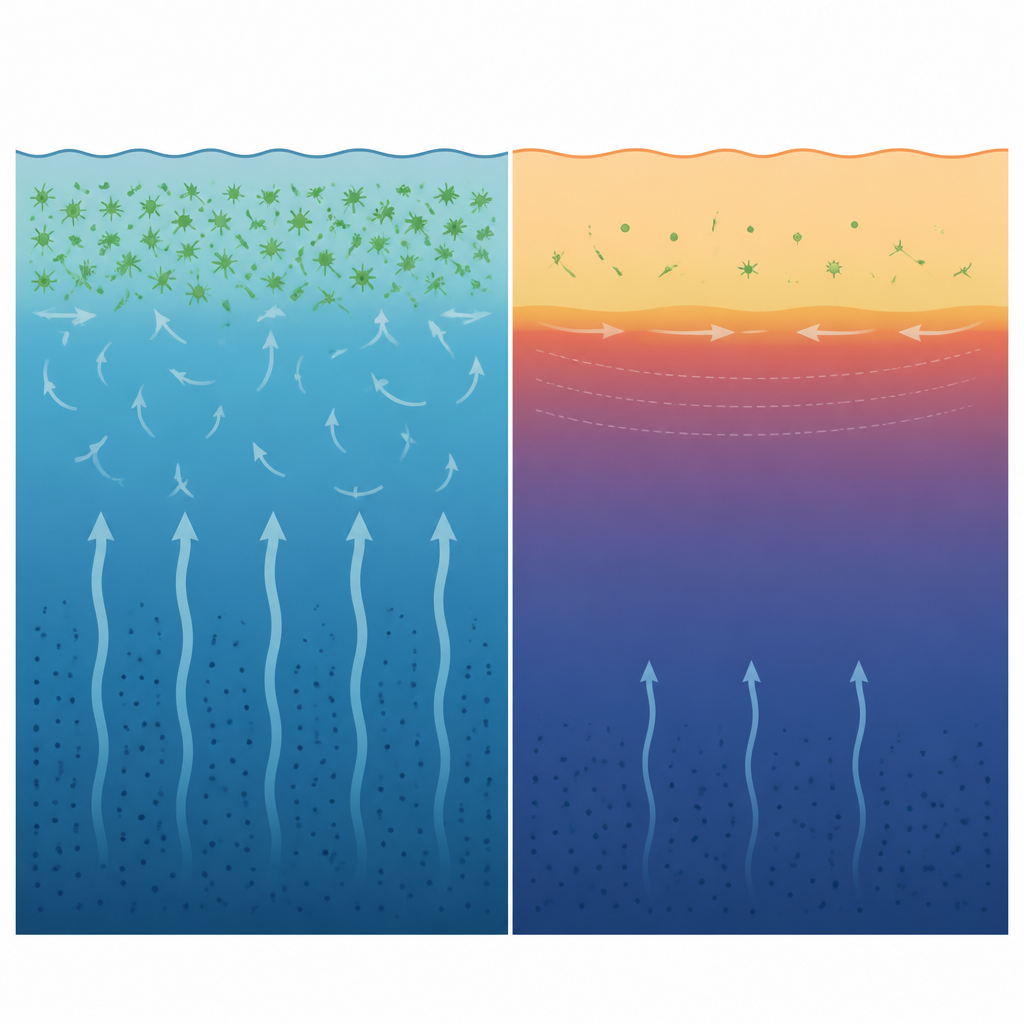
The contrasting response comes down to baseline conditions. Tropical and subtropical seas are warm, brightly lit, and chronically starved of nutrients. Extra surface heating there tends to strengthen layering in the water column, cutting off nutrient resupply from below, thinning phytoplankton populations, and reducing productivity. High-latitude and many upwelling regions, by contrast, start out cooler and nutrient-rich but more limited by light. In these places, the same weather patterns that drive marine heatwaves often also clear skies and raise light levels. Because nutrients are relatively plentiful, phytoplankton can take advantage of the brighter conditions, so productivity can hold steady or increase even as temperatures climb.
When temperature takes the driver’s seat
Under ordinary warm conditions, most year-to-year swings in productivity are governed by processes that do not line up neatly with temperature, such as complex food web shifts. During marine heatwaves, this balance changes. Across nearly four fifths of the global ocean and most large marine ecosystems, productivity variations become tightly linked to how warm the surface waters are. This does not mean temperature alone controls the biology, but it shows that many physical and ecological responses get bundled together with the heat, leaving ecosystems less flexible in how they respond.
What this means for the future ocean
As climate change makes marine heatwaves more frequent, longer, and stronger, the ocean is likely to experience repeated episodes in which productivity is suppressed in nutrient-poor low latitudes and boosted in cooler, nutrient-rich high latitudes. This emerging tilt raises concerns for tropical and subtropical regions, where many coastal communities already depend heavily on marine resources. The study highlights that to understand and manage future marine ecosystems, scientists and policymakers must account not only for gradual warming but also for the sharp, short-lived extremes that can temporarily rearrange where the ocean does most of its biological work.
Citation: Bian, C., Zhao, Z., Holbrook, N.J. et al. Marine heatwaves shift ocean net primary productivity from the tropics toward the poles. Nat Commun 17, 4624 (2026). https://doi.org/10.1038/s41467-026-71238-w
Keywords: marine heatwaves, ocean productivity, phytoplankton, climate change, large marine ecosystems