Clear Sky Science · en
Deciphering the Hidden Ecology and Connectivity of Vibrio in the Oceans
Why tiny sea germs matter
The oceans are full of invisible life that can shape human and animal health. Among these hidden passengers are Vibrio bacteria, a group that includes the agents of cholera and other serious infections. This study asks a simple but important question: how do these microbes move around the planet, and how quickly can they travel between distant coasts?
Tiny travelers on drifting life rafts
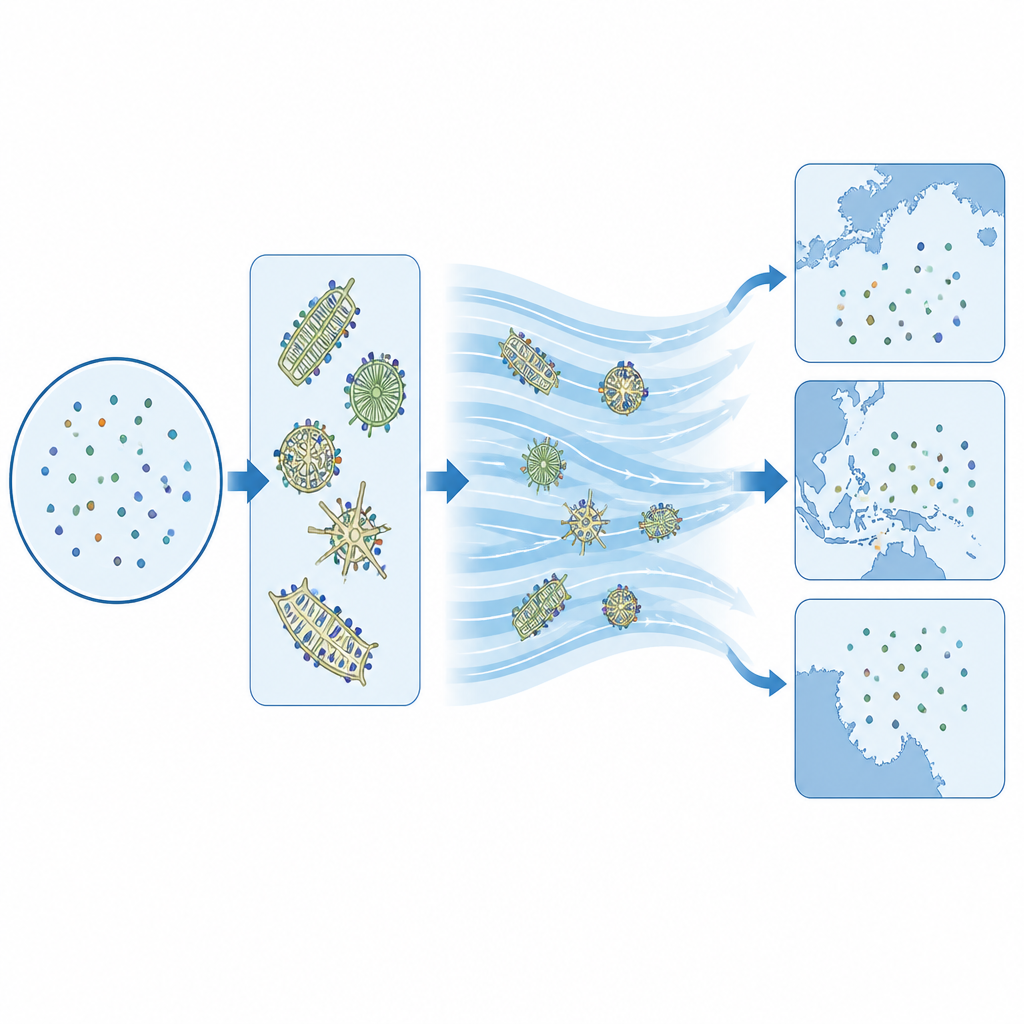
Using DNA data from about 1,500 seawater samples collected during the global Tara Oceans expedition, the researchers showed that Vibrio are far from rare in the open sea. They are especially common near the surface and are much more abundant when attached to floating particles and plankton than when free in the water. This suggests that many Vibrio cells spend their lives stuck to small drifting organisms, rather than swimming alone.
Maps of hidden communities
By looking at short DNA fragments, the team could treat Vibrio as genetic fingerprints and compare communities across the globe. Free-living Vibrio showed clear regional patterns and high local variety, meaning that groups in different ocean areas tend to become distinct from one another. In contrast, Vibrio attached to larger plankton formed more blended patterns, with similar communities found in far apart regions. This difference hints that the attached bacteria are better connected over long distances than their free-living cousins.
Ocean currents as highways
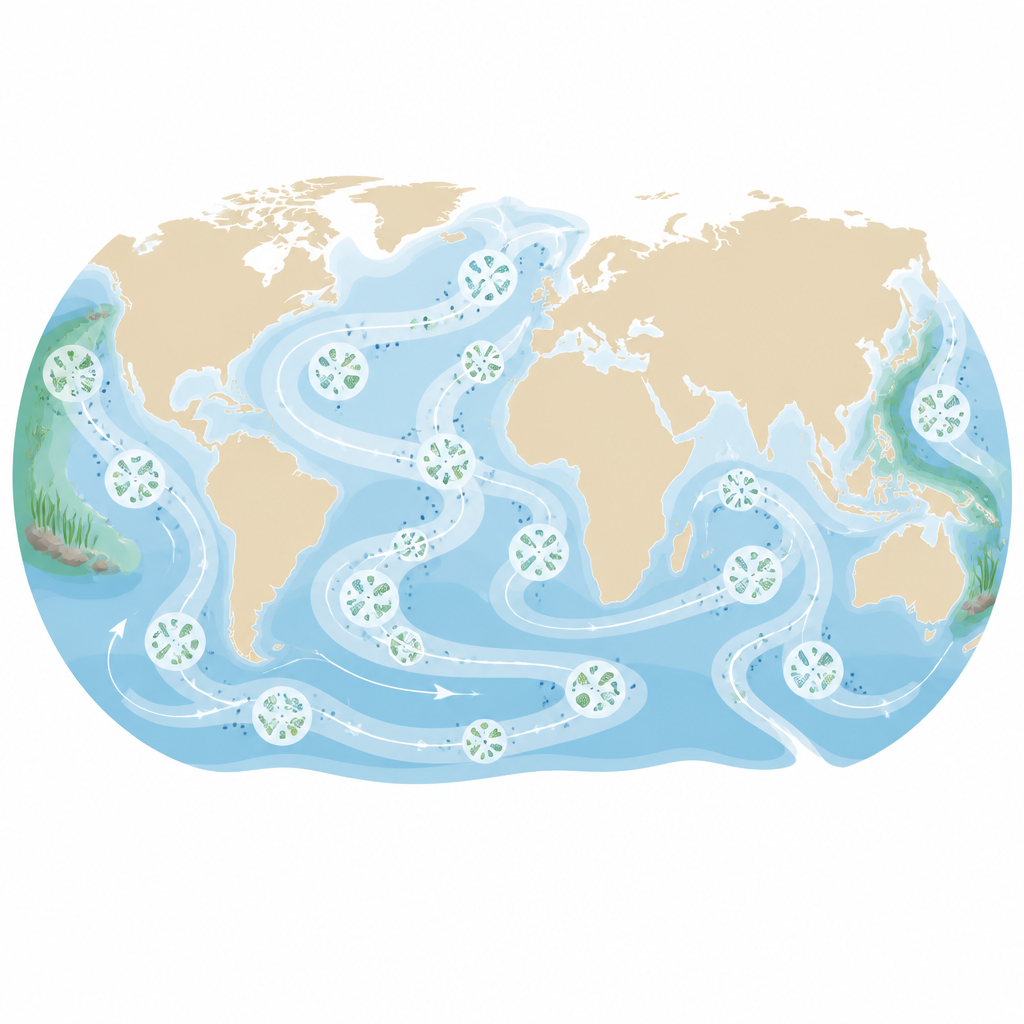
To test how Vibrio might be carried around the world, the scientists combined their DNA maps with data from thousands of drifting buoys that track surface currents. They estimated how long it would take water parcels to move between sampling sites and then compared this travel time with the genetic similarity of Vibrio communities. For free-living bacteria, similarity faded strongly with both distance and time. For Vibrio on larger plankton, similarity declined much more slowly with distance and was more closely tied to how long currents took to link places, up to about a year and a half. This pattern matches the idea that plankton, blown along by currents, act as living rafts that ferry Vibrio across ocean basins.
Global corridors and busy hubs
Network maps of connected sites revealed invisible “biological corridors” where Vibrio communities on plankton remain strikingly alike despite being thousands of kilometers apart. Many of the most connected hubs sit in the Indian and Pacific Oceans, areas already known as hotspots of Vibrio-related disease. In these regions, currents create shortcuts that allow Vibrio attached to plankton to cross an entire ocean basin in less than 1.5 years, repeatedly mixing newcomers from afar with local populations.
What this means for people and the planet
Overall, the study shows that the open ocean is not a barrier for Vibrio but a vast, dynamic transport system. Free-living Vibrio tend to adapt to local conditions and stay more isolated, while Vibrio riding on plankton can rapidly spread and mingle across the globe. This constant reshuffling may help disease-causing strains appear in new places and form lasting environmental reservoirs, especially as warming seas change currents and expand the regions where Vibrio can thrive. For a lay reader, the message is that microscopic life does not stay put: it travels along moving webs of plankton and water, and those journeys can influence future risks of marine and coastal infections.
Citation: Doni, L., Trinanes, J., Bosi, E. et al. Deciphering the Hidden Ecology and Connectivity of Vibrio in the Oceans. Nat Commun 17, 4707 (2026). https://doi.org/10.1038/s41467-026-71231-3
Keywords: Vibrio bacteria, plankton, ocean currents, marine microbiome, disease ecology