Clear Sky Science · en
Programmable multiscale energy release in synergistic energetic composites with three dimensional printed architectures
Building safer, smarter blasts
Explosions power rockets, airbags, and mining, but the energy they release is often hard to control. This study explores how to sculpt that burst of power in space and time by combining specially designed reactive particles with advanced 3D printing. The result is a new class of energetic materials whose burn speed, pressure surge, and fireball shape can be tuned more like an engineered machine than a simple bang.
Bringing two energetic worlds together
Conventional explosives, such as HMX, store fuel and oxidizer inside single molecules and produce large volumes of hot gas very quickly. They are good at driving powerful shock waves but limited in how much heat they release and how long the reaction lasts. Another family of materials, called metal-based reactive composites, mixes metal fuel with solid oxidizers. These burn very hot and dense but mostly form solid residues, so they build pressure less efficiently. The authors set out to merge these two approaches in a way that lets each compensate for the other’s weaknesses.
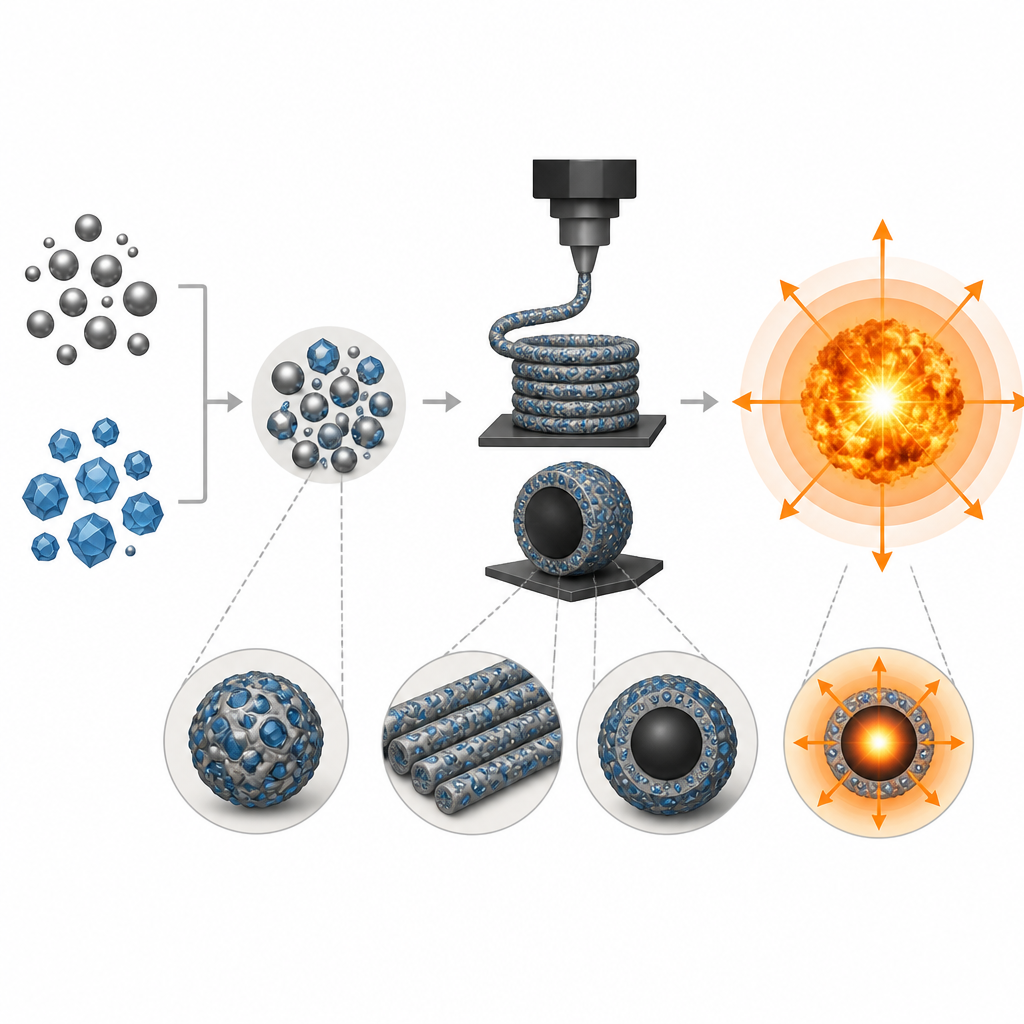
They focused on a tailored composite made from aluminum, titanium, and copper oxide particles wrapped around crystals of HMX. Using an acoustic mixing method, they caused fine metal and oxide grains to coat and cling to the larger explosive crystals, forming uniform core–shell particles. Microscopy and X-ray tests confirmed that the ingredients stayed chemically separate during preparation while being intimately interlocked in structure. Among several mixing ratios, the blend with 40 percent metal composite and 60 percent HMX gave the most even coverage and densest packing.
How the new particles burn
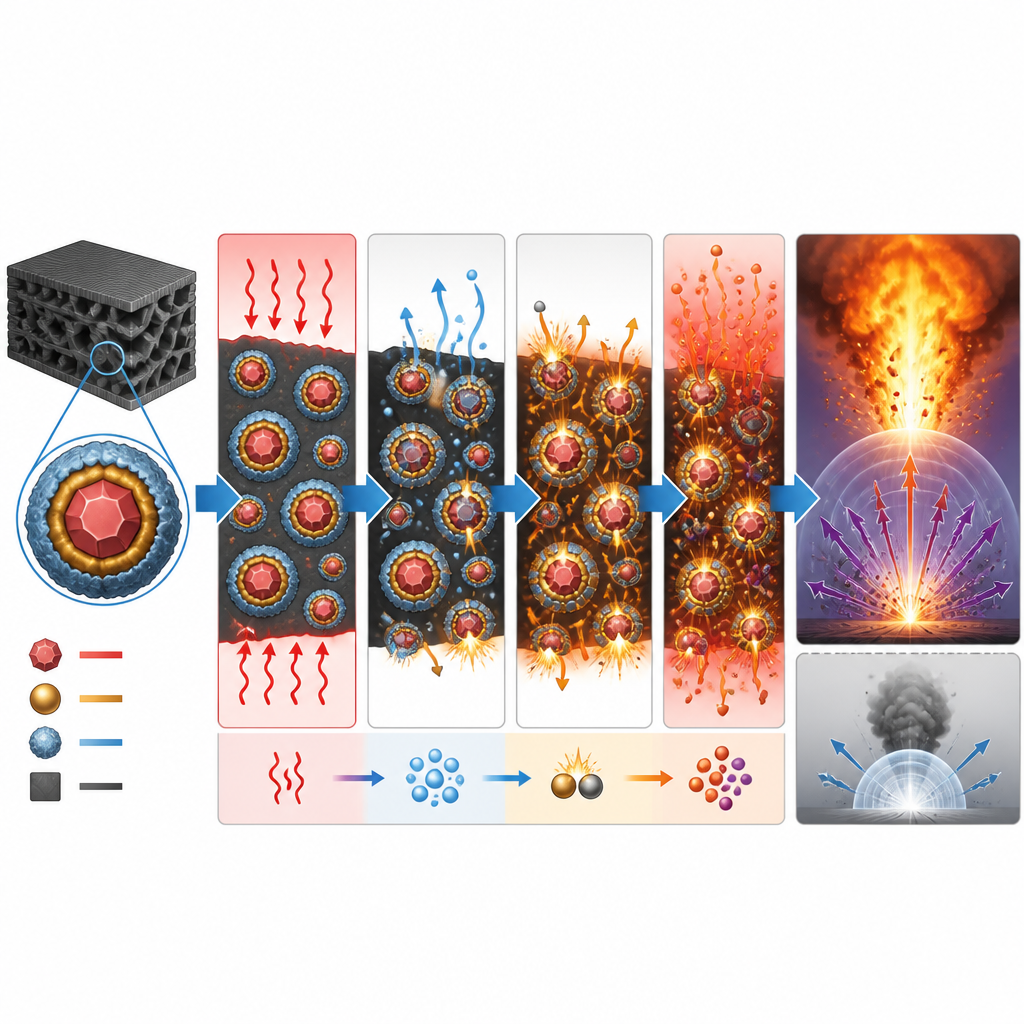
When gently heated, pure HMX melts and then decomposes in a quick, gas-producing burst. In the new composite particles, the metal-rich shell changes this behavior. It nudges HMX to start breaking apart at slightly lower temperature and in both solid and molten forms, while the early gases and heat from HMX trigger a second, slower stage: intense metal–oxide reactions that extend up to nearly 1000 degrees Celsius. Infrared and mass-spectrometry measurements show that the presence of aluminum, titanium, and copper not only speeds up the first stage but also diverts the breakdown through pathways that favor continued heat release rather than unstable by-products.
These microscopic changes have clear macroscopic effects. Under open air, laser ignition tests reveal that all mixed powders burn more vigorously than HMX alone, which does not ignite under the same conditions. The 40–60 blend, in particular, shows a tall, steady flame that lasts longer at high temperature than mixtures richer in metal, which burn fiercely but fade quickly. In closed vessels, adding the metal composite sharply increases both the peak pressure and the rate at which pressure rises, thanks to the coupling between hot gas from HMX and heat from the mostly solid metal reaction. Under modest geometric confinement, the mixtures can even shift from simple burning to detonation as pressure waves and gas production reinforce each other.
Printing energy in three dimensions
To move beyond loose powders, the team turned the optimized composite into printable ink using a rubbery binder. Rheology tests showed that the ink flows under shear but recovers its stiffness once deposited, a key requirement for direct ink writing. They printed straight filaments and cylindrical “core–shell” structures in which a central rod of HMX is wrapped by an outer sleeve of the composite. Microscopy confirmed that the printed strands are dense and continuous, with the finer metal–oxide particles nestled around the larger explosive grains. Safety tests indicated that, despite higher sensitivity to impact and friction than HMX alone, the materials can be handled more safely when shaped remotely by 3D printing instead of cast by hand.
When ignited, printed composite filaments burn faster and more uniformly than printed HMX filaments, and in pressure chambers they produce higher peak pressures along with secondary pressure rises as the metal reactions catch up with the initial gas blast. In full-scale air shots, the core–shell charges generate large, long-lived fireballs and stronger shock waves than equal masses of HMX, while also spraying burning fragments that undergo small secondary bursts. Thermal cameras record higher average and peak temperatures, and pressure sensors show both increased overpressure close to the source and a particularly strong impulse farther away. Together, these results show that both composition and geometry can be used as knobs to program how energy is delivered.
Why programmable blasts matter
To a layperson, the key message is that explosions need not be crude, all-at-once events. By carefully wrapping explosive crystals in reactive metal shells and arranging them with 3D printing, engineers can choreograph when and where heat, gas, and pressure appear. This work demonstrates a toolkit for tuning energy release across multiple scales, which could support more efficient propulsion, tailored mining and demolition, and better control over blast-driven tests, all while hinting at safer manufacturing routes for powerful energetic devices.
Citation: Chen, Y., Ren, H., Xin, H. et al. Programmable multiscale energy release in synergistic energetic composites with three dimensional printed architectures. Nat Commun 17, 4491 (2026). https://doi.org/10.1038/s41467-026-71222-4
Keywords: energetic materials, 3D printing, explosives, combustion, shock waves