Clear Sky Science · en
Epitranscriptomic RNA editing resolves Mus81 DNA repair tradeoffs in heat tolerance and meiosis
How a Crop Fungus Juggles Survival and Reproduction
Farmers and plant breeders worry about fungi that ruin grain harvests and become harder to control as they evolve. This study looks inside one such fungus, Fusarium graminearum, and asks a simple question with big implications: how does it keep its DNA safe both when it is growing in heat and when it is making sexual spores that spread disease? The answer turns out to hinge on a subtle chemical tweak to RNA that lets the fungus fine‑tune a single repair protein rather than rewrite its genes forever.
Keeping DNA Safe at Different Times of Life
Every living organism must repair broken DNA, but the best repair strategy is not the same in all situations. During everyday growth, cells mostly want stability. During sexual reproduction, they deliberately break and reshuffle DNA to generate variety in their offspring. The researchers mapped the main DNA repair players in Fusarium and found that one protein, called Rad51, is essential for making sexual spores but not for ordinary growth in the lab. In contrast, several other repair helpers seemed less critical on their own, hinting that only a few key factors sit at the center of the fungus’s life‑cycle decisions.
One Protein at the Heart of a Trade‑Off
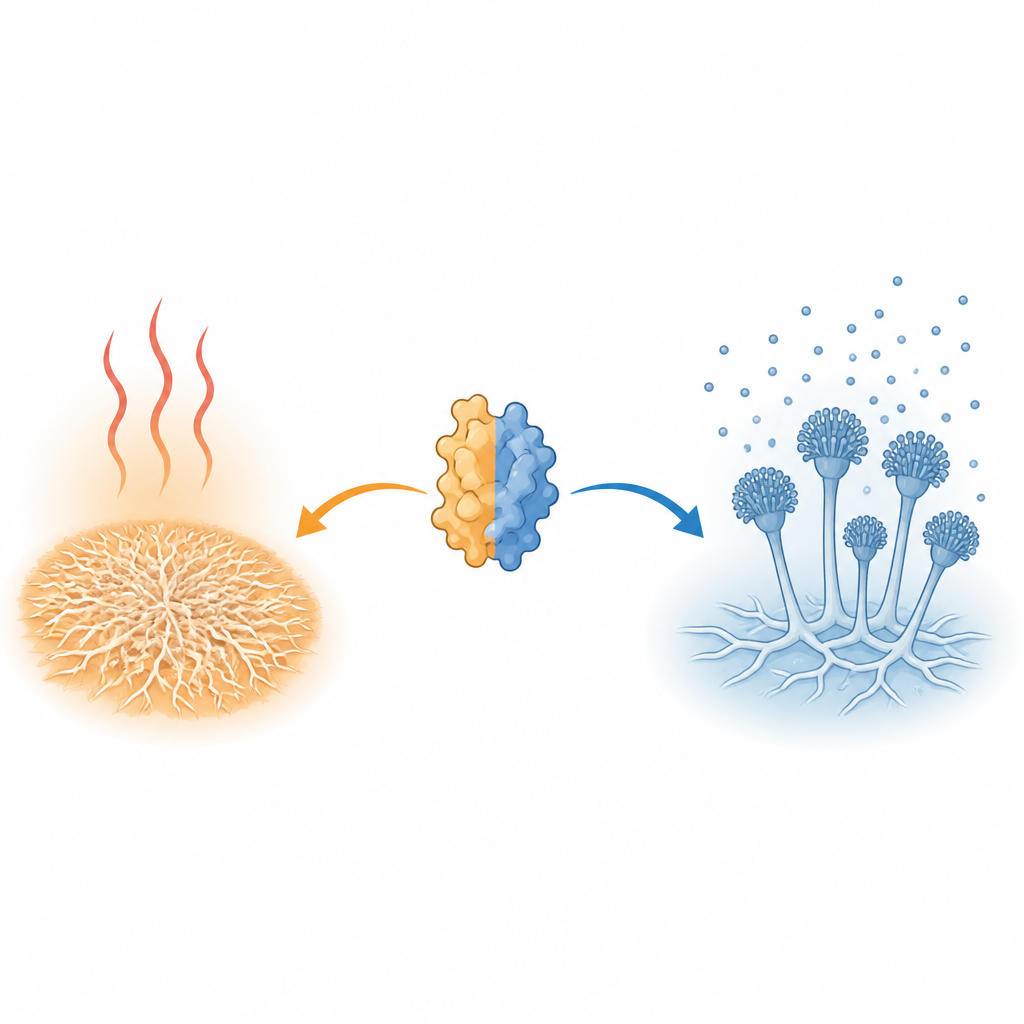
Among these helpers, a protein named Mus81 stood out. When the team deleted the Mus81 gene, the fungus struggled in two ways: it produced fewer normal sexual spores, and it grew poorly and lost pigment at higher temperatures. Surprisingly, removing Mus81’s usual partner or disabling Mus81’s cutting activity on DNA did not cause the same problems. This suggests that, in this fungus, Mus81 has a special, non‑standard role that goes beyond simply chopping DNA structures. It seems to act more like a hub that helps the cell finish tricky DNA repair jobs during both heat stress and the complex divisions of meiosis that lead to spore formation.
An RNA Switch That Dials Protein Levels
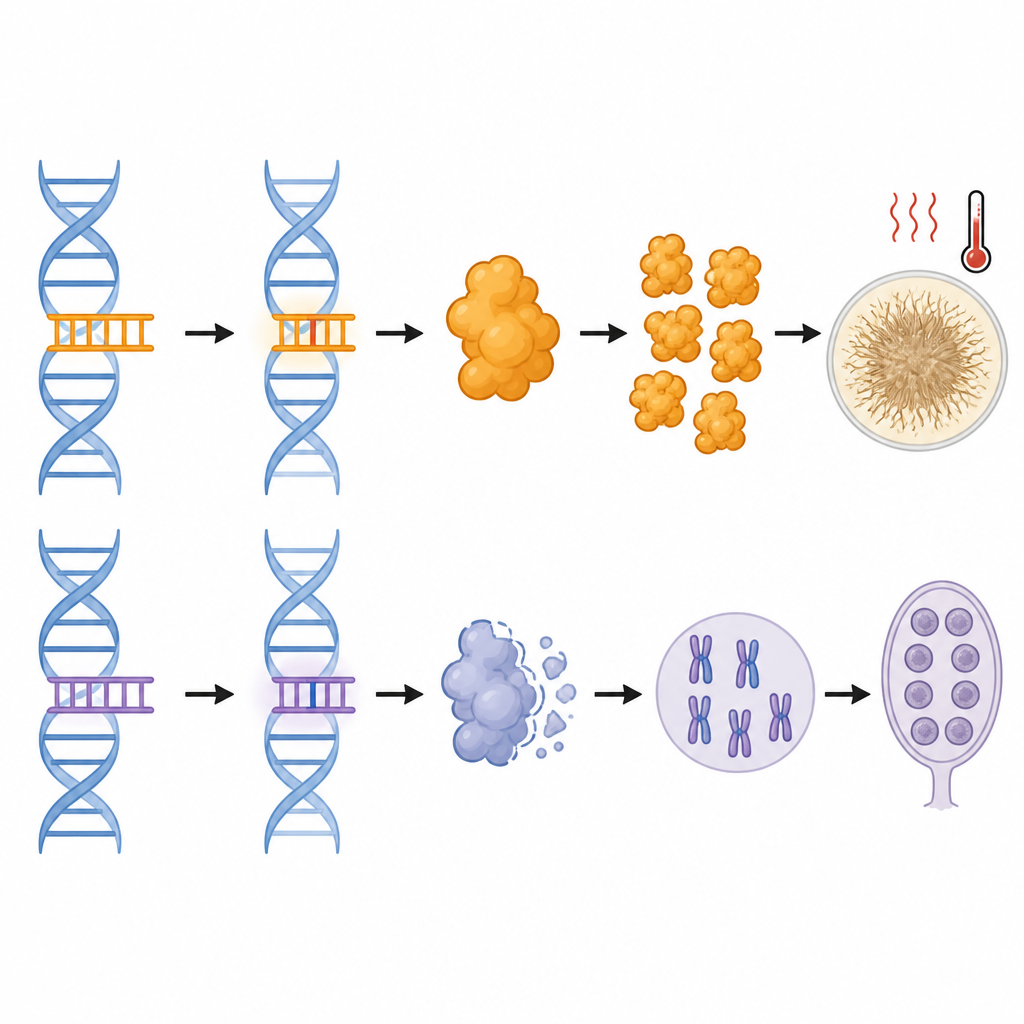
The key twist is that the fungus does not manage Mus81 only at the DNA level. During the sexual stage, it chemically edits its own Mus81 RNA at a single position, converting one letter into another in a process known as A‑to‑I editing. This tiny change swaps one amino acid in the Mus81 protein, creating a “post‑editing” version that is less stable than the original. Strains forced to keep Mus81 unedited could repair DNA well during normal growth but showed faulty nuclear divisions and abnormal spore numbers. Strains forced to use only the edited version formed normal spores but were weaker when grown in the heat. Measurements of protein levels and artificial strains carrying extra gene copies confirmed that too much Mus81 harms meiosis, while too little undermines heat tolerance.
Balancing Heat Survival and Sexual Success
Together, the results point to a clear trade‑off. High Mus81 output helps the fungus cope with the extra DNA stress that comes with high temperature, but the same high output appears to disturb the careful handling of DNA during meiosis. Lowering Mus81 through RNA editing fixes the meiotic problem but leaves the fungus less equipped for heat. By turning the edit on only during the sexual stage, the fungus gets the best of both worlds: a sturdy, long‑lived Mus81 protein for stressful vegetative growth, and a weakened, short‑lived version when it needs precise chromosome segregation.
Why a Temporary Edit Beats a Permanent Mutation
Looking across many related fungi, the authors found that this particular editing site in Mus81 is preserved in several species but has been lost or permanently hard‑wired in others. This pattern supports the idea that the RNA edit is under evolutionary selection, offering a flexible way to adjust DNA repair without committing to a fixed genetic change. In everyday terms, the fungus uses a reversible “volume knob” on a single protein to avoid choosing between heat survival and successful reproduction. Understanding such switches could eventually suggest new strategies to weaken plant pathogens by targeting their stage‑specific DNA repair controls.
Citation: Wu, M., Liu, J., Cao, P. et al. Epitranscriptomic RNA editing resolves Mus81 DNA repair tradeoffs in heat tolerance and meiosis. Nat Commun 17, 4617 (2026). https://doi.org/10.1038/s41467-026-71219-z
Keywords: RNA editing, DNA repair, Fusarium graminearum, heat stress, meiosis