Clear Sky Science · en
Structural basis for the assembly and translocation of the Vip1-Vip2 insecticidal toxin from Bacillus thuringiensis
New ways to protect crops from hungry grubs
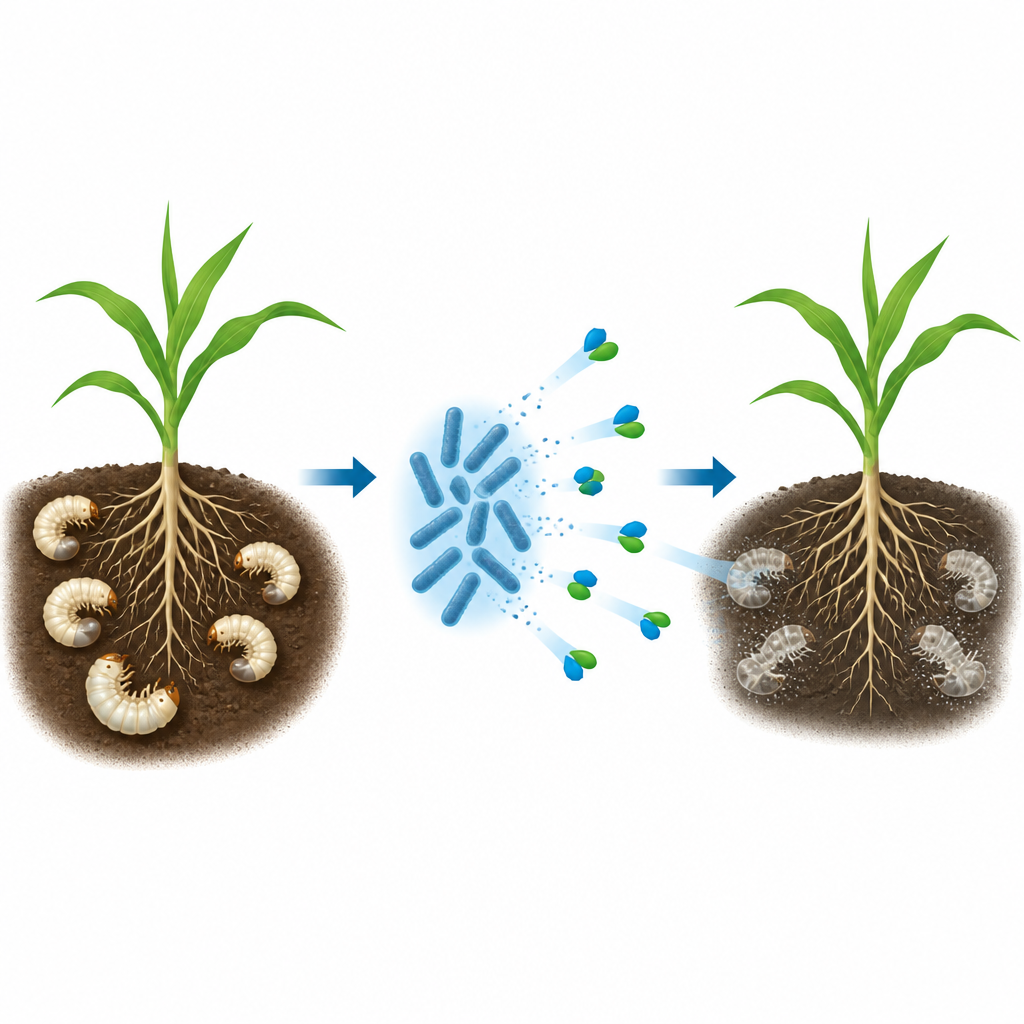
Farmers around the world rely on helpful bacteria to keep insect pests from destroying their crops. One such ally, Bacillus thuringiensis, makes proteins that are widely used in biopesticide sprays and engineered plants. But as insects evolve resistance, we urgently need new tools. This study uncovers how a powerful two-part protein from this bacterium, called Vip1 and Vip2, assembles and punches tiny holes in insect cells, and shows that the same system could be repurposed as a safe delivery tunnel for other useful proteins.
How a friendly bacterium fights crop pests
Bacillus thuringiensis produces several families of insect-killing proteins. Most commercial products use single proteins known as Cry toxins, which have been so successful that many insects are now evolving ways to evade them. A different group, called Vip toxins, contains a pair named Vip1 and Vip2 that together are highly effective against stubborn beetle larvae such as white grubs, notorious for chewing up plant roots. Unlike single toxins, Vip1 and Vip2 work as a team: Vip1 forms a passage in the gut cells of the insect, and Vip2 enters through this passage to disrupt the cell’s internal skeleton. Until now, however, scientists did not know in detail how this passage forms or how Vip2 is moved across the cell membrane.
Revealing the shape of the toxin’s gateway
Using cryo-electron microscopy, which freezes molecules in thin ice and images them at near-atomic detail, the researchers captured the three-dimensional structure of the Vip1 “pore,” a ring of seven identical units that resembles a funnel with a long stem. They showed that when insect gut enzymes clip the Vip1 protein, a flexible loop flips into a rigid tube, creating a narrow channel that can span the cell membrane. The opening of this funnel contains several checkpoints that help recognize the partner protein Vip2, while the long stem forms a smooth tunnel. The inner surface of this tunnel is strikingly water-loving, unlike many similar bacterial pores that mix water-loving and water-fearing patches.
Watching cargo being threaded through the pore
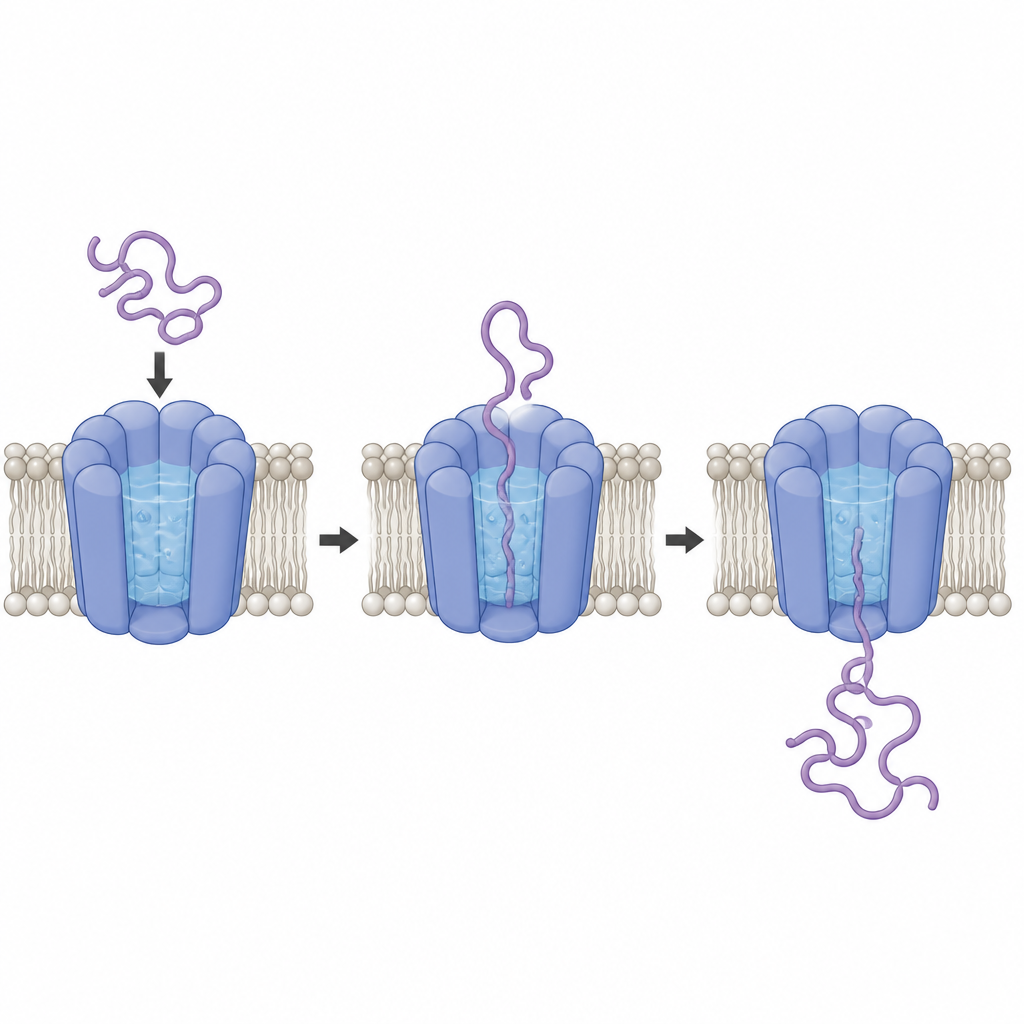
The team then examined how Vip2 binds to and passes through the Vip1 pore. They found that Vip2 docks at the wide mouth of the funnel and touches four of the seven Vip1 units through a network of contacts. A short loop on Vip2 acts as an anchor, while its front end begins to unfold and move toward a tight ring of aromatic amino acids known as a clamp. By collecting images under different chemical conditions, the researchers captured partial complexes containing Vip1 rings with only four or five subunits attached to a single Vip2 molecule. Comparing these snapshots suggests that the pore and toxin assemble step by step, and that Vip2 rotates and unravels as it is pulled deeper into the tunnel, threaded through the clamp and into the cell.
Why a wet tunnel matters more than the exact sequence
To test what makes the tunnel work, the scientists changed specific building blocks lining the inside of the pore. Swapping charged residues for other water-loving ones barely affected insect killing, but replacing several of them with water-fearing residues sharply reduced damage to the larval gut. Microscopy of treated beetle larvae confirmed that the altered pores caused far less tissue destruction. These experiments show that what really matters is that the tunnel stays highly water-friendly, not the exact sequence of amino acids. In other words, once a protein like Vip2 is unfolded, the pore can help slide it through largely without caring about its detailed makeup.
Turning an insect weapon into a protein delivery tool
Recognizing that the Vip1 tunnel moves unfolded proteins in a sequence-independent way, the authors asked whether it could carry other cargo. They fused green fluorescent protein, a common laboratory marker, to Vip2 and showed that Vip1 pores could deliver this bulky fusion into beetle-derived cells. An even smaller version, in which only the front “guiding” domain of Vip2 was kept and the toxic part replaced by green fluorescent protein, entered cells more efficiently. This means the guiding domain can act as an address label that brings almost any attached protein to the pore for transport into the cell.
What this means for future pest control and beyond
For a non-specialist, the main message is that scientists have deciphered how a two-part bacterial toxin punches controlled holes in insect cells and uses a smooth, watery tunnel to pull its partner protein inside. Because the tunnel cares more about general water-loving properties than about precise sequences, it can also serve as a versatile gateway for other proteins that are not themselves toxic. This opens the door to designing new biopesticides that combine custom targeting domains with chosen cargo proteins, offering fresh options against resistant crop pests and a safe model system to study similar toxins that affect humans.
Citation: Zhao, T., Wang, Z., Ren, J. et al. Structural basis for the assembly and translocation of the Vip1-Vip2 insecticidal toxin from Bacillus thuringiensis. Nat Commun 17, 4591 (2026). https://doi.org/10.1038/s41467-026-71211-7
Keywords: Bacillus thuringiensis, Vip1 Vip2 toxin, biopesticide, protein translocation, insect resistance