Clear Sky Science · en
A dual role of EZH2 in regulating A-to-I RNA editing and mRNA stability through ADAR
How tiny RNA edits shape prostate cancer
Our cells constantly fine tune their genetic messages, and small changes in this tuning can tip the balance between health and disease. This study explores how a well known cancer protein, EZH2, unexpectedly teams up with an RNA editing enzyme to reshape messages inside prostate cancer cells, affecting how tumors grow and how they respond to treatment.
RNA letters that can be rewritten
Genes are often described as fixed sequences, but the RNA copies made from DNA can be altered after they are written. One common change, called A to I editing, subtly swaps one chemical letter for another on RNA strands. Because the cell reads this edited letter as a different one, the change can affect how proteins are built, how RNAs are cut and joined, or how other small RNAs control them. The main enzyme that carries out this editing in most tissues is ADAR1. Earlier cancer studies showed that editing patterns are disturbed in many tumors, including prostate cancer, but it was not clear what was steering ADAR1 in these cells or why the edits changed in both directions. 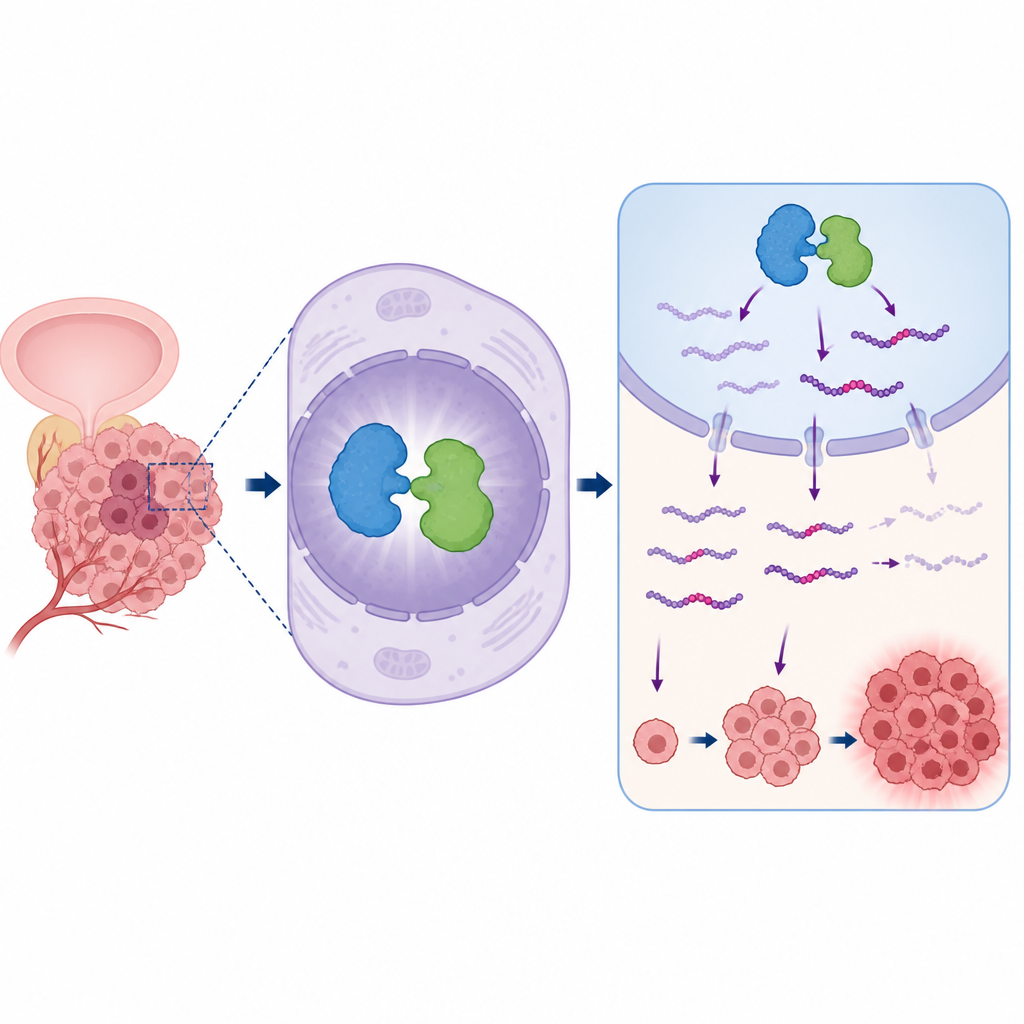
A chromatin protein steps into RNA control
EZH2 is best known as part of a protein complex that shuts down genes by modifying DNA packaging. High levels of EZH2 are linked to aggressive prostate cancer, and several drugs already target its usual enzyme activity. In this work, the authors discovered that EZH2 also binds directly to ADAR1 and its related enzyme ADAR2 inside the nucleus, using specific contact regions on both partners. When they reduced EZH2 in prostate cancer cells and organoids and then read the entire RNA content, they found that overall A to I editing dropped, even though ADAR1 levels remained the same. Looking site by site, some RNA positions became less edited, while others became more edited, revealing that EZH2 can guide editing in two directions rather than simply turning it up or down.
Choosing which RNAs get edited
To understand this mixed effect, the team mapped which RNAs were physically bound by EZH2, ADAR1, and another RNA binding protein called ILF2. They found that EZH2 and ILF2 compete for the same region on ADAR1. When EZH2 is abundant, it binds ADAR1 on certain target RNAs and favors editing at those sites. When EZH2 is reduced, ILF2 takes its place on ADAR1 and the set of edited RNAs shifts. One important example lies in the tail region of the MDM2 RNA, which encodes a protein that restrains the guardian protein p53. Editing at this site weakens the grip of two small regulatory RNAs, helping MDM2 levels rise. Prostate tumors show higher editing at this position than normal tissue, and this increase tracks with EZH2 levels rather than with ADAR1 itself, pointing to EZH2 as a key selector of this cancer related edit.
Moving an editor changes RNA survival
EZH2 also influences ADAR1 in a way that does not depend on editing chemistry. Under normal conditions, a transport protein called TRN1 ferries ADAR1 into the nucleus, where most editing occurs. The authors found that EZH2 supports the translation of TRN1 from RNA into protein through a special initiation system in the TRN1 RNA leader. When EZH2 is depleted or degraded, TRN1 protein falls while its RNA stays steady. As a result, more ADAR1 accumulates in the cytoplasm. There, ADAR1 binds to double stranded regions in the tails of certain cancer promoting RNAs and blocks another protein, STAU1, from marking them for decay. Measurements over time showed that many oncogenic RNAs, including ATM, YES1, CCNG1, and SMARCD1, live longer and build up when EZH2 is lost, but they become less stable when ADAR1 is removed.
Implications for prostate cancer treatment
The dual control of editing and RNA stability by EZH2 has important consequences for therapy. Drugs that only block EZH2’s usual enzyme activity free some tumor suppressor genes but do not stop EZH2’s non enzymatic influence on RNA. Newer "degrader" molecules that remove EZH2 protein are more powerful, yet this study shows they also drive ADAR1 into the cytoplasm, unintentionally helping cancer promoting RNAs to persist. In mouse models of prostate cancer, eliminating ADAR1 made tumors far more sensitive to an EZH2 degrader, shrinking tumors more than either strategy alone. 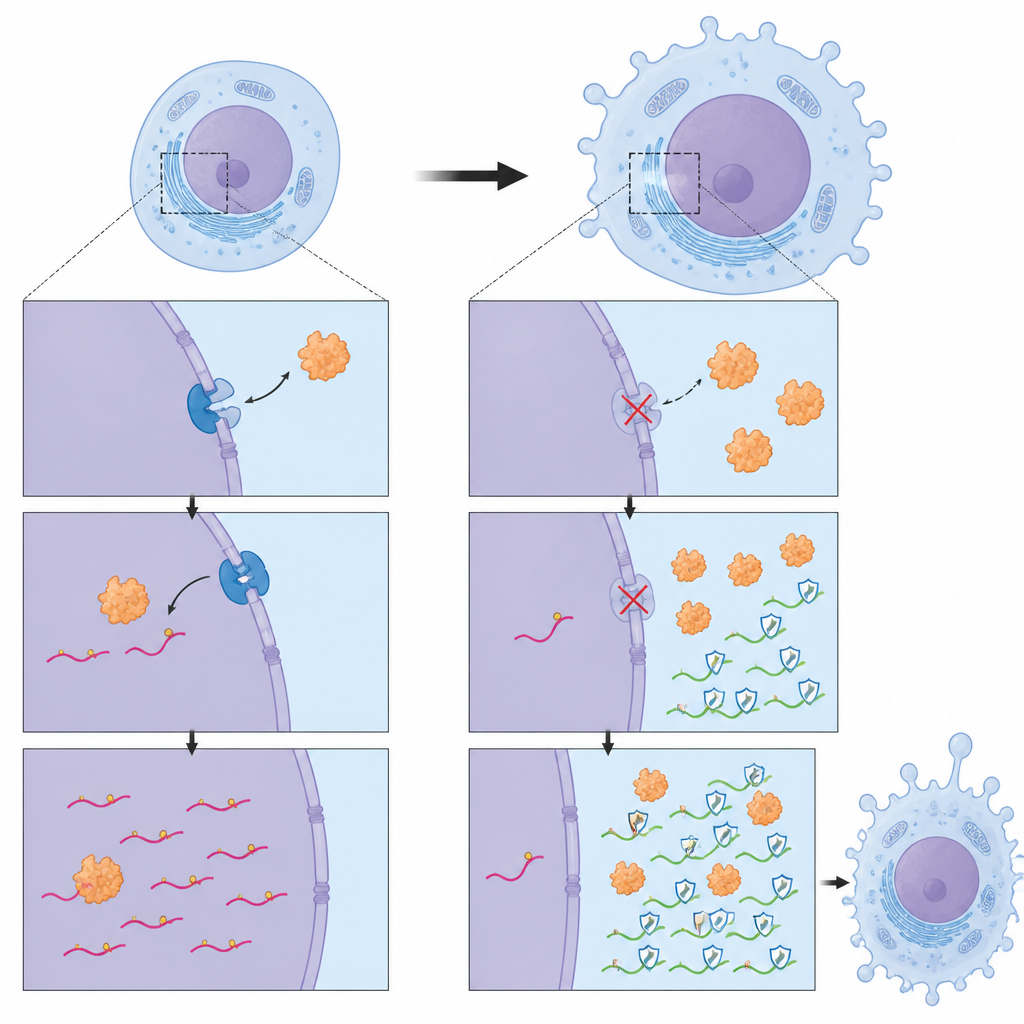
Why this matters for future care
In simple terms, this work reveals that EZH2 acts like a master switch at two levels: it helps decide which RNA messages are edited and how long many cancer linked messages survive. Both actions flow through its partnership with ADAR1, and both can either restrain or fuel tumor growth depending on context. These insights suggest that combining EZH2 targeting drugs with future ADAR1 inhibitors may yield more effective treatments for advanced prostate cancer by cutting off the cancer cell’s ability to quietly rewrite and preserve its own instructions.
Citation: Yi, Y., Li, Y., Wang, R. et al. A dual role of EZH2 in regulating A-to-I RNA editing and mRNA stability through ADAR. Nat Commun 17, 4421 (2026). https://doi.org/10.1038/s41467-026-71207-3
Keywords: RNA editing, EZH2, ADAR1, prostate cancer, mRNA stability