Clear Sky Science · en
Deep homology and design of proteasome chaperone proteins in Candidozyma auris
Why tiny protein helpers matter
Every cell in your body, and in microbes such as fungi, must constantly recycle worn-out proteins. A huge molecular machine called the proteasome does this clean-up work. This study asks a surprising question: how far can the parts that help build this machine change their genetic code and still work, and can we even design new parts from scratch that keep cells alive? 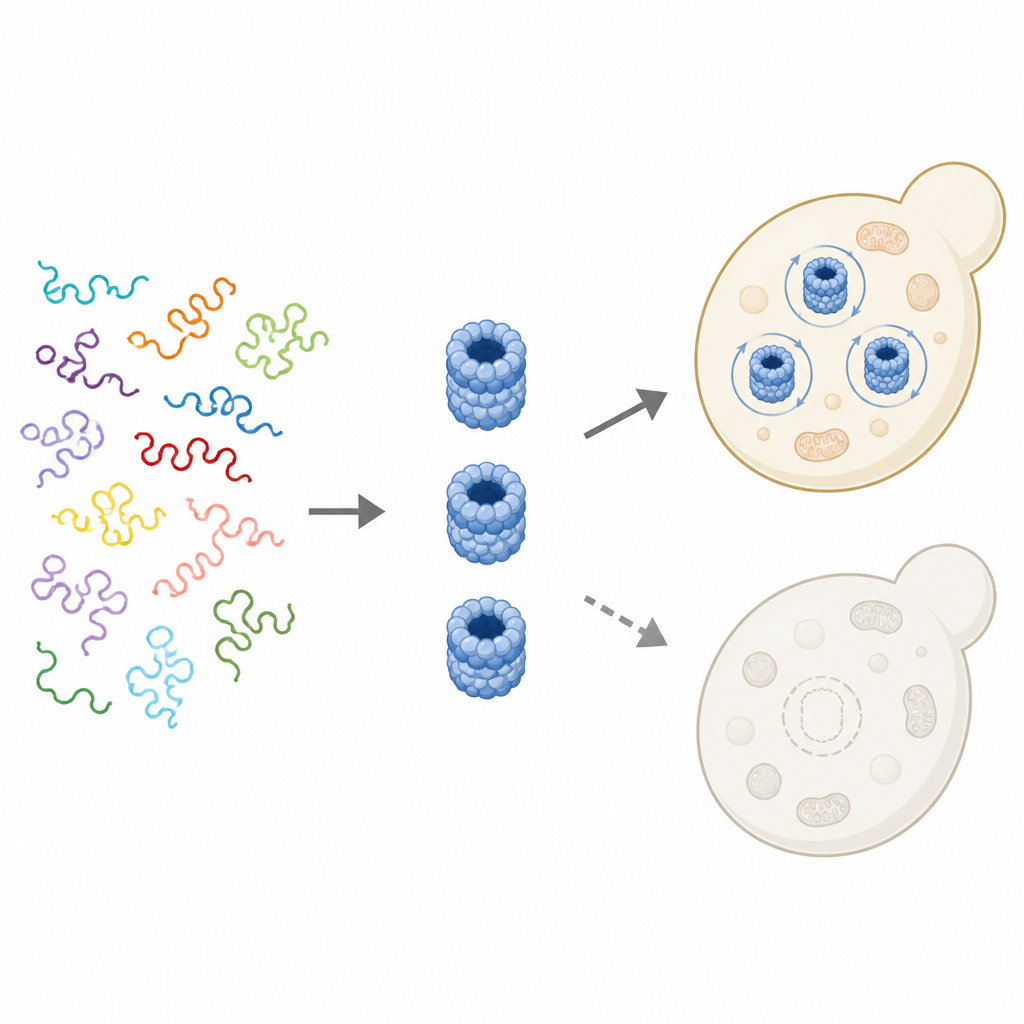
Seeing past misleading DNA signals
Biologists often guess what a protein does by comparing its gene sequence to known genes. But when sequences drift too far apart over evolutionary time, real relatives can look unrelated. The authors focused on proteins that assemble the proteasome in the disease-causing fungus Candidozyma (Candida) auris. One key helper protein, called Poc4, had changed so much in its DNA sequence that standard tools could no longer recognize it as related to known Poc4 proteins in baker’s yeast and other species. Using modern 3D structure prediction programs instead of sequence matching, the team showed that C. auris Poc4 still folds into almost the same shape as Poc4 in other organisms, hinting that structure, not sequence, preserves function.
Proving the hidden family connection
Finding a look-alike shape is not enough; the protein must actually do the same job in the cell. The researchers deleted the Poc4 gene in C. auris and found that cells then struggled to manage damaged proteins, especially at high temperature. This matched what happens when proteasomes are directly blocked by drugs, or when related assembly helpers are removed. They also showed that Poc4 in C. auris physically binds to proteasome parts, just as in other species, confirming that this highly altered sequence still acts as a bona fide assembly helper. Strikingly, when they inserted the Poc4 protein from baker’s yeast, which shares only about one fifth of its amino acids with the C. auris version, it could still restore normal growth in the mutant fungus and form the right contacts with the C. auris proteasome. 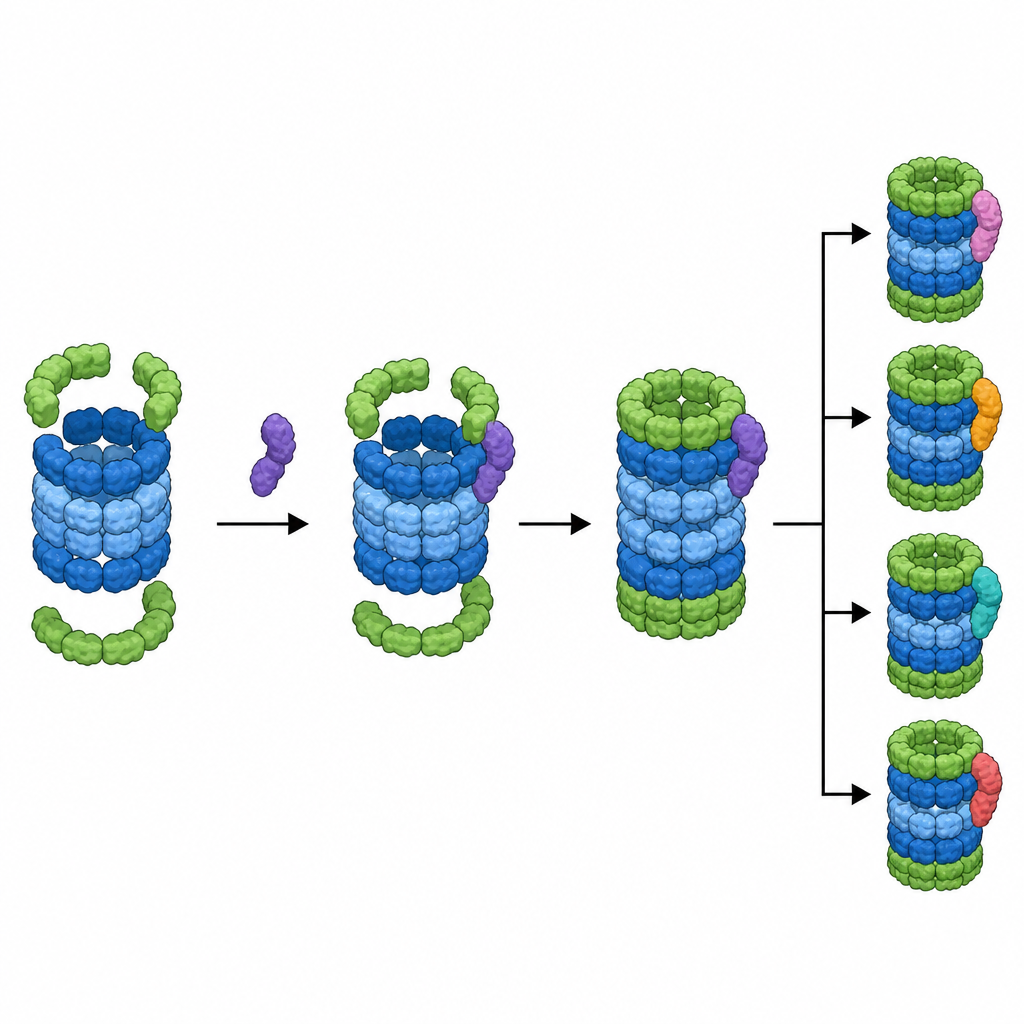
Designing brand-new helper proteins
If natural Poc4 proteins with very different sequences can do the same job, could a computer-designed protein with no real evolutionary history do it too? To test this, the team used deep learning tools that take a target 3D shape and propose possible amino acid sequences likely to fold into that structure. They locked in the small section of Poc4 that directly grips its partner protein, then allowed the rest of the protein to vary, generating thousands of new sequences. After filtering these designs using structure prediction again, they selected a handful with strong folding scores and no obvious similarity to known proteins, then built these genes and put them into C. auris cells lacking Poc4.
Which designs actually work in living cells
Several of the artificial Poc4 variants were made and folded in C. auris, but only some could fully rescue the heat-sensitive growth defect, while others gave only partial or no rescue. By modeling how each designed protein contacted a key proteasome subunit, the authors linked successful rescue to specific packing interactions and close docking between surfaces of the helper and the proteasome ring. Designs that docked too poorly, or in a subtly different way, failed in cells even if their overall shape looked right. This showed that having the broad fold is important but not sufficient; fine details of how the surfaces touch still matter for real biological function.
What this means for evolution and design
This work shows that cells can tolerate wide variation in the genetic sequence of some proteins, so long as their three-dimensional shape and crucial contact points are preserved. As a result, standard sequence comparisons can overlook genuine relatives and give a skewed view of how protein systems evolve. At the same time, the study demonstrates that computer-guided design can create new proteins that plug into complex cellular machines and keep them running. For a layperson, the takeaway is that nature often cares more about the shape and fit of molecular parts than their exact recipe, and we are now beginning to redesign those parts to test and harness that principle.
Citation: Rapala, J.R., Siddiq, M., Wittkopp, P.J. et al. Deep homology and design of proteasome chaperone proteins in Candidozyma auris. Nat Commun 17, 4593 (2026). https://doi.org/10.1038/s41467-026-71206-4
Keywords: protein structure, proteasome, Candida auris, protein design, evolution