Clear Sky Science · en
Accelerated drug development using a digital formulator and a self-driving tableting data factory
Faster pills for patients
When a new medicine is discovered, turning it into a simple swallowable tablet can take years and use large amounts of precious drug powder. This study describes a highly automated way to design and make tablets that cuts both time and material use, helping medicines reach patients more quickly and efficiently.
The hidden bottleneck after discovery
Modern artificial intelligence tools now help scientists discover drug candidates and design clinical trials much faster than before. As a result, the slowest part of getting medicines to patients has shifted to the stage where chemists and engineers figure out how to turn a fine drug powder into a stable, safe tablet that can be manufactured at scale. This step involves many interlocking decisions about recipe, processing route, and factory settings. Changing course late is costly, so companies need smarter, earlier choices about how to blend the drug with helper ingredients and how to press it into tablets that are strong enough to handle yet still break apart and dissolve in the body as intended.
A digital formulator that thinks ahead
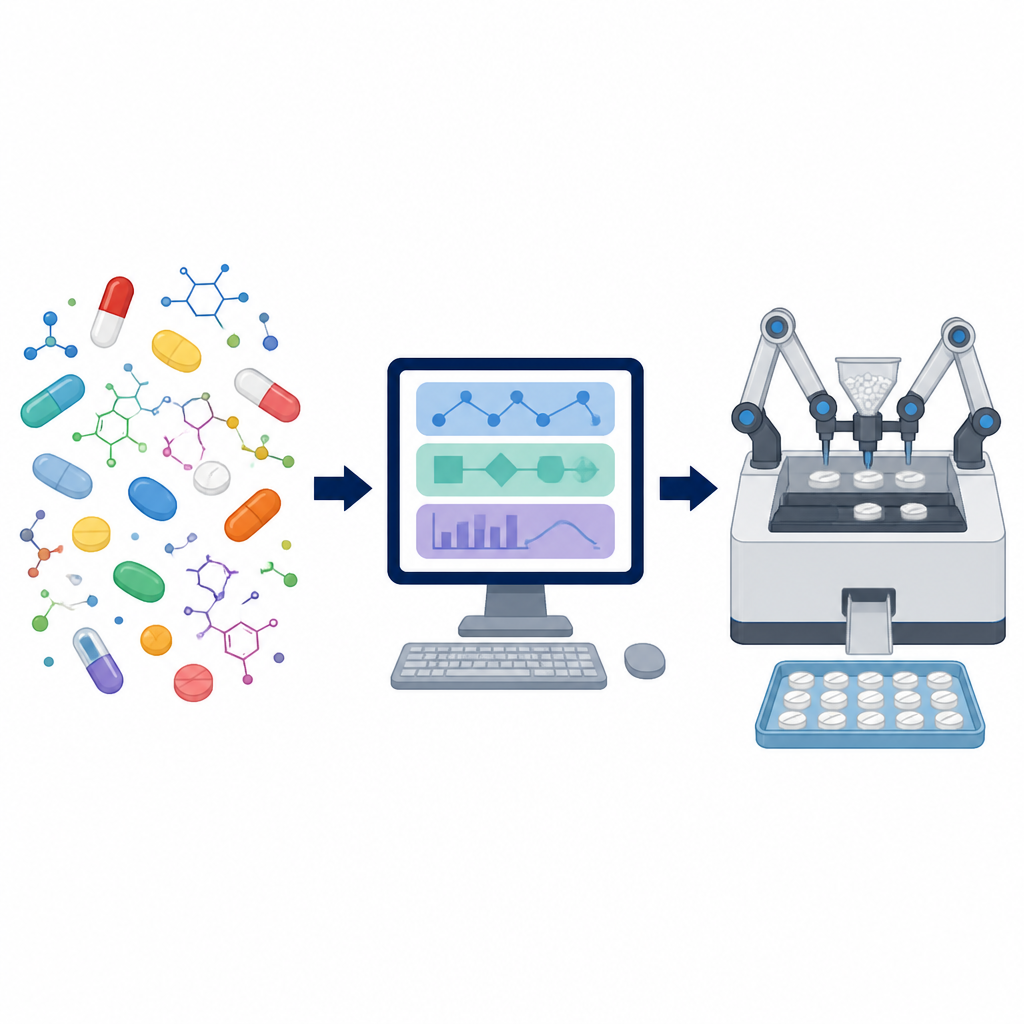
The researchers built a “digital formulator” that predicts how a powdered mixture will behave before anyone mixes a gram in the lab. Instead of memorising specific chemicals, the models learn from basic physical traits such as particle size, shape, and density. Using a library of common tablet ingredients, the system tests thousands of virtual recipes in silico. It searches for combinations that are likely to flow smoothly through machinery while forming tablets that reach a target strength and porosity, key measures of how well a tablet will survive handling yet still disintegrate in the stomach. Deep neural networks trained on more than a thousand experimental data points can forecast tablet porosity and strength, along with their uncertainty, for new drugs whose properties fall within the learned space.
A self-driving tableting line
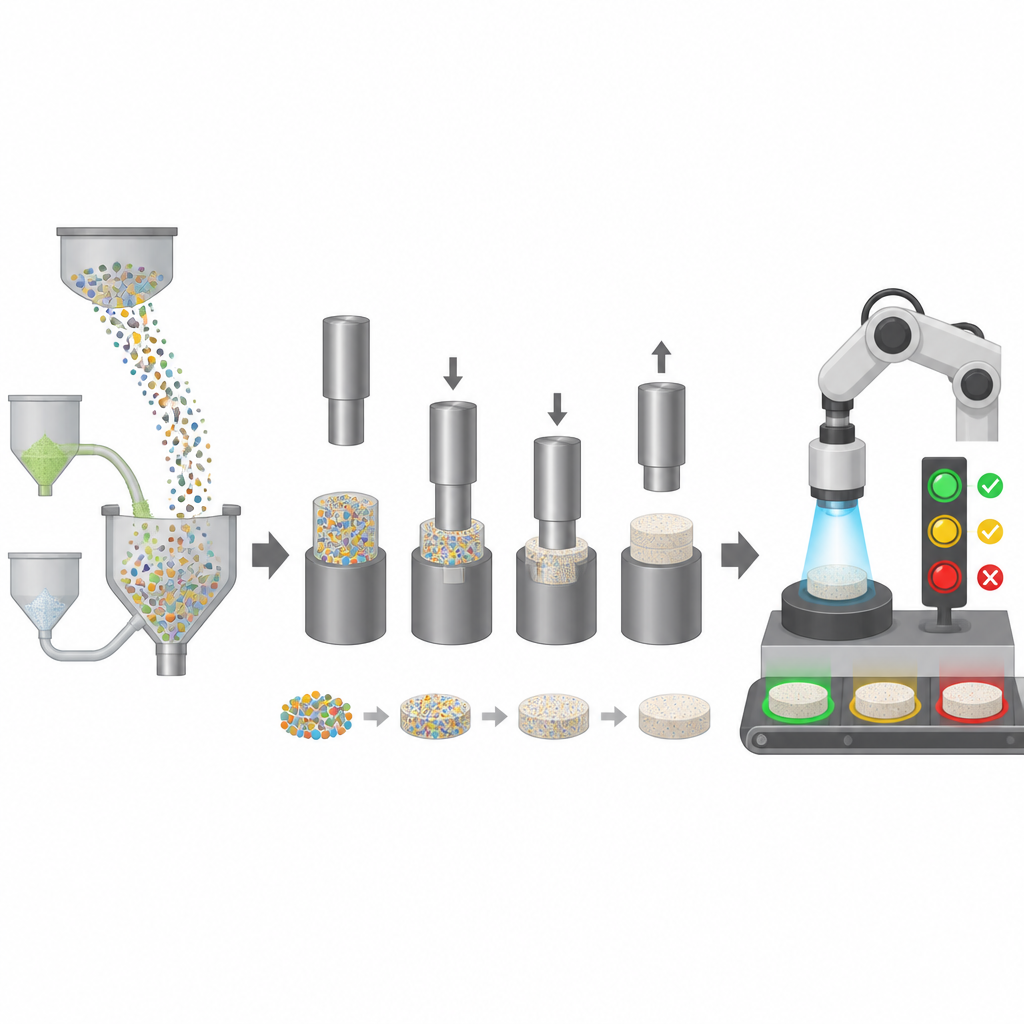
Once the digital formulator suggests an optimal recipe and starting press settings, a “self-driving tableting data factory” takes over. This bench-top system links powder dosing, transport, tablet pressing, and testing through two robotic arms and an orchestration computer. The platform weighs each dose of powder, records near-infrared spectra to check blend uniformity, compacts single tablets, and then automatically measures weight, dimensions, and breaking force. A built-in decision system discards off-spec tablets and triggers cleaning steps to avoid cross-contamination between recipes. Throughout, data from every step are streamed to a central controller, which keeps the process running with minimal human input.
Learning the right pressure with fewer trials
To fine-tune the press settings, the team used a physics-informed optimisation strategy. This method combines simple physical equations for how powders compact with a machine learning layer that proposes the next best experiment. For nine different case studies involving six drugs, it adjusted the main compression pressure to hit a target tablet porosity while keeping strength above a set threshold. In each case, only a handful of test tablets were needed to calibrate the models, and the final tablets all met the manufacturing and disintegration criteria for immediate-release products. The study also used the digital models to explore how different particle size patterns affect powder flow and tablet strength, confirming and quantifying rules that formulators previously relied on mainly from experience.
What this means for future medicines
By tightly coupling predictive models with an automated tablet-making line, this platform shrinks the journey from raw powder measurements to acceptable tablets to about six hours while using roughly one-third of the drug material required by current best practices. Although the setup still has practical limits and is not yet a factory-ready system, it points toward a future where the design and testing of tablet recipes is faster, more data-rich, and less wasteful. For patients, such tools could translate into more medicines moving smoothly from discovery to the pharmacy shelf, with better use of time, expertise, and scarce drug substances.
Citation: Abbas, F., Salehian, M., Hou, P. et al. Accelerated drug development using a digital formulator and a self-driving tableting data factory. Nat Commun 17, 4739 (2026). https://doi.org/10.1038/s41467-026-71204-6
Keywords: tablet formulation, self-driving lab, digital formulator, pharmaceutical automation, drug manufacturing