Clear Sky Science · en
Pillar[5]arene-catalyzed anti-Markovnikov halogenations through cationic intermediates stabilization in confined spaces
A Tiny Cup That Changes Where Atoms Go
Chemists have long known where a halogen such as bromine “likes” to add across a carbon–carbon double bond, and textbooks teach this Markovnikov rule as if it were law. This study shows that by tucking reacting molecules inside a carefully designed molecular cup, researchers can gently bend that rule, steering atoms to the less expected position and opening shortcuts to useful chemicals.
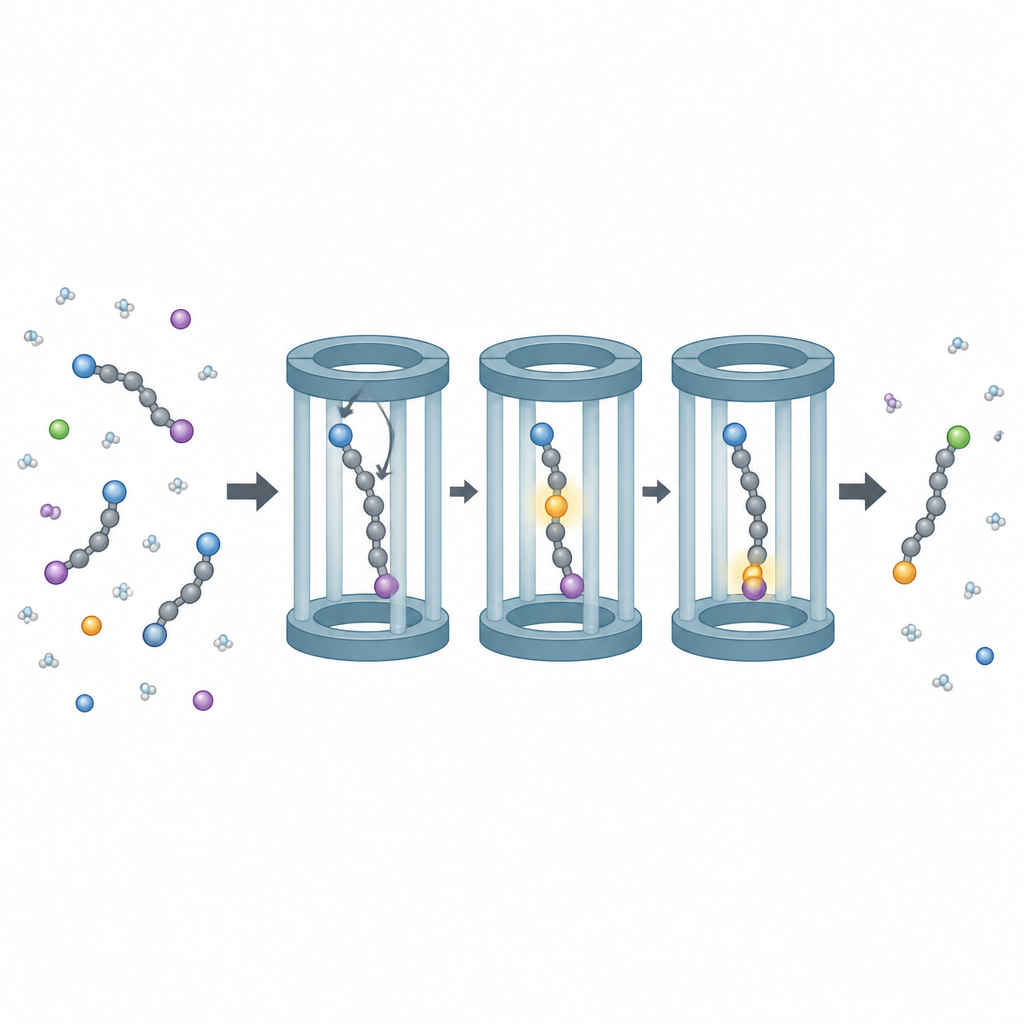
Why Controlling Addition Matters
When a double bond reacts with a halogen, a positively charged intermediate forms before the final product. In ordinary liquids this charged state is fleeting and tends to give the Markovnikov product, where the new group lands on the more substituted carbon atom. Reversing that preference, known as anti-Markovnikov selectivity, would give a different family of molecules valuable as building blocks, but direct and reliable ways to do this with simple halogenation have been missing.
Building a Molecular Room for Reactions
The team turned to pillarenes, ring-shaped organic molecules that stack into hollow, pillar-like cavities. These hosts can enfold suitable guest molecules much like an enzyme pocket cradles its substrate. By attaching flexible hexyl chains around the rim, the researchers created a version called pillar[5]arene PA5, whose size, shape, and electronic character are tuned to interact with positively charged intermediates formed during bromination of unactivated alkenes.
Turning the Rule on Its Head
Using a standard bromine source together with benzoic acid, the authors tested many catalysts and found that only specific pillar[5]arenes could flip the usual outcome. Under mild, cold conditions, PA5 converted a wide range of double-bonded substrates into bromoester products with high yields and strong anti-Markovnikov selectivity, often producing almost no Markovnikov byproduct. The approach worked even for molecules that normally prefer to cyclize into internal rings, and it could distinguish between similar options on the same molecule or in mixtures, favoring less bulky, more linear partners.
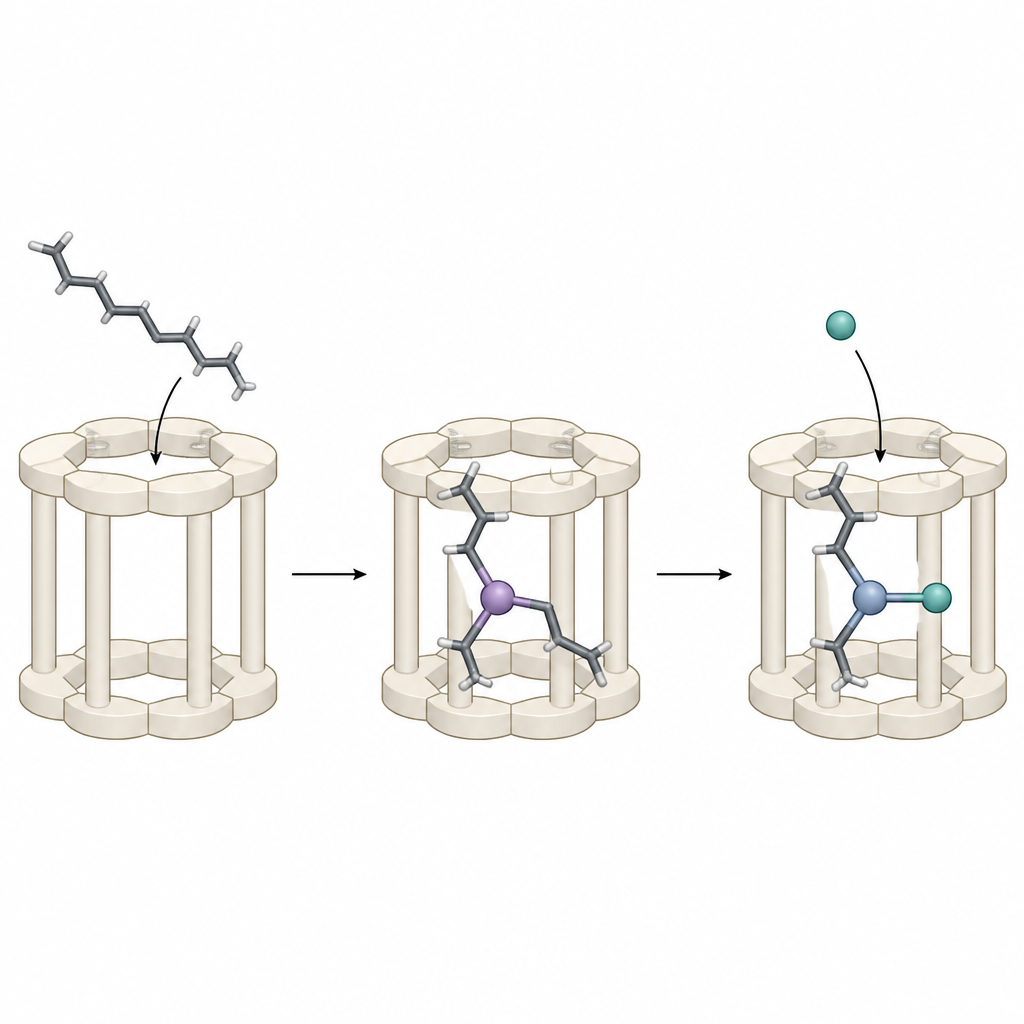
Peeking Inside the Confined Space
To understand how this tiny cup enforces new behavior, the researchers combined nuclear magnetic resonance, infrared spectroscopy, and quantum chemical calculations. These tools revealed that the positively charged bromine-containing intermediate is not only formed more easily inside the pillar[5]arene but is also stabilized by many subtle attractions to the aromatic walls. Within this snug space the more substituted carbon becomes shielded, while the less substituted carbon remains more open to attack by the carboxylate partner, naturally guiding the reaction toward the anti-Markovnikov product.
What This Means for Future Chemistry
In plain terms, the study shows that shaping the tiny environment around a reaction can override its usual habits without using metals or harsh conditions. By using a molecular host to cradle and protect a reactive charged state, chemists can redirect where bonds form and gain access to molecules that were previously hard to make. This strategy hints at a broader way to design catalysts that control reactions by confining unstable intermediates, rather than just by decorating their outer surfaces with reactive groups.
Citation: Xu, T., Lai, S., Ajitha, M.J. et al. Pillar[5]arene-catalyzed anti-Markovnikov halogenations through cationic intermediates stabilization in confined spaces. Nat Commun 17, 4668 (2026). https://doi.org/10.1038/s41467-026-71201-9
Keywords: supramolecular catalysis, pillar[5]arene, anti-Markovnikov halogenation, cationic intermediates, olefin functionalization