Clear Sky Science · en
KATANIN promotes cell elongation and division to generate proper cell numbers in maize organs
How Corn Plants Grow Tall or Stay Small
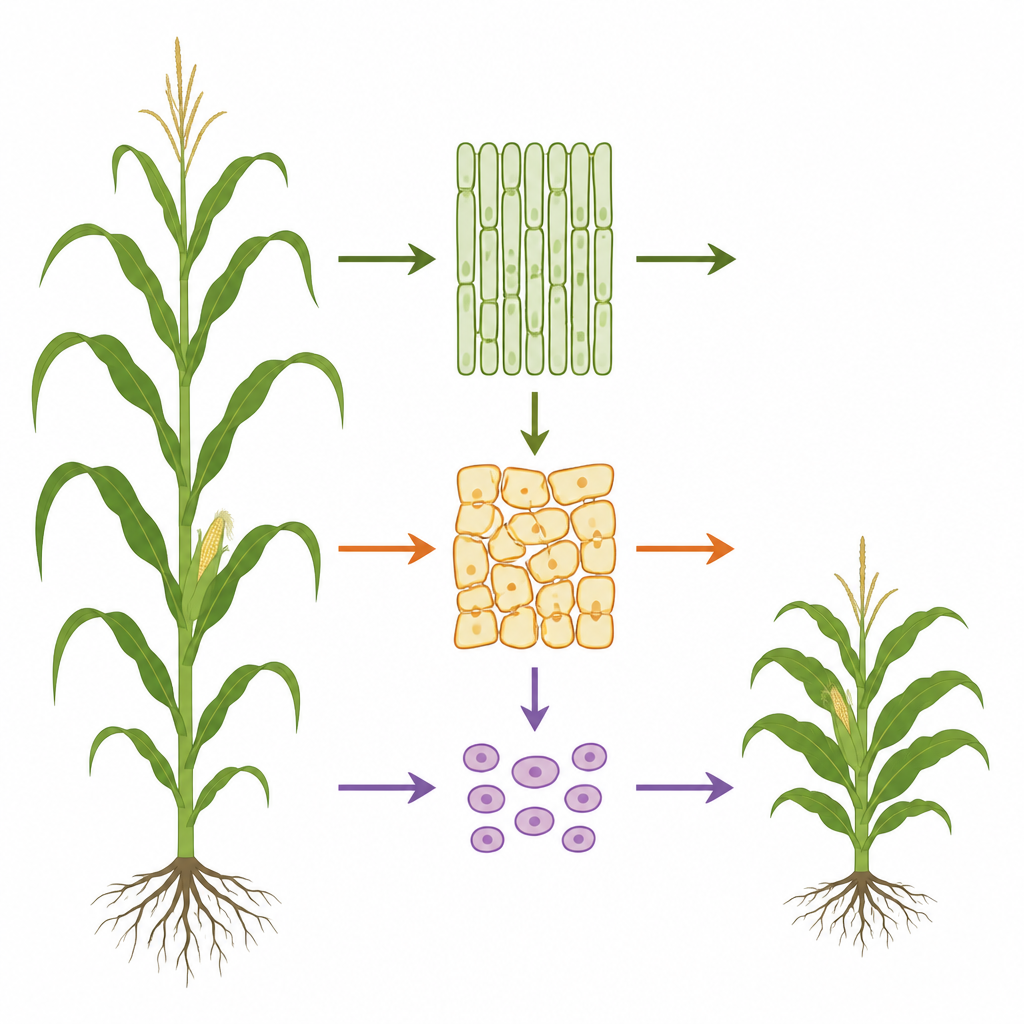
Why do some corn plants shoot up tall while others stay short and stubby, even when they share the same genes and soil? This study looks inside maize leaves and roots to reveal how tiny protein machines that cut internal scaffolding help cells stretch and divide. By following what happens when these machines fail, the researchers link microscopic events inside cells to the overall size, shape, and fertility of the plant.
The Cell’s Inner Scissors
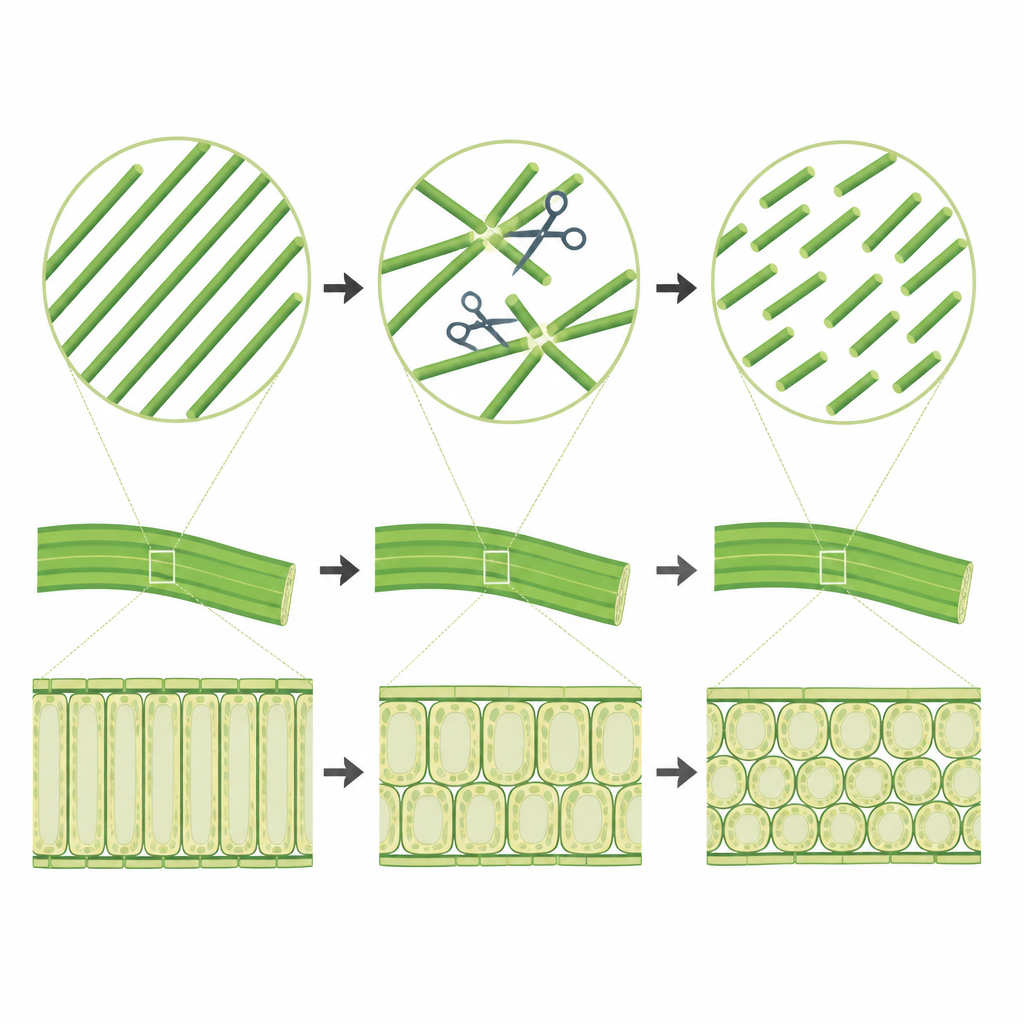
Plant cells contain stiff protein tubes that act like scaffolding, guiding how cells grow and split. A protein complex called KATANIN works like a molecular pair of scissors, snipping these tubes so they can be rearranged. In maize, the team found that the key cutting subunit, called p60, is produced by two very similar genes, named Dcd3a and Dcd3b. They identified several maize mutants in which one or both of these genes are damaged, as well as a special variant called Clumped tassel1 that interferes with normal p60 complexes. These mutants gave the scientists a toolkit for testing how much cutting activity is needed for normal plant growth.
From Bent Scaffolds to Stunted Plants
Using live imaging of glowing microtubules, the researchers showed that plants lacking both p60 genes have fewer cutting events at the points where microtubules cross. In root and leaf zones where cells are actively elongating, the microtubules of mutant plants are less uniformly aligned and more weakly oriented than those of their healthy siblings. This disordered internal scaffolding coincides with slower root and leaf elongation, shorter plants, and poor pollen and seed production. Plants with only one defective gene are mostly normal, revealing that the two versions of p60 can back each other up, but when both are impaired, the cutting system falters.
Fewer, Shorter Cells Make Smaller Leaves
To find out why mutant leaves are so small, the team measured thousands of surface cells along different parts of several leaves. In healthy plants, pavement cells are long and narrow, helping leaves extend in length. In double mutants, these cells are shorter and more rounded, and each cell covers less area. The scientists then built “what if” models, asking how big a wild-type leaf would be if its cells shrank to mutant size, or if it had fewer cells but kept normal shapes. These projections showed that leaf shrinkage cannot be explained by stubbier cells alone or by reduced cell numbers alone; instead, both fewer cells and reduced cell elongation are needed to match the actual mutant leaf size.
Cell Cycle Timing and Division Direction
Cell number depends on how often cells divide, so the researchers tracked dividing cells in real time. In mutants, the actual duration of mitosis and the building of new cell walls were similar to normal plants, but fewer cells were caught in the act of dividing. DNA staining revealed that many mutant cells linger longer in the first gap phase, known as G1, before committing to copy their DNA. This G1 delay is consistent with cells needing extra time to reach a minimum size before division when their elongation is impaired. At the same time, many mutants showed abnormal preprophase bands, ring-like microtubule structures that mark where a new wall will form. Uneven or partially formed bands often pulled the nucleus off center, and the rare bands that formed in the wrong orientation led to divisions that cut the cell at odd angles.
Linking Invisible Cuts to Visible Crops
Taken together, the results show that KATANIN’s cutting of microtubules is crucial for giving maize cells the right shape and number. When cutting activity is reduced, cells do not elongate as much, they hesitate longer before dividing, and some divisions slice at slightly wrong angles. The combined effect of these small missteps is a plant with shorter roots and leaves, fewer cells, altered cell walls, and poor fertility. For farmers and plant breeders, this work highlights how proteins that quietly remodel the cell’s inner scaffolding can strongly influence crop stature and yield, offering new molecular targets for shaping future varieties.
Citation: Martinez, S.E., Lau, K.H., Allsman, L.A. et al. KATANIN promotes cell elongation and division to generate proper cell numbers in maize organs. Nat Commun 17, 4534 (2026). https://doi.org/10.1038/s41467-026-71200-w
Keywords: maize, cell division, microtubules, plant growth, KATANIN