Clear Sky Science · en
Interchain supramolecular interactions drive nearly 21% efficiency organic solar cells
Why this solar breakthrough matters
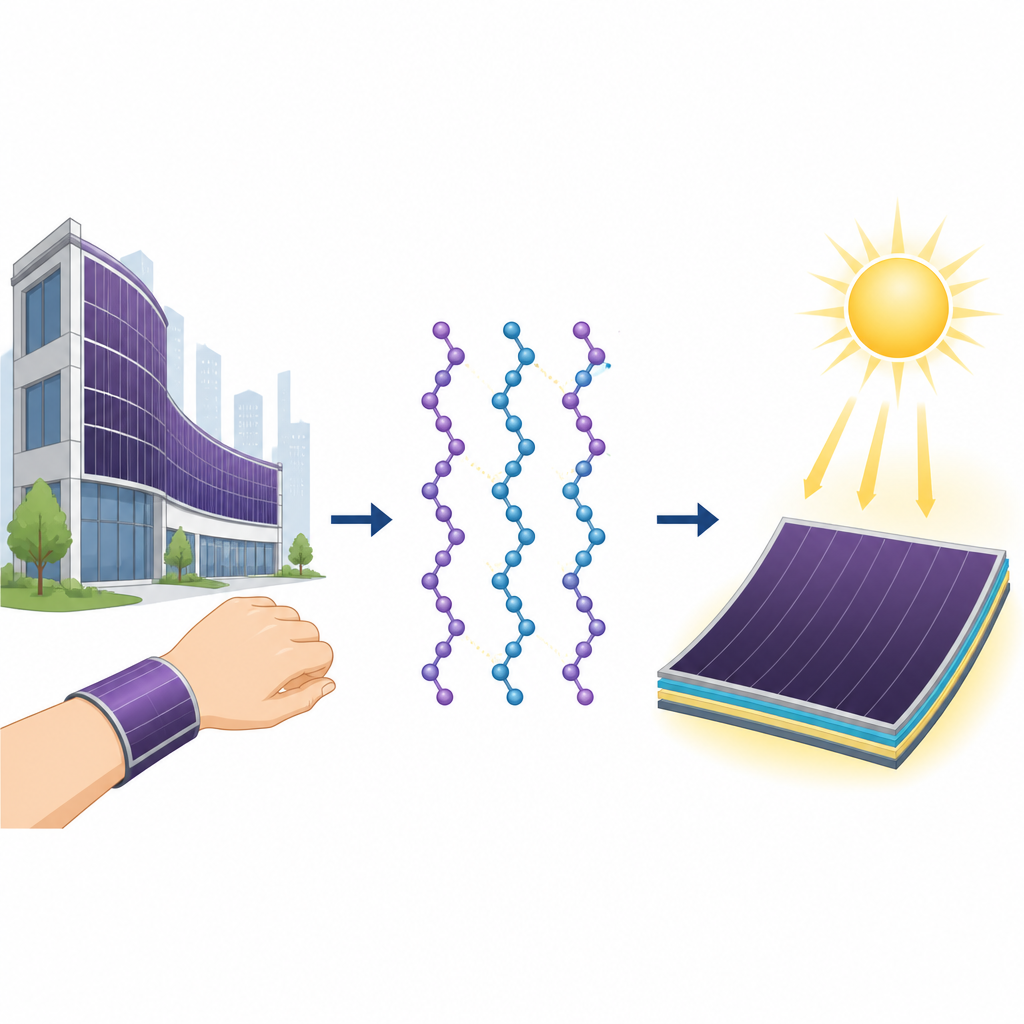
Solar panels made from plastics rather than rigid silicon could be light, flexible, and even see-through, perfect for powering gadgets, windows, and curved surfaces. But these organic solar cells have struggled to match the efficiency of today’s best panels because some of the energy they absorb quietly leaks away as heat. This study shows how carefully reshaping the tiny side chains on organic molecules can tame that hidden energy loss and push flexible solar cells close to 21 percent efficiency, rivaling more traditional technologies.
Making better plastic solar materials
Organic solar cells rely on blends of carbon-based molecules that absorb light and separate charges. The authors focused on a family of “acceptor” molecules that partner with a polymer donor called D18. In standard designs, these acceptors carry floppy side chains that help them dissolve and process easily but also allow them to vibrate and jiggle. Those motions couple to moving charges and encourage energy to drain away as heat. The team designed a new acceptor, named S-Cb, whose side chains include a small, strained four‑carbon ring called cyclobutane. This ring is relatively rigid and flat, so it stiffens the molecule and subtly shifts how the materials pack together in a film.
Quieting wasted energy inside the film
To see whether the stiffer design really helped, the researchers compared the light emission and absorption of S-Cb with a state-of-the-art acceptor called L8-BO. Measurements in solution and thin films showed that S-Cb loses slightly less energy as excited states relax, and its emission spectrum is narrower, both signs that fewer vibrational pathways are available for charges to dump energy. The glass transition temperature of S-Cb is higher, indicating a more rigid material. X-ray studies also revealed that S-Cb forms more ordered layers, and calorimetry showed it has a stronger tendency to crystallize. Together, these tests indicate that the cyclobutyl ring makes the material stiffer and better organized, which weakens the unwanted coupling between electrons and molecular vibrations.
Letting molecules clasp together
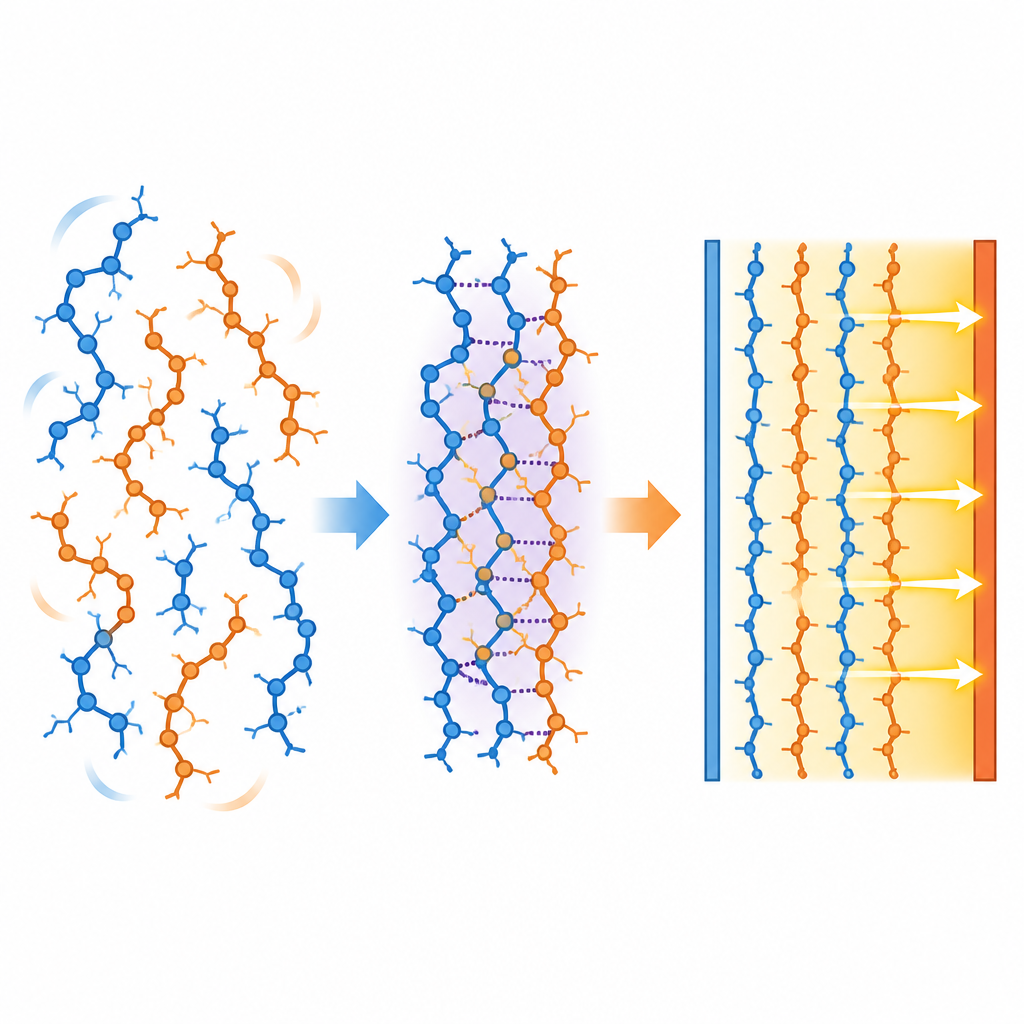
The most striking behavior emerged when S-Cb was mixed with L8-BO in a ternary device that also contained the D18 polymer. Computer simulations and crystallographic analysis showed that when S-Cb and L8-BO are present in equal amounts, their different side chains can lock together in a “clamping” arrangement. The nearly planar cyclobutyl ring on S-Cb slots into the forked side chains of L8-BO, held in place by many weak hydrogen-based contacts. This intermolecular clasping pulls the molecules into a tightly packed, highly uniform alloy-like acceptor phase. In this state, the free space in the film shrinks, molecular motion is restricted, and calculations show that vibrational reorganization and the attraction between electrons and holes are both reduced, helping charges separate and travel instead of recombining.
Turning structure into higher performance
Solar cells built with only S-Cb already performed well, reaching almost 19.6 percent power conversion efficiency, similar to cells based only on L8-BO. When the two acceptors were blended with D18, performance depended strongly on the mixing ratio. At a 1:1 blend of S-Cb and L8-BO, where the clamping effect is strongest, the cells reached 20.93 percent efficiency, with a certified value of 20.74 percent. Detailed optical and electrical tests showed that at this sweet spot the devices combine strong light absorption, balanced charge transport, slower recombination, and smaller non-radiative energy losses. Nanoscale microscopy confirmed a finely interwoven network of donor and acceptor regions with well-matched domain sizes, favoring both exciton splitting and charge extraction.
What this means for future solar panels
To a non-specialist, the key message is that tiny changes to the side chains of organic molecules can have an outsized impact on how charges move in a solar cell. By adding a small rigid ring, the researchers created molecules that not only vibrate less themselves but also clasp their neighbors into an ordered network, cutting down on wasted heat and helping charges escape. This “molecular clamping” strategy lifted flexible organic solar cells to nearly 21 percent efficiency, suggesting a practical design path toward thin, lightweight panels that approach the performance of today’s best silicon devices while offering far greater versatility in where and how they can be used.
Citation: Gao, W., Hai, Y., Zeng, J. et al. Interchain supramolecular interactions drive nearly 21% efficiency organic solar cells. Nat Commun 17, 4590 (2026). https://doi.org/10.1038/s41467-026-71199-0
Keywords: organic solar cells, cyclobutyl side chains, supramolecular interactions, energy loss reduction, ternary photovoltaic blends