Clear Sky Science · en
Spin-selective heterogeneous chiral perovskites for circular-polarization-resolved retinomorphic sensors
Why new light sensors matter
Our eyes do more than record brightness and color; they adapt to changing light and help us make sense of the world in real time. Modern cameras and artificial eyes, however, still struggle to match this blend of sensitivity, adaptability, and in-hardware processing. This study introduces a new kind of light sensor that can not only see color and brightness but can also tell apart two subtle “twists” of light and process that information directly on the chip. Such sensors could help build artificial visual systems that see hidden patterns, resist optical noise, and even perceive depth in new ways.
Light with a twist
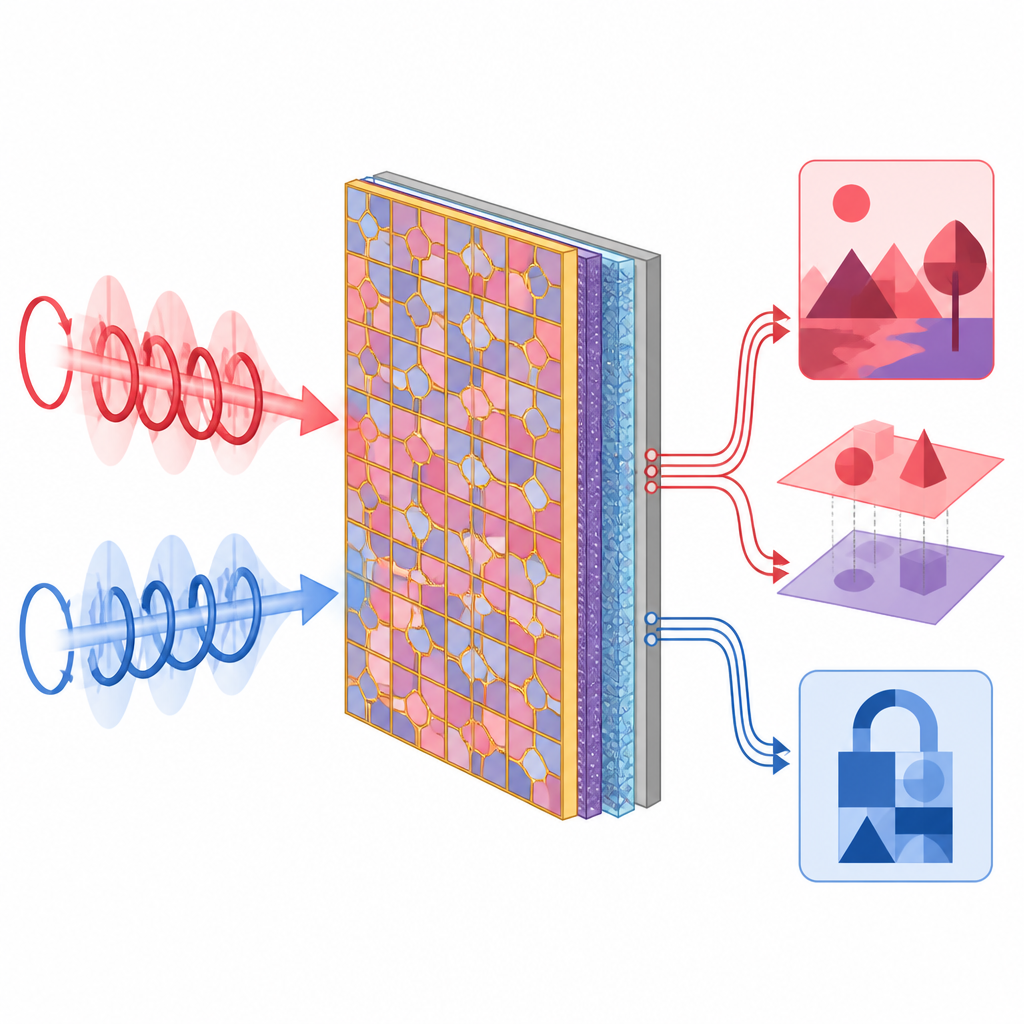
Light waves can be twisted like a corkscrew, a property known as circular polarization. Many animals cannot sense this twist, but some insects do and use it for camouflage breaking and secret signaling. Today’s vision chips mostly ignore this extra channel of information, focusing only on how bright and what color light is. The researchers set out to build “retina-like” sensors that also tell whether light spirals to the left or to the right, and to do so while still mimicking key behaviors of the human retina, such as memory of past light signals, automatic adjustment to very bright or very dim scenes, and the ability to distinguish colors.
A smart material with built-in order
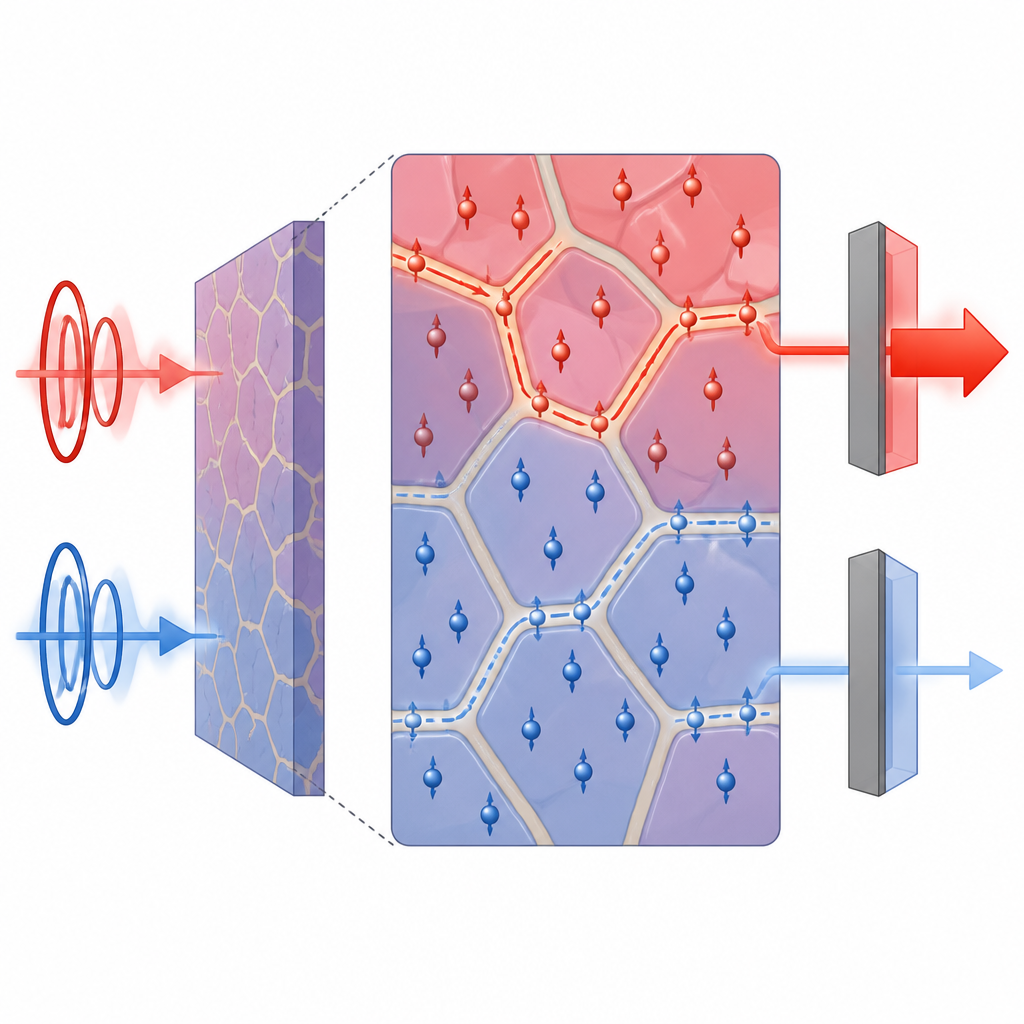
To reach this goal, the team turned to a class of materials called chiral perovskites, which naturally distinguish between left- and right-twisted light through their internal handedness. The challenge is that packing a lot of chiral molecules into these crystals usually harms their electronic quality, while using fewer improves the electronics but weakens the twist sensitivity. The authors solved this by letting the material self-organize into a heterogeneous microstructure: the interiors of the tiny crystalline grains contain relatively few chiral molecules, while the grain boundaries between them become chiral-rich zones. These boundaries act as bridges that help charges move smoothly from grain to grain and at the same time behave like in-plane “spin valves,” strongly preferring one spin orientation of electrons over the other.
From twisted light to retina-like signals
Using this microstructured material in transistor-style devices, the researchers built circular-polarization-resolved “retinomorphic” sensors, meaning they combine light sensing with in-device signal processing inspired by the retina. When illuminated with left- and right-twisted light of the same color and brightness, the heterogeneous devices show a very large difference in response, close to the theoretical maximum for such sensors, and this strong contrast holds across much of the visible spectrum. Beyond simple detection, the devices exhibit synapse-like memory: repeated light pulses strengthen the electrical response in a way that depends on the light’s twist, pulse timing, and color. They also adapt to both bright and dim backgrounds, gradually shifting their sensitivity so that patterns emerge from glare or from near darkness, much as our eyes adapt when we walk from sunlight into a dim room.
Seeing hidden messages and virtual depth
The team then demonstrated how these abilities can support advanced visual tasks. In one test, an image of a cat encoded in one twist of light was masked by heavy “noise” encoded in the opposite twist. Arrays of the new sensors selectively responded to the correct twist, effectively decrypting the hidden cat image, which a neural network could still recognize with high accuracy even under the strongest noise. In another test, two sensor arrays, each tuned to an opposite twist of light, played a role similar to our two eyes. When looking at a polarized 3D display that sends right- and left-twisted images from slightly different viewpoints, the paired arrays captured these two views and allowed the reconstruction of the 3D positions of objects with only a few percent error in depth.
What this means for future artificial eyes
To a layperson, the key message is that the researchers have built a material and device structure that teaches a camera to sense “how” light is twisting as well as how bright and what color it is, and to process that information directly within the sensor. By carefully arranging chiral molecules so that grain boundaries do the heavy lifting for both charge transport and twist sensitivity, they achieve strong circular polarization detection without sacrificing electronic performance. The result is a family of compact, low-power vision chips that can adapt to changing light, remember visual events, read hidden polarized codes, and help reconstruct 3D scenes, pointing toward artificial visual systems with richer perception than today’s cameras.
Citation: Yu, D., Zhang, X., Wang, T. et al. Spin-selective heterogeneous chiral perovskites for circular-polarization-resolved retinomorphic sensors. Nat Commun 17, 4587 (2026). https://doi.org/10.1038/s41467-026-71190-9
Keywords: circularly polarized light, chiral perovskite, retinomorphic sensor, artificial vision, neuromorphic imaging