Clear Sky Science · en
Tropical precipitation response to anthropogenic climate change in recent decades
Why tropical rain patterns are shifting
People living in the tropics depend on reliable seasonal rains for food, water and livelihoods. This study asks a simple but urgent question: as the planet warms, why are some tropical regions getting wetter while others dry out? By combining satellite records, weather reanalyses and climate model experiments, the authors show that recent tropical rainfall changes are driven mainly by shifts in winds and circulation patterns, strongly influenced by faster land warming and growing deserts, rather than by a simple increase in air moisture.
What the data show about changing rain belts
Observations since 1979 reveal a clear reorganization of rainfall. The main tropical rain band over the Pacific has strengthened and crept northward, with more rain over the western and northern equatorial Pacific, the Maritime Continent and northern India, and less rain south of the equator over the Pacific and South America. The South Pacific rain band has tilted further southeast, and many tropical land regions show distinct wetting or drying. These patterns do not match the late‑century responses that climate models commonly project, which resemble an El Niño‑like pattern, suggesting that present‑day changes are not just an early glimpse of the distant future. 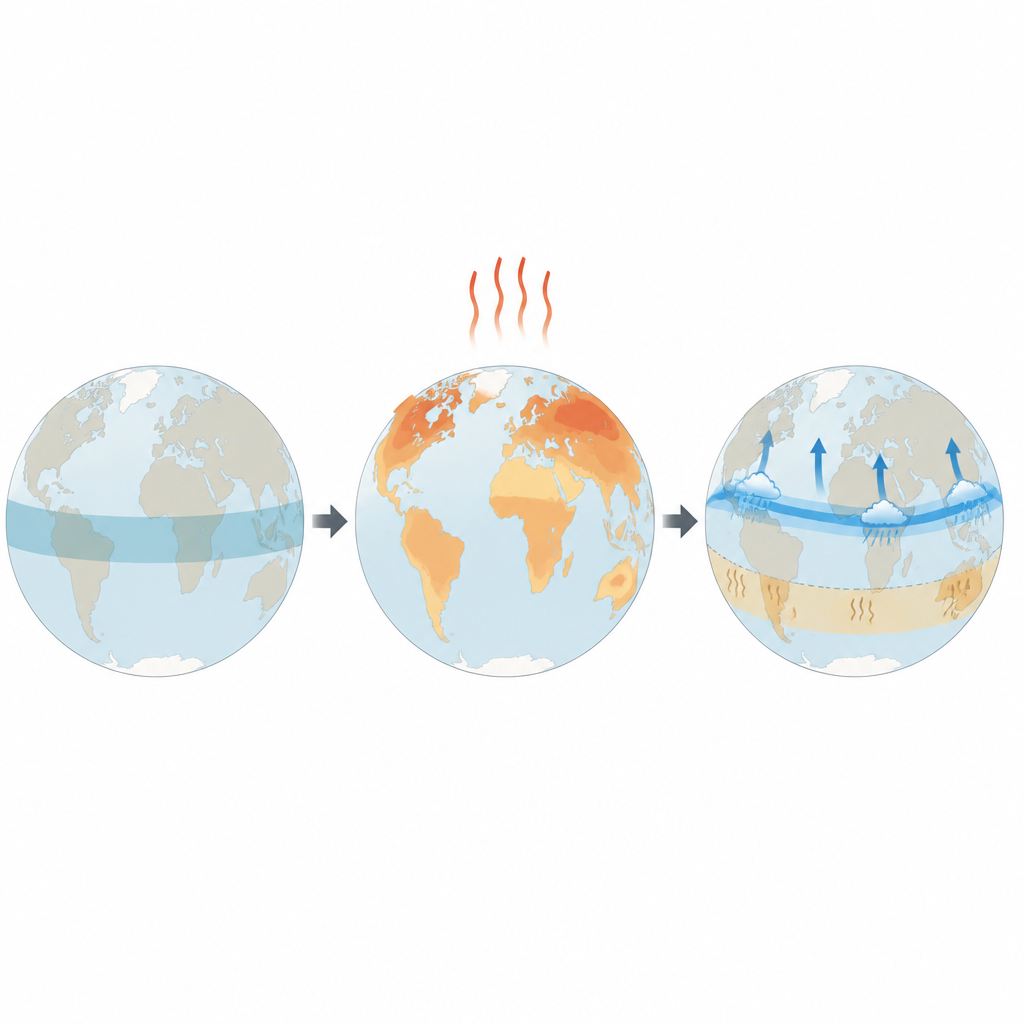
Why simple “wet get wetter” ideas fall short
A popular picture of global warming holds that warm air holds more moisture so wet areas get wetter and dry areas drier. The authors test this idea by comparing observed changes in rainfall minus evaporation with those expected purely from warmer air taking up more water vapor. They find that the moisture‑based contribution is tiny, about ten times smaller than what is actually observed. When they break rainfall changes into parts driven by circulation shifts versus added moisture, the circulation term dominates. In other words, where the air is rising and sinking is changing more than how much moisture the air can hold.
Hidden drivers: warm lands, hot deserts and a growing warm pool
The team then looks for large‑scale temperature patterns that could be steering tropical winds and rain. Three stand out: stronger warming over land than ocean, greater warming in the Northern Hemisphere than in the south, and the growth of a vast warm pool of surface waters across the Indian and western Pacific oceans. These features are present in both observations and climate models, even though the models misplace the resulting rainfall. Statistical analyses show that stronger land‑sea contrast and a hotter Indo‑Pacific warm pool together best reproduce the observed northward shift and narrowing of the main tropical rain belts and the strengthening of the Pacific trade winds.
Testing the role of land by tweaking deserts
To probe cause and effect, the authors run coupled ocean–atmosphere models in which they artificially darken land surfaces, especially over major Northern Hemisphere deserts, making them absorb more sunlight. The land heats rapidly, more than nearby oceans, amplifying land‑sea and hemispheric temperature contrasts. This in turn strengthens trade winds, cools parts of the southern and eastern Pacific, and shifts tropical rain bands northward over the Pacific and Indian regions, while drying areas south of the equator. These simulated patterns closely resemble what has been observed in recent decades, and additional experiments that only modify desert regions produce similar, though weaker, responses. 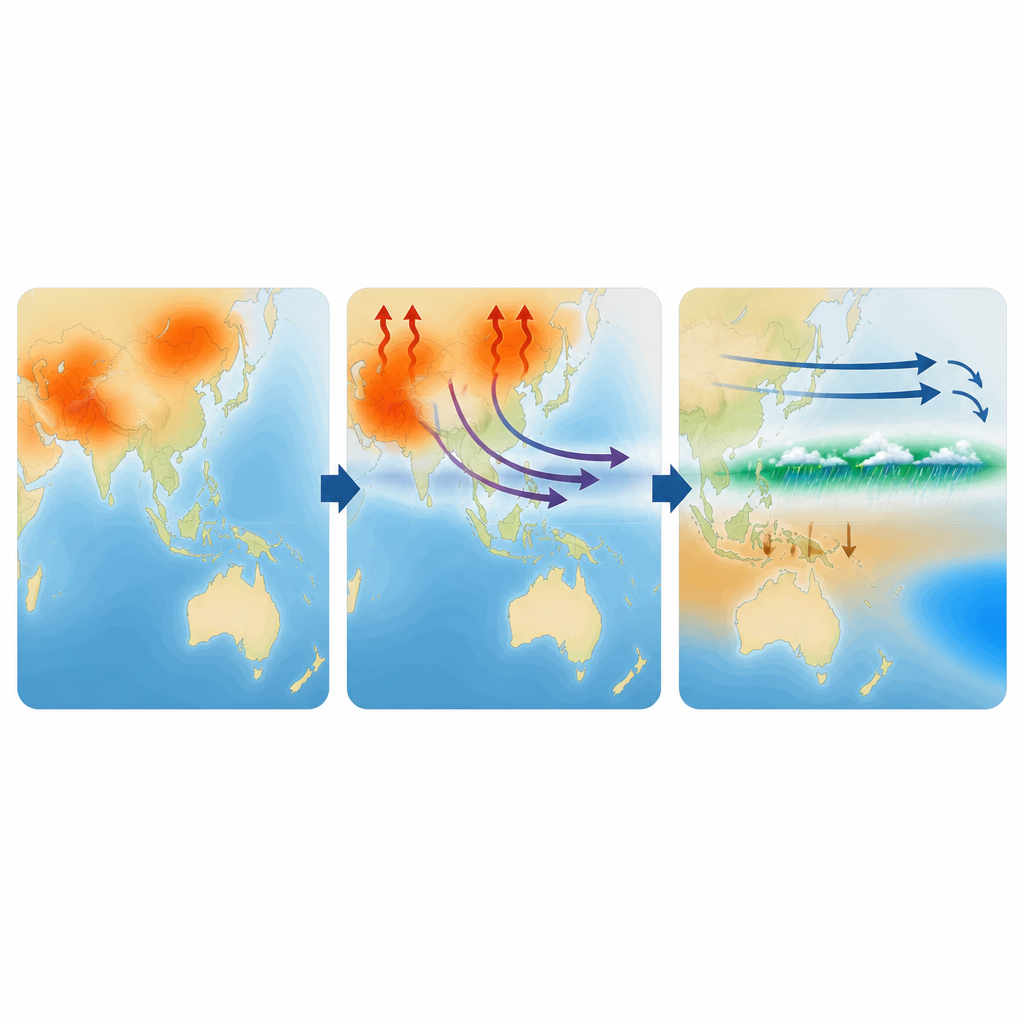
What this means for our picture of climate change
The study concludes that recent changes in tropical rainfall arise mainly from circulation shifts tied to faster land warming and expanding deserts in the Northern Hemisphere, working together with a growing Indo‑Pacific warm pool. This view challenges the ocean‑focused assumptions built into many current climate models, which tend to weaken the Pacific trade winds and misplace tropical rain bands. For people living in the tropics, the findings imply that human‑driven changes on land, including desertification, can actively reshape where and when life‑giving rains fall, adding urgency to efforts to understand and manage both greenhouse gas emissions and land use.
Citation: Joseph, L., Terray, P., Sooraj, K.P. et al. Tropical precipitation response to anthropogenic climate change in recent decades. Nat Commun 17, 4450 (2026). https://doi.org/10.1038/s41467-026-71187-4
Keywords: tropical rainfall, land sea contrast, desertification, Indo Pacific warm pool, Walker circulation