Clear Sky Science · en
Early life bacteria and sibling exposure associate with restoration of the infant gut microbiome after cesarean section
Why the first germs in life matter
For many new parents, a cesarean section is a vital medical choice, but it can quietly shape a baby’s inner world of gut bacteria. This study follows hundreds of children to ask a simple question with big implications: can early contacts, especially with certain bacteria and with older brothers or sisters, help a cesarean-born baby’s gut ecosystem bounce back toward that of vaginally delivered babies, and in turn ease the risk of asthma later in childhood? 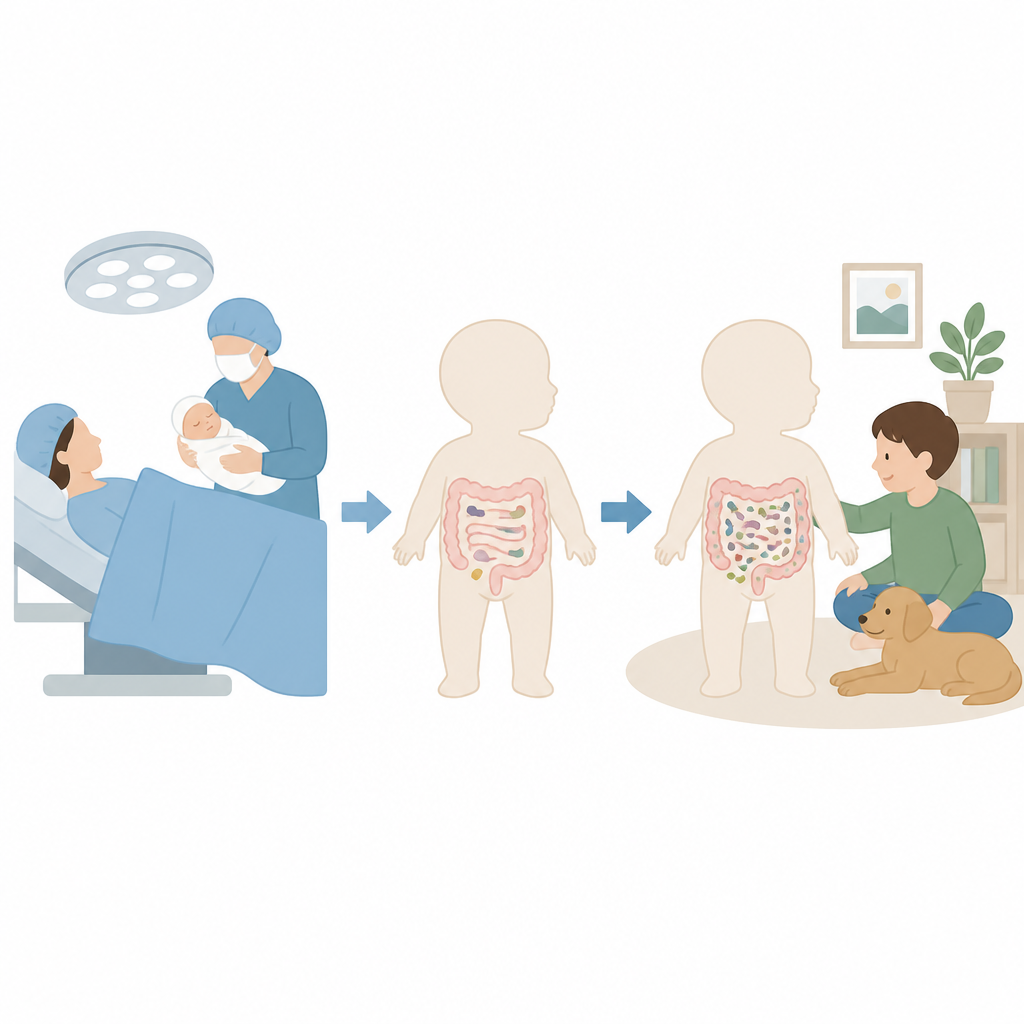
A scorecard for baby gut recovery
The researchers worked with two large birth cohorts in Denmark and Canada, tracking babies from the first week of life through the first year and beyond. They built a “restoration score” to describe how closely a child’s gut bacteria at one year of age resembled that of vaginally delivered infants. A high score meant a more “vaginal-like” gut community, while a low score meant a more “cesarean-like” pattern. Earlier work had already shown that cesarean-born children whose gut communities stayed cesarean-like at one year had a higher risk of developing asthma, while those whose gut bacteria shifted toward the vaginal pattern did not share this extra risk.
Clues from early gut guests
To find out what steers this recovery, the team looked at stool samples collected at one week and one month of age. Babies who later achieved higher restoration scores already showed richer and more varied gut communities in the first week of life. Certain friendly species, including members of the Bacteroides and Bifidobacterium groups, were more common early on in babies who later “caught up.” In contrast, high levels of a bacterium called Clostridium perfringens in early life were linked with poorer restoration and a gut pattern that stayed closer to the cesarean profile. These patterns suggest that the balance between helpful and potentially troublesome bacteria is set very early and can shape the trajectory of gut development.
Brothers, sisters, and the home environment
Beyond microbes themselves, the study explored everyday surroundings such as pets, breastfeeding, rural versus urban homes, and especially siblings. Having older brothers or sisters stood out as a strong predictor of a higher restoration score. Babies with close-in-age older siblings tended to harbor more of the helpful bacteria and fewer of the species tied to a stubborn cesarean-like pattern. Statistical models indicated that part of the sibling effect was transmitted through the gut bacteria already present at one week, hinting that very early exchanges of microbes within the household, such as through touch or shared spaces, help seed a more protective gut community. 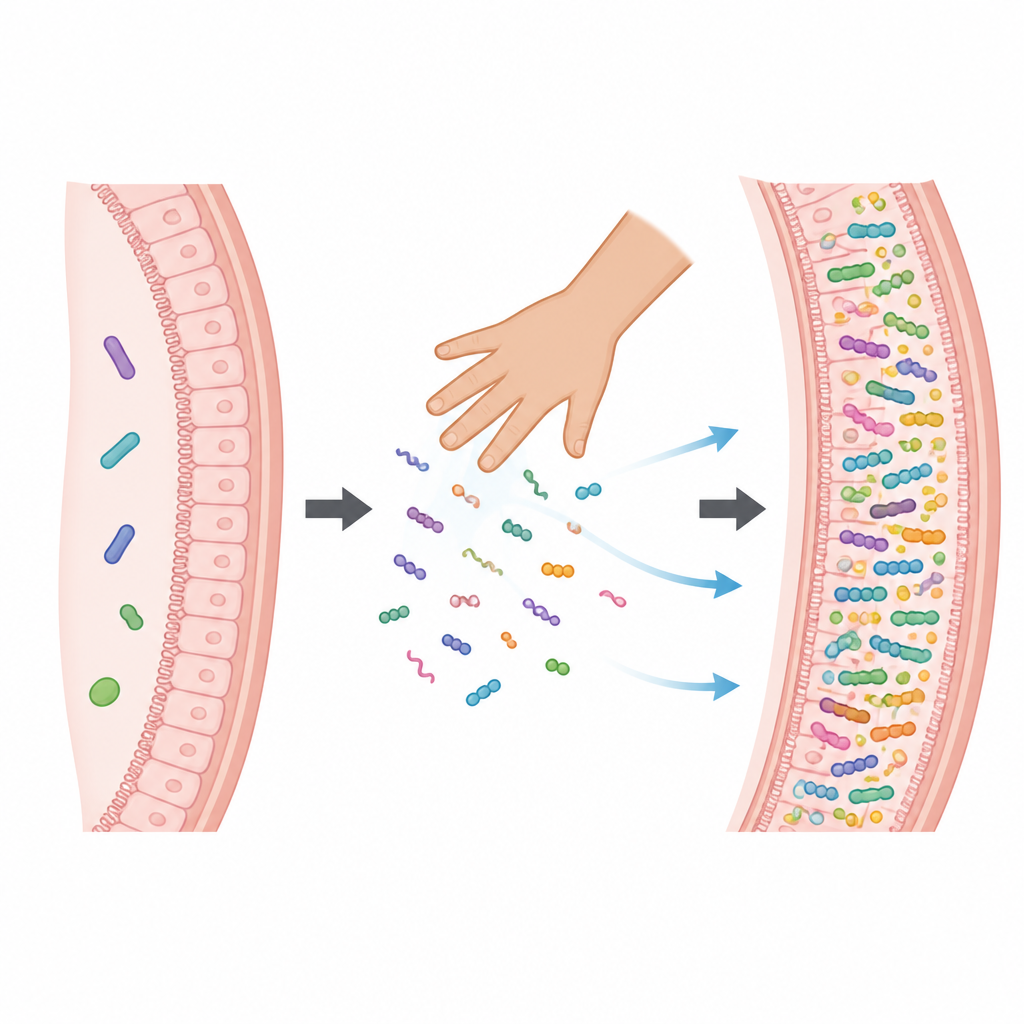
Testing the pattern in another country
To check whether these findings were robust, the researchers applied their restoration score to a separate Canadian cohort. Without retraining the model, the same score again ran lower in cesarean-born infants and higher in those with older siblings. Most importantly for families and doctors, children with higher restoration scores in Canada also had a lower chance of being diagnosed with asthma at age five, echoing the Danish results. Early presence of Bacteroides and Bifidobacterium, and lower levels of Clostridium perfringens, again marked babies whose gut ecosystems moved toward the vaginal-like pattern.
What this means for parents and health
In plain terms, the study suggests that while cesarean birth can temporarily disturb the natural assembly of gut bacteria, this is not a fixed fate. Certain early gut guests, together with rich everyday microbe sharing from older siblings and perhaps other aspects of home life, appear to nudge the infant gut back toward a more typical course and reduce the extra asthma risk linked to cesarean delivery. The work does not yet prescribe specific treatments, but it highlights how the first weeks of life, the mix of bacteria in the diaper, and the presence of siblings in the household can all quietly support healthier immune development in cesarean-born children.
Citation: Jiang, J., Poulsen, C.S., Boulund, U. et al. Early life bacteria and sibling exposure associate with restoration of the infant gut microbiome after cesarean section. Nat Commun 17, 4594 (2026). https://doi.org/10.1038/s41467-026-71185-6
Keywords: infant gut microbiome, cesarean section, siblings, early life bacteria, childhood asthma