Clear Sky Science · en
The ecological and developmental foundations of brood parasitism in a catfish
A fish story of secret babysitting
Most people know the cuckoo bird that tricks other birds into raising its chicks. This study tells a similar story from Lake Tanganyika in Africa, where a small catfish sneaks its eggs into the mouths of other fish. By uncovering how this "cuckoo catfish" evolved its unusual lifestyle, the research shows how complex cheating strategies can grow out of ordinary feeding and reproduction, even in animals that never cared for their own young.
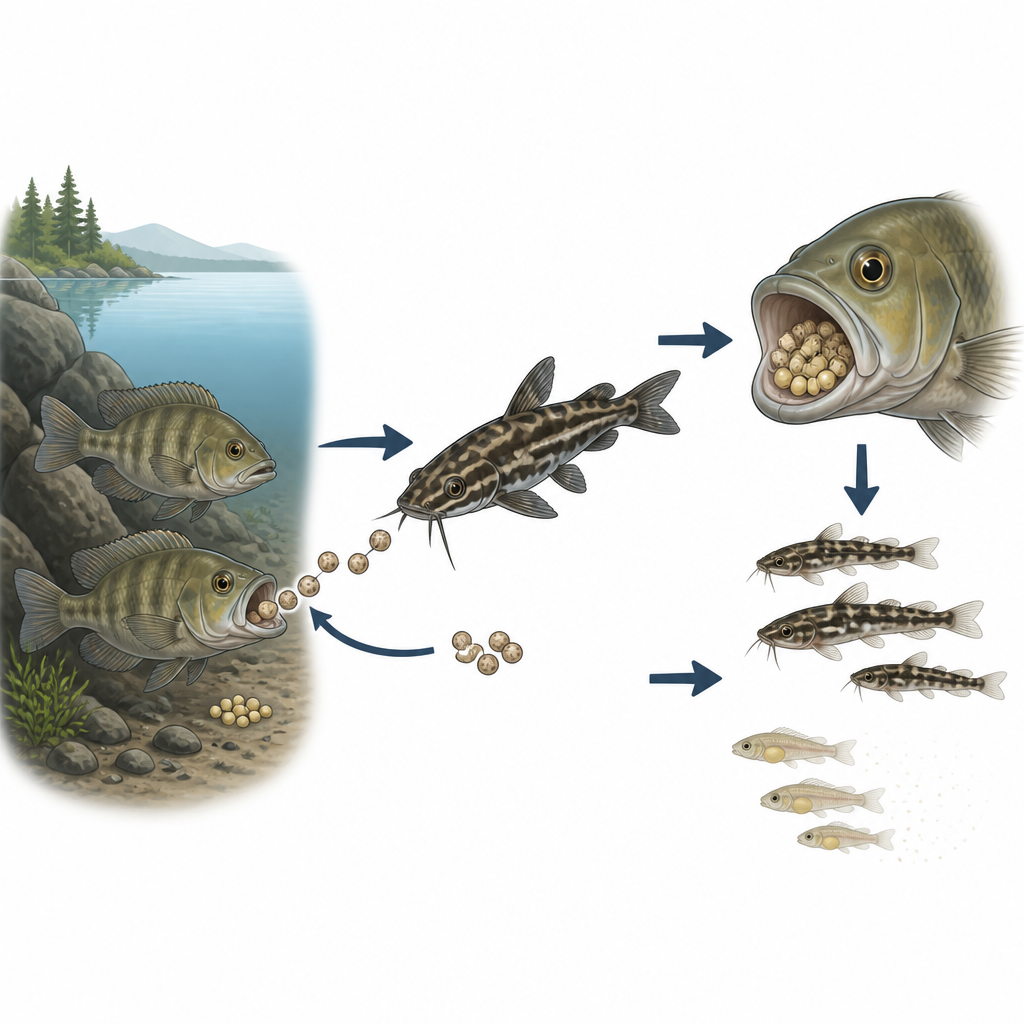
How a catfish turns parents into victims
The cuckoo catfish lives alongside many cichlid species that carry their eggs and young inside the mouth for safety, a behavior called mouthbrooding. When a cichlid pair is spawning, adult catfish rush in and eat some of the freshly laid eggs. The startled cichlid mother quickly scoops up what is left, unknowingly collecting catfish eggs mixed with her own. Inside her mouth, the catfish embryos develop faster than the cichlid brood, hatch earlier, and then eat the host’s young. The host parents invest all their energy into guarding and carrying the intruders, much like small songbirds feeding a giant cuckoo chick.
What the catfish eats and why that matters
One idea was that brood parasitism evolved from a strict taste for fish eggs. To test this, the researchers dissected the guts of more than one hundred Synodontis catfish from Lake Tanganyika and measured chemical fingerprints in their muscles that reveal long term diet. They found that the cuckoo catfish is a dietary generalist, eating many types of bottom dwelling invertebrates and other foods, with fish eggs appearing only rarely. Other related species in the lake are true specialists, feeding almost entirely on fish flesh, algae, or lake sponges. Stable isotope data confirmed that the cuckoo catfish occupies a broad feeding niche rather than a high, egg heavy position in the food chain. This suggests that constant egg eating was not the key first step toward parasitism.
Egg tricks that help the catfish sneak in
The team then compared how different Synodontis species reproduce, using hormone induced spawning, egg measurements, and examination of gonads from wild fish. The cuckoo catfish stands out by producing very small clutches of unusually large, yellow eggs that are only weakly sticky. The eggs are close in size and color to the big yellow eggs of their cichlid hosts and are easily scooped up from the lake bottom, which likely helps them blend into the host clutch. Most relatives release hundreds of smaller, more adhesive eggs at once, often in a short breeding season. In contrast, the cuckoo catfish can produce small batches of eggs every few days, keeping it ready to seize any chance encounter with a spawning host pair.
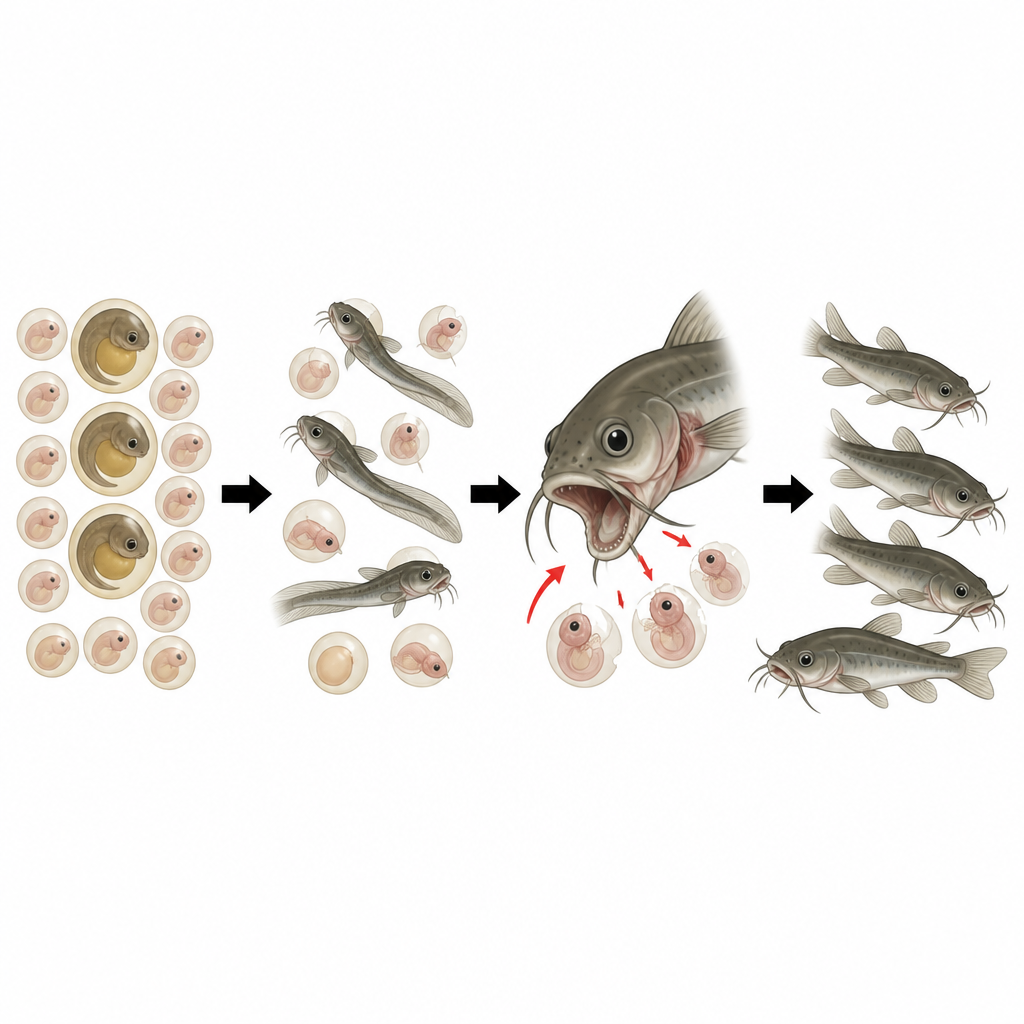
Fast growing jaws built for raiding
The scientists also raised embryos of several catfish species under identical conditions to track how they grow. Both the cuckoo catfish and its deep water sister species, Synodontis granulosus, hatch from large eggs and grow quickly, but only the cuckoo catfish shows extremely early development of strong jaws and throat teeth. By the time its yolk reserves are used up, the young catfish already has mineralized mouthparts and supporting bones that allow it to grip and puncture cichlid embryos and suck out their yolk. Experiments placing eggs of different catfish into the mouths of mouthbrooding cichlids revealed that some non parasitic relatives can survive for a while inside a naive host, but they lack the specialized dentition and behavior needed to reliably feed on host offspring, especially in hosts that have evolved defenses.
A familiar pattern in an unfamiliar animal
Taken together, the study shows that brood parasitism in the cuckoo catfish likely arose from occasional egg predation combined with pre existing traits such as large eggs and fast embryo growth. Natural selection then fine tuned this starting point, favoring small frequent clutches, egg mimicry, and rapid jaw development that make the parasitic strategy more effective. Remarkably, these changes mirror patterns seen in classic bird brood parasites, even though the catfish’s ancestors did not guard their young at all. This suggests that very different animals can evolve similar cheating strategies when they tap into the devoted parental instincts of their hosts.
Citation: Reichard, M., Blažek, R., Polačik, M. et al. The ecological and developmental foundations of brood parasitism in a catfish. Nat Commun 17, 4630 (2026). https://doi.org/10.1038/s41467-026-71179-4
Keywords: brood parasitism, cuckoo catfish, mouthbrooding cichlids, egg mimicry, evolution