Clear Sky Science · en
Genetic nurture in intergenerational transmission of substance use
Why family smoking habits matter
Many people know that smoking runs in families, but fewer realize that this pattern is shaped not only by shared genes, but also by the ways parents create the home environment. This study looks at how parents’ genetic tendencies toward substance use, especially smoking, can influence their children’s smoking across life, even through pathways that do not involve directly passing on specific DNA variants.
Looking beyond simple heredity
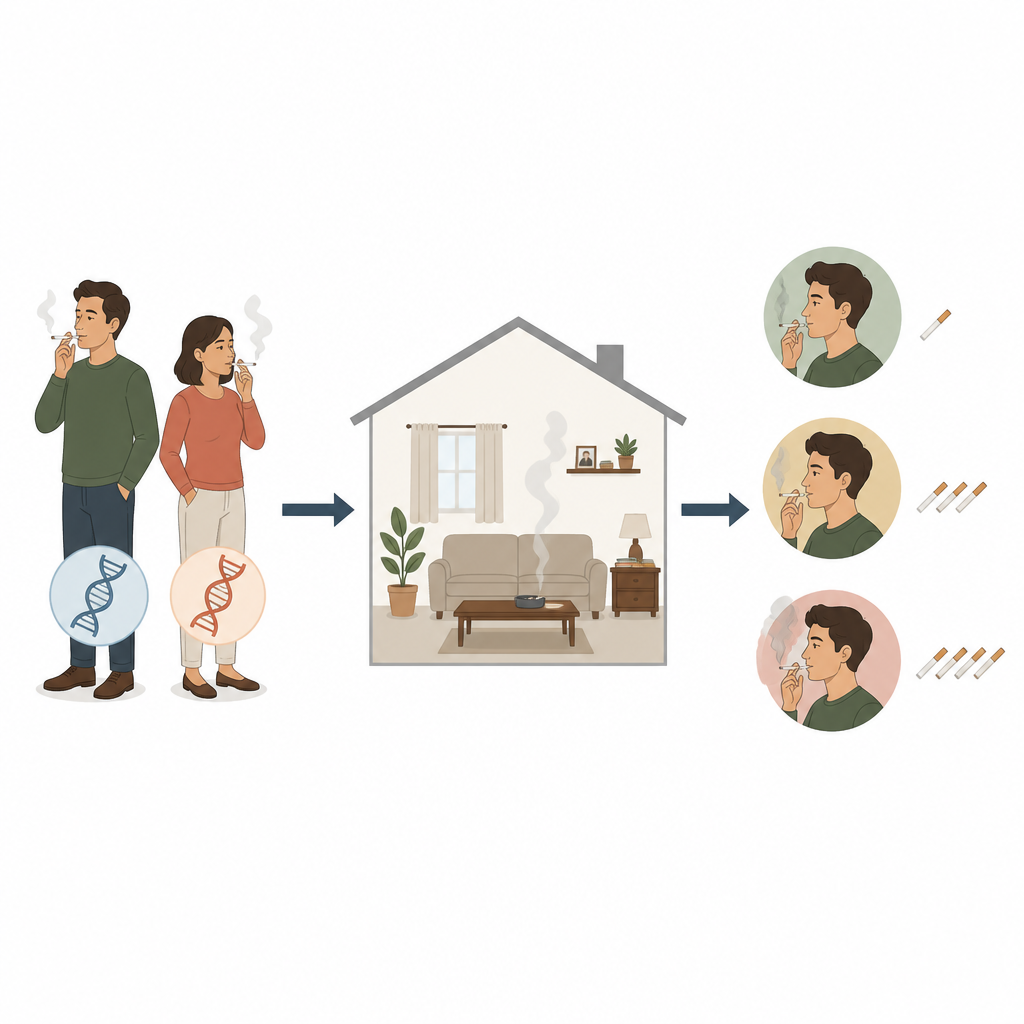
The researchers worked with data from over 15,000 adults in the Dutch Lifelines study, each with at least one genotyped parent. They separated the genetic variants that parents passed on to their children from those they did not. By doing so, they could estimate two forces: direct genetic transmission, where inherited DNA affects the child’s behavior, and “genetic nurture,” where parents’ own genetics shape the home and parenting, which in turn affect the child. They examined several outcomes: whether people ever smoked, how many cigarettes they typically smoked per day, their lifetime smoking dose, daily alcohol intake, and whether they had tried cannabis.
What kinds of substance use are most affected
The study found that genetic nurture plays a clear role in how heavily people smoke, but not in whether they start. Parents’ non-transmitted genetic risk for heavier smoking was linked to their adult children’s lifetime cigarettes per day and total pack-years, accounting for roughly one quarter of the size of the direct genetic effect. In contrast, for smoking initiation, cannabis use, and everyday alcohol consumption, the main influence came from genes that children inherited directly, with little evidence that the non-transmitted parental genes, and thus genetic nurture, made a measurable difference.
Lasting impact across adulthood
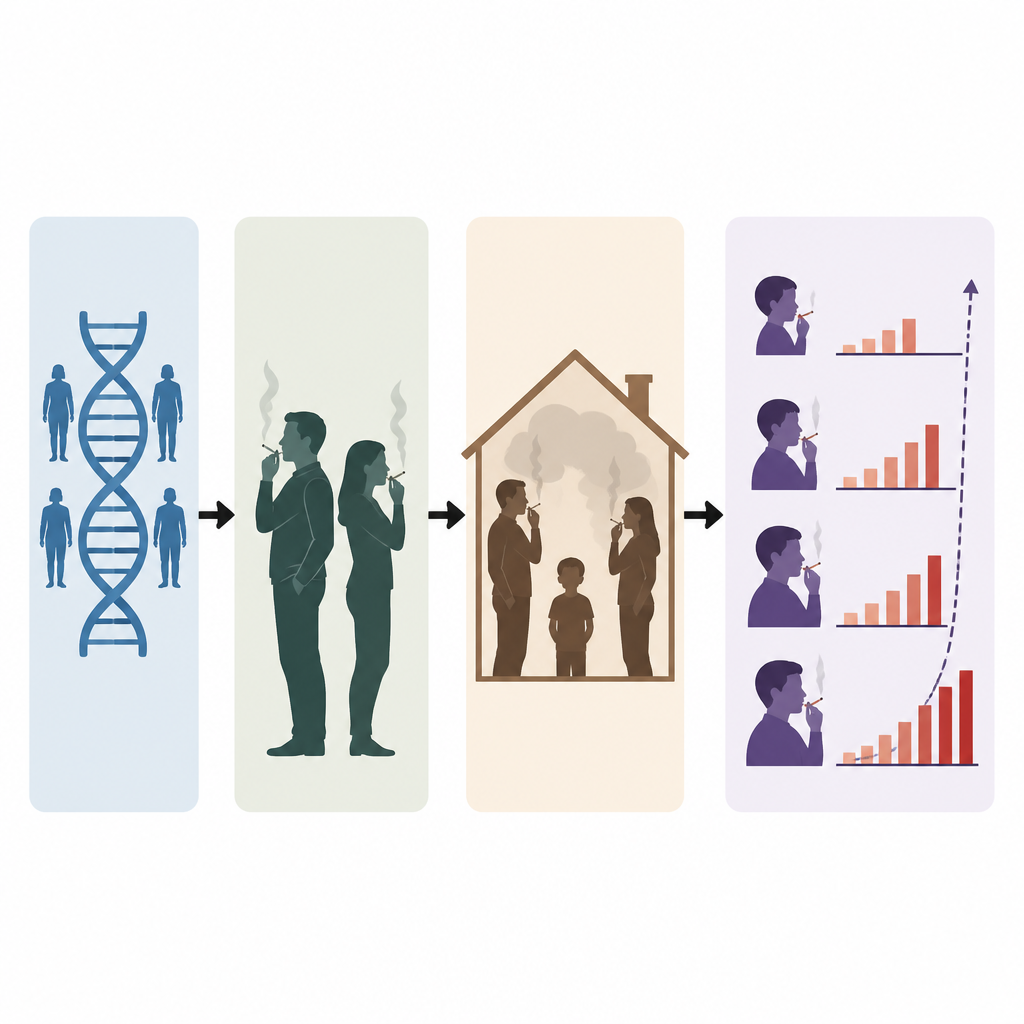
To see how these influences change as people age, the team followed repeated reports of how many cigarettes participants were currently smoking across three assessment waves, from early adulthood into middle age. They observed that the effect of people’s own smoking-related genes weakened with age, suggesting that other life circumstances, like health concerns or changing social roles, dampen genetic tendencies later in life. In contrast, the influence of genetic nurture on current smoking stayed stable. This implies that the imprint of a home shaped by parents with a strong tendency to smoke leaves a lasting mark that persists well beyond childhood.
Mothers, fathers, and how they pass on risk
The researchers next asked whether mothers and fathers differ in how their genetics and behavior affect their children’s smoking. They found that, overall, maternal and paternal genetic nurture effects were similar in size. However, when they examined the pathways in more detail, a key difference emerged: how much mothers smoked explained more of the link between parental genetics and offspring smoking than how much fathers smoked. This stronger maternal pathway was especially apparent in daughters, consistent with the idea that young people may model the behavior of the same-sex parent more closely. Still, the study notes that larger samples will be needed to detect small differences between parents with more confidence.
What this means for breaking the cycle
In everyday terms, the findings suggest that parents’ genetic make-up can shape their children’s smoking not just through DNA they pass down, but also through how much they themselves smoke and the environment they create at home. This indirect “genetic nurture” is especially important for how heavily, and how long, people smoke, and its effects last into adulthood even as direct genetic influences fade. Because a sizable part of this pathway runs through parental, particularly maternal, smoking behavior, family-centered efforts to reduce smoking may have benefits that echo into the next generation.
Citation: Luo, M., Trindade Pons, V., Gillespie, N.A. et al. Genetic nurture in intergenerational transmission of substance use. Nat Commun 17, 4446 (2026). https://doi.org/10.1038/s41467-026-71175-8
Keywords: genetic nurture, family smoking, intergenerational risk, substance use, polygenic scores