Clear Sky Science · en
A lightweight zero thermal expansion magnesium alloy
Metal that does not grow or shrink with heat
From airplane frames to phone cameras, many devices must hold their shape as temperatures swing from cold to hot. Most metals quietly swell when heated and shrink when cooled, which can throw off the alignment of delicate parts. This study describes a new magnesium based metal that stays almost exactly the same size across a wide temperature range while remaining very light and strong, opening the door to more precise and efficient machines.
Why thermal stability matters
Whenever a metal warms up, its atoms jiggle more and push each other farther apart. This effect, known as thermal expansion, may seem tiny but becomes serious in long beams, satellite structures, or precision instruments, where even a hair’s breadth of movement can blur images or weaken joints. Until now, the best known low expansion metal has been a heavy iron nickel blend called Invar, used in measure rods and telescope mounts. Invar works only over a limited temperature range and is too dense for many modern lightweight designs that rely on metals like aluminum and magnesium.
A new light metal that stays the same size
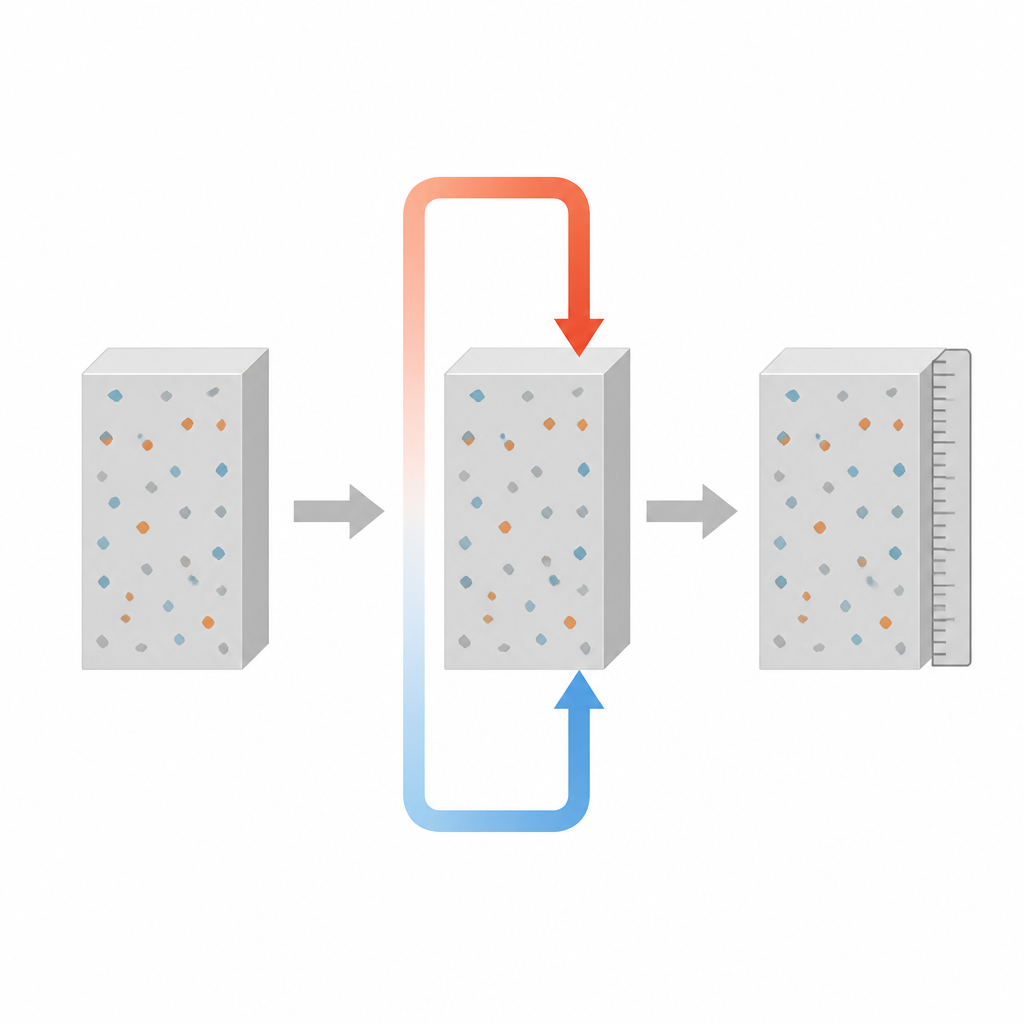
The researchers set out to create a magnesium alloy that barely changes volume as it heats, yet keeps the low weight that makes magnesium attractive. They started with a commercial alloy called WE43 and carefully mixed in a tiny amount, only about one percent by volume, of solid particles made from another compound called MnCoGe with added aluminum. When this mixture is pressed and heated into a solid, the result is a metal that is both very light and remarkably size stable. Between normal room temperature and 150 degrees Celsius, its overall expansion is about a thousand times smaller than that of the original magnesium alloy, and even much lower than that of Invar, while its strength and ductility stay high.
Hidden strains that cancel expansion
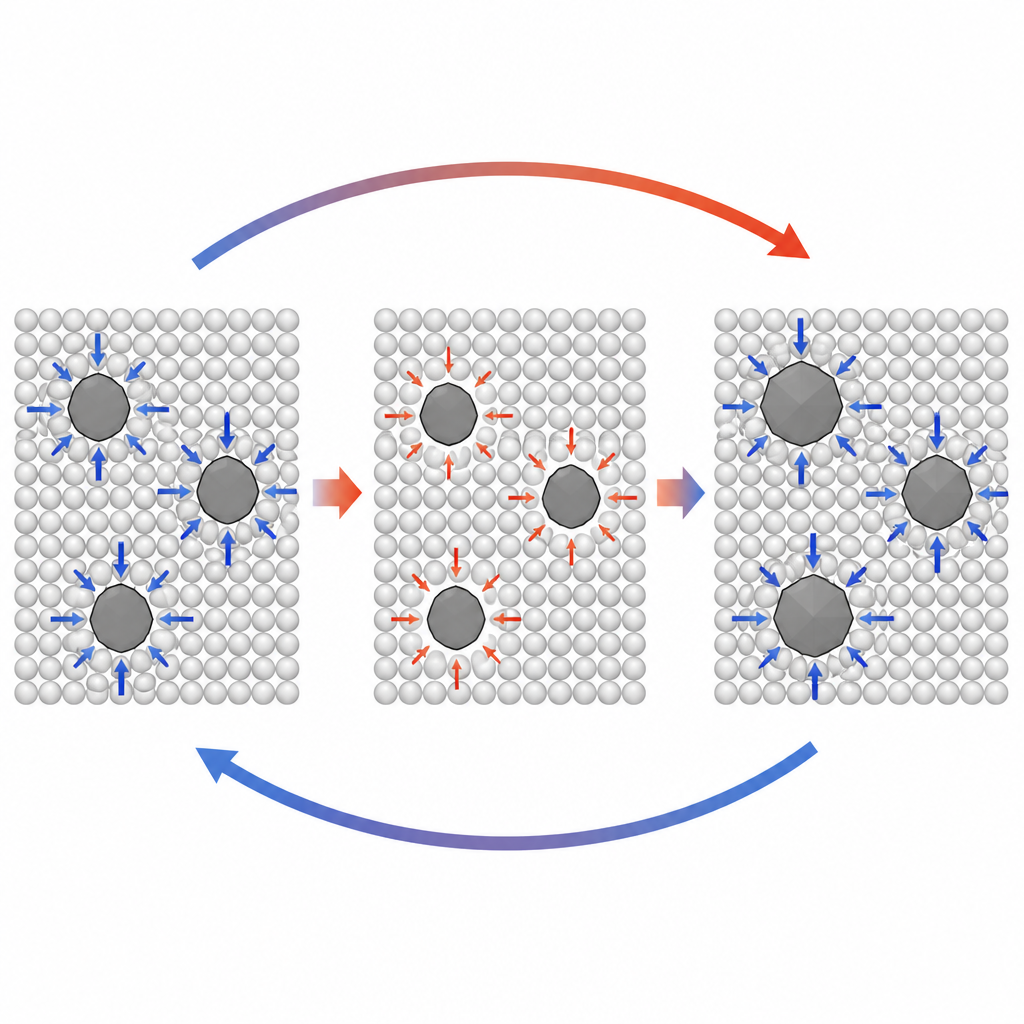
The secret lies in how the tiny MnCoGe particles interact with the softer magnesium around them. As the metal is cooled during processing, these particles change their internal structure and expand slightly, squeezing the nearby magnesium. This leaves a network of built in strains and defects, much like tiny springs stored inside the metal. When the alloy is later heated in service, those internal strains relax: dislocations in the crystal glide, grains rotate, and the squeezed regions loosen. That relaxation causes a small contraction that nearly cancels out the normal tendency of the atoms to move apart with heat. High resolution microscopes, X ray measurements, and computer models all show this cycle of strain storage and release repeating over many heating and cooling passes.
A self balancing cycle of push and pull
Crucially, the strain does not disappear forever. As the metal cools back down, the MnCoGe particles again switch structure and change volume, pushing on the surrounding magnesium and rebuilding the hidden stresses. This self renewing push and pull keeps the metal’s overall size constant over a broad temperature window. Calculations suggest that the compressed regions of the magnesium matrix can even produce a slight negative expansion, meaning a tiny net shrinkage, which helps fine tune the balance. The same design idea also works in aluminum based alloys that include similar particles, showing that the approach is flexible rather than tied to a single recipe.
What this means for future devices
By turning internal strain from a nuisance into a tool, this work outlines a general recipe for metals that hardly move with temperature while staying light and tough. Instead of relying on special magnetic effects, engineers can combine a soft base metal with particles that undergo controlled shape changes as they heat and cool. The result is a built in, repeatable compensation mechanism where contraction from strain recovery offsets normal thermal expansion. Such zero expansion yet lightweight alloys could help keep satellites aligned, sensors accurate, and mechanical parts fitting perfectly even as they ride through large temperature swings.
Citation: Huang, Y., Wu, S., Dong, Z. et al. A lightweight zero thermal expansion magnesium alloy. Nat Commun 17, 4432 (2026). https://doi.org/10.1038/s41467-026-71165-w
Keywords: zero thermal expansion, magnesium alloy, lightweight materials, thermal stability, martensitic transformation