Clear Sky Science · en
Direct evidence for magnetohydrodynamic disk winds driving rotating outflows in protostar HOPS 358
How newborn stars shed their spin
When a star is born, it forms inside a swirling cloud of gas and dust. This material spins as it falls inward, but if all that spin stayed put, the growing star and its surrounding disk would whirl so fast that planets could never assemble. Astronomers have long suspected that invisible winds, guided by magnetic fields, help carry this excess spin away. This study uses sharp radio images of a very young star called HOPS 358 to show, in detail, that such winds are indeed at work in the very zone where future planets will form.
A young star seen from the side
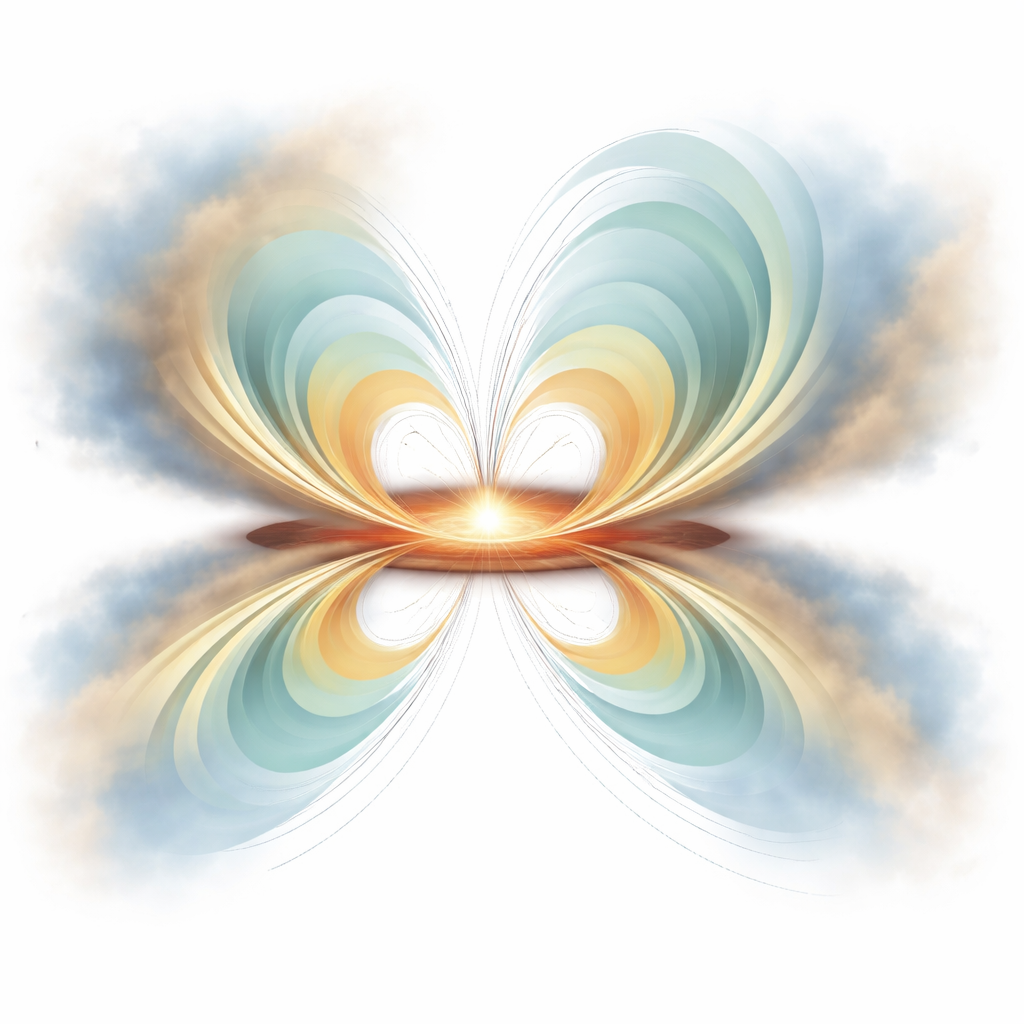
HOPS 358 sits in the Orion B cloud, about 400 light-years away, and is in one of the earliest stages of star birth, known as Class 0. It is wrapped in a thick envelope of gas and dust, but its disk is seen almost edge-on, like a coin viewed from the side. This geometry is a stroke of luck: it lets astronomers separate motions along and across the disk plane. Using the Atacama Large Millimeter/submillimeter Array (ALMA), the team mapped faint radio signals from several molecules that trace both the dense disk and the gas being pushed away from it. These data reveal not only how fast the material moves but also which way it spins.
Layered winds that keep spinning
The ALMA maps show that gas streaming away from HOPS 358 does not flow straight out in a simple jet. Instead, it forms a set of nested, shell-like outflows that all share the same sense of rotation as the disk itself. Three molecules—formaldehyde (H2CO), methanol (CH3OH), and sulfur monoxide (SO)—light up different parts of this structure. SO hugs the central axis, CH3OH sits at intermediate distances, and H2CO extends farther out, together outlining a layered wind rising from a wide range of disk radii. Because the outflow keeps the disk’s direction of spin and is tightly aligned with the disk axis, it matches expectations for a wind launched directly from the disk, rather than gas merely shoved aside by a narrow central jet.
Reading the wind’s hidden forces
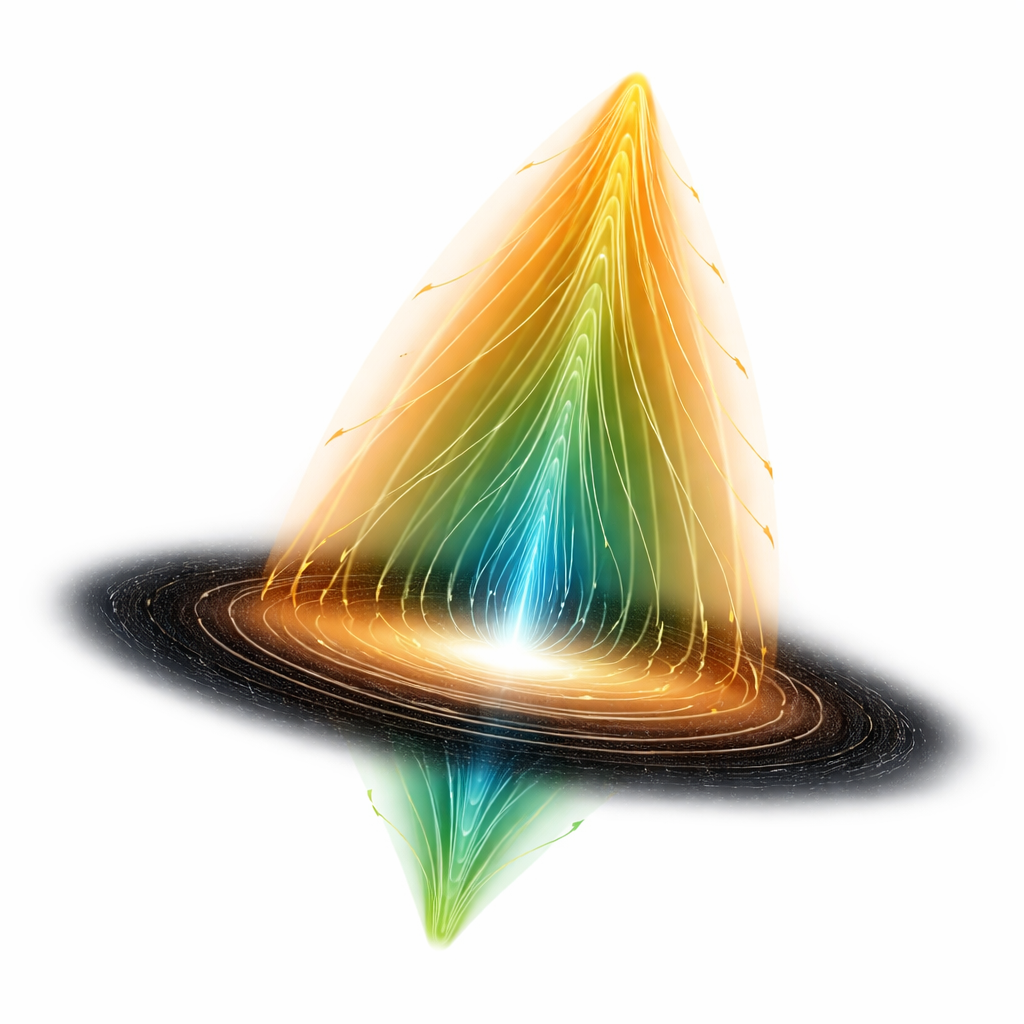
To turn these images into physical insight, the researchers dissected how speed and position vary across the wind. By fitting the data with simple geometric models, they measured the outflow’s rotation speed, outward expansion, and motion along the axis at different heights above the disk. From these values they calculated the wind’s specific angular momentum—how much spin each parcel of gas carries—and compared it to predictions from computer models of magnetically driven disk winds. A key quantity, the “magnetic lever arm,” tells how efficiently the wind extracts angular momentum. In HOPS 358, this lever arm comes out around 2.3, comfortably above the threshold expected for magnetically powered winds and higher than values typical of winds driven mainly by starlight heating.
Where the wind starts and what it carries away
The same analysis reveals where on the disk the different wind layers begin. For the molecules studied, the launch points lie between about 10 and 18 times the Earth–Sun distance from the star—right in the region where giant planets and many smaller worlds are expected to form. The three tracers occupy different launch radii and heights, confirming a truly nested wind structure. Chemical behavior helps explain this pattern: some molecules are easier to kick off icy grains in gentle shocks far from the star, while others prefer stronger shocks and ultraviolet light closer in. The team also estimated how much mass the wind removes compared with how fast the star gains mass. The outflow carries away material at a rate several times higher than the current accretion rate onto the star, enough to regulate how quickly the star grows and how the disk evolves.
Why this matters for building planetary systems
This work provides direct, quantitative evidence that magnetically guided disk winds are already active in one of the youngest known protostars and that they originate inside the planet-forming zone. By stripping away angular momentum over a broad stretch of the disk, these winds allow gas to spiral inward while keeping the disk midplane relatively calm—a condition that favors dust grains sticking together and eventually forming planets. They may also carry solid particles, such as crystalline grains made near the hot inner regions, out to colder comet-forming zones. In short, the study shows that magnetic winds are not a late clean-up act but a central player from the very beginning, shaping how stars grow and how the building blocks of planetary systems are distributed.
Citation: Kim, CH., Lee, JE., Johnstone, D. et al. Direct evidence for magnetohydrodynamic disk winds driving rotating outflows in protostar HOPS 358. Nat Commun 17, 2957 (2026). https://doi.org/10.1038/s41467-026-71142-3
Keywords: protostar disk winds, star and planet formation, magnetic fields in space, ALMA observations, rotating outflows